
San Antonio ranked seventh among U.S. cities in 2025, with 1,548,422 residents, making it larger in city proper population than both Dallas and Austin. That scale is only one part of the city’s unusual profile: few large American metros combine a 1718 Spanish colonial origin, a UNESCO-listed mission system, major tourism volume, and one of the country’s largest military communities in the same civic footprint. The result is a Texas city whose identity cannot be explained by population growth alone.
Its development connects an 18th-century presidio, the Alamo, the River Walk, major defense institutions, and the 1,900-acre former Kelly Airfield campus in one continuous story of settlement, adaptation, and economic reuse. The sections that follow examine how those layers shaped the city and why they still influence how residents, visitors, and institutions understand it.
Why San Antonio stands out in Texas
The 2020 U.S. Census counted 1,434,625 residents inside San Antonio, a city-proper total large enough to place it among the biggest municipalities in both Texas and the United States. That figure is distinct from the wider metropolitan population, which means the city’s rank reflects people living within municipal boundaries rather than the full regional economy around it. The distinction matters because city-proper rankings can differ sharply from metro-area comparisons.
Its geographic frame is equally important: the city anchors Bexar County in south-central Texas, positioned between the Hill Country to the north and west and the broader South Texas region to the south. This location has helped make it a regional center for government, health care, education, tourism, and military activity without reducing its identity to any single function. Bexar County also gives the city a clear administrative and civic context, since county institutions, courts, and public services form part of the area’s daily structure.
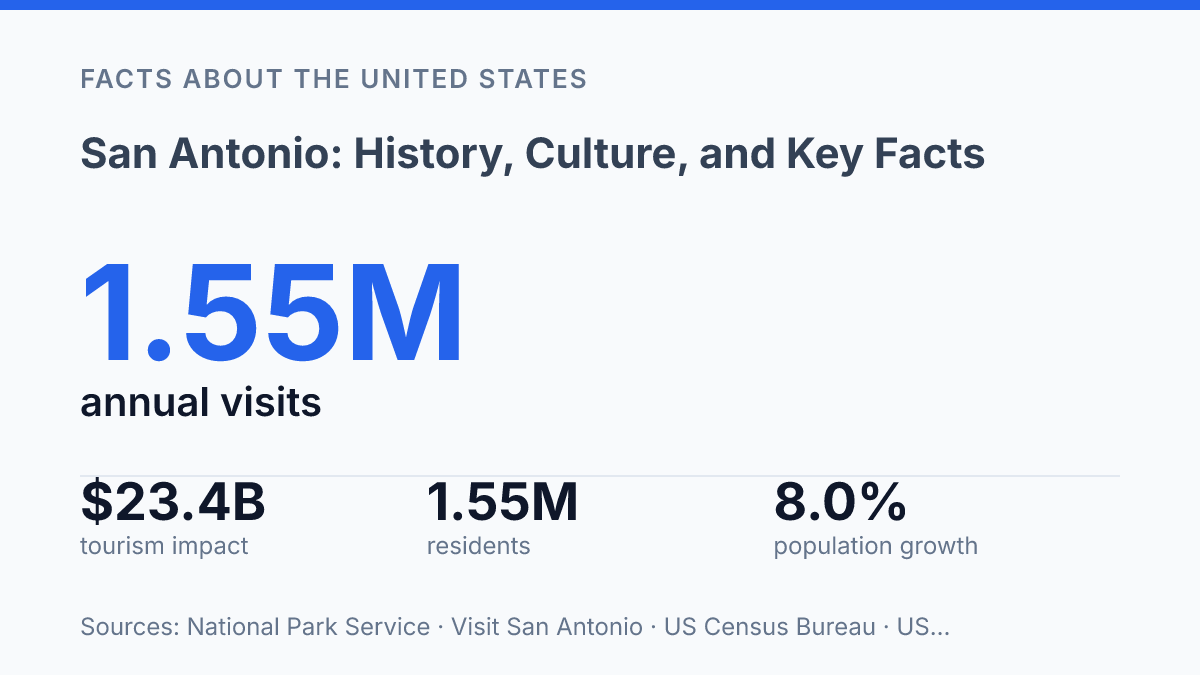
Population growth reinforces that scale. The U.S. Census Bureau estimated the city had 1,548,422 residents on July 1, 2025, ranking seventh among U.S. cities and ahead of Dallas (1,329,491) and Austin (1,002,632).
Headcount alone, however, does not fully explain the city’s prominence. Its wider significance also comes from military installations, cultural institutions, and historic sites that give it influence beyond what population tables can show.
How the city grew from Spanish settlement to modern metro
A mission and a presidio, rather than a port or mineral strike, supplied the institutional frame from which the city grew. According to the Spanish Governor’s Palace historical account, Don Martín de Alarcón established Presidio San Antonio de Béjar on May 5, 1718, to protect Mission San Antonio de Valero, later known as the Alamo. That pairing reflected Spanish colonial priorities on the northern frontier: religious conversion, military protection, and the creation of a permanent settlement able to support imperial claims in a contested borderland.
The settlement’s early development was shaped by institutions as much as by population. Missions organized labor, agriculture, irrigation, and religious life, while the presidio provided defense and administrative order. After Mexican independence in 1821, the same place inherited a different political setting without losing its strategic value, becoming part of a frontier zone where local communities, military power, land claims, and cross-border trade remained closely connected.
The Battle of the Alamo in 1836 gave the city its most famous historical marker, but the event is best understood as one layer in a longer urban history rather than the whole explanation for it. The defeat of Texian defenders by Mexican forces became a powerful symbol in Texas history, especially as a rallying point during the wider struggle for independence. Its memory has often dominated public attention, which can obscure the deeper colonial, Mexican, Tejano, and postcolonial forces that had already shaped the settlement for more than a century.
U.S. annexation followed the Republic of Texas’s decision to join the Union in 1845, placing the former Spanish and Mexican frontier town inside a rapidly expanding American state. Rail access in 1877 helped shift the city from an isolated inland settlement toward a connected commercial center, strengthening markets for livestock, goods, and services. Later growth layered modern infrastructure over older civic patterns, and U.S. Census Bureau QuickFacts places municipal growth at 8.0% from the April 2020 estimates base to the July 2025 estimate, showing that the historical center continued to expand within a contemporary metropolitan frame.
Major institutions, industries, and military ties
Few U.S. military communities match Joint Base San Antonio’s combination of operational scale, training volume, and economic reach. A 2024 municipal official statement reported that the joint base supports more than 80,000 personnel, trains over 138,000 personnel each year, works with 266 mission partners, and contributes about $39.1 billion to the Texas economy. That scale makes defense activity more than a legacy presence; it shapes employment, contracting, medical training, cybersecurity work, and demand for professional services across the region.
Private-sector anchors broaden that base beyond the military. H-E-B connects the city to grocery retail, logistics, food distribution, and corporate administration, while USAA represents a large concentration of insurance, banking, technology, and customer-service roles tied to military families and financial services. Toyota Motor Manufacturing Texas adds a manufacturing pillar on the city’s South Side, supporting production jobs and supplier relationships that are different from the office-heavy employment found in finance and public administration.
Institutional employment is also reinforced by healthcare and higher education. UT Health San Antonio operates as a major academic health center, linking clinical care, professional training, and biomedical research.
The University of Texas at San Antonio adds a large public university presence, with workforce pipelines in fields such as business, engineering, data-related disciplines, and public policy. Together, these institutions help convert population growth into skilled labor, research capacity, and specialized services rather than simple consumer demand.
The city’s military past has also shaped newer economic development sites. At the former Kelly Airfield campus, Port SA reported nearly 18,000 employees, $800 million in tax revenue, and $9 billion in economic activity in 2024, according to Texas Public Radio reporting on a Zenith Economics analysis. The result is an economy with stabilizing strengths in defense, public institutions, healthcare, education, and corporate headquarters activity, though reliance on a few large sectors still leaves the region exposed to changes in federal spending, institutional budgets, and major-employer investment decisions.
What visitors and residents associate with the city
The River Walk functions less like a single attraction than a linear civic space, linking hotels, restaurants, performance areas, museums, and public plazas along a shaded downtown watercourse. Its importance comes from that continuity: visitors often encounter the city through this pedestrian corridor, while residents use it for festivals, commuting on foot between central destinations, and everyday public gathering. That role helps explain why postcards and tourism campaigns lean so heavily on river imagery, even though the city’s identity extends well beyond the downtown bend.
Mexican American heritage is one of the clearest through-lines in local public life, expressed through foodways, music, religious observances, public art, markets, and neighborhood traditions. Fiesta San Antonio is the best-known annual expression of that civic culture, bringing parades, medals, community fundraisers, music, and public celebrations into a citywide calendar rather than confining heritage to museums or designated historic districts. The event’s scale matters because it frames culture as a living practice shaped by families, schools, military groups, charities, and local associations.
International recognition of the city’s mission-era heritage broadened the frame beyond the most photographed downtown landmarks. The San Antonio Missions were inscribed as a UNESCO World Heritage Site in 2015, a designation that recognizes the connected mission system as a cultural landscape rather than a collection of isolated buildings. According to the National Park Service, San Antonio Missions National Historical Park recorded 1.55 million recreation visits in 2025, showing that the missions remain active public sites as well as preserved historic places.
Tourism is still a major economic force, but its cultural meaning is not limited to visitor spending or landmark recognition. Visit San Antonio reported $23.4 billion in tourism economic impact and more than 150,000 supported jobs, figures that show how strongly public identity, hospitality, and local employment intersect. The city most commonly appears in outside imagination through the River Walk and the Alamo, yet its present-day character is more accurately read through the combination of river-centered public space, Mexican American civic traditions, and the UNESCO-recognized mission corridor that continues to shape neighborhoods and memory.
Where growth puts the city’s identity to the test
The next question is not whether the city can keep growing, but how its older assets are managed as growth raises the value of land, labor, and public attention. The missions depend on preservation, tourism depends on access and local character, and military-linked redevelopment depends on keeping specialized employers tied to a usable urban setting.
Those priorities can reinforce one another, but only when planning treats heritage sites, neighborhoods, training installations, and technology campuses as connected parts of the same economy. A practical measure of success will be visible in ordinary details: whether historic corridors remain legible, whether reuse sites keep producing skilled jobs, and whether public revenue from visitors and employers improves services beyond the places tourists see.
Frequently Asked Questions
Q: What is San Antonio best known for?
A: San Antonio is widely known for the Alamo, the River Walk, and its strong Mexican American cultural influence. These landmarks and traditions make the city a major center for tourism and heritage in Texas.
Q: Why is the Alamo historically important?
A: The Alamo is important because it was the site of the 1836 battle that became a symbol of Texas independence. Its legacy extends beyond the battle itself, since it remains one of the most recognized historic sites in the United States.
Q: How old is San Antonio as a city?
A: San Antonio was founded in 1718, which makes it one of the oldest cities in Texas. Its long history is reflected in its architecture, historic districts, and colonial-era heritage.
Q: What cultural influences shape San Antonio today?
A: The city’s culture is shaped by Spanish, Mexican, German, and Indigenous influences. That mix appears in local food, festivals, religious traditions, and neighborhood identities across the city.
Q: Is San Antonio a good place to learn about Texas history?
A: San Antonio offers some of the clearest examples of Texas history in one place, from Spanish missions to 19th-century independence sites. Its historic resources make it a strong destination for visitors interested in the state’s colonial and revolutionary past.