
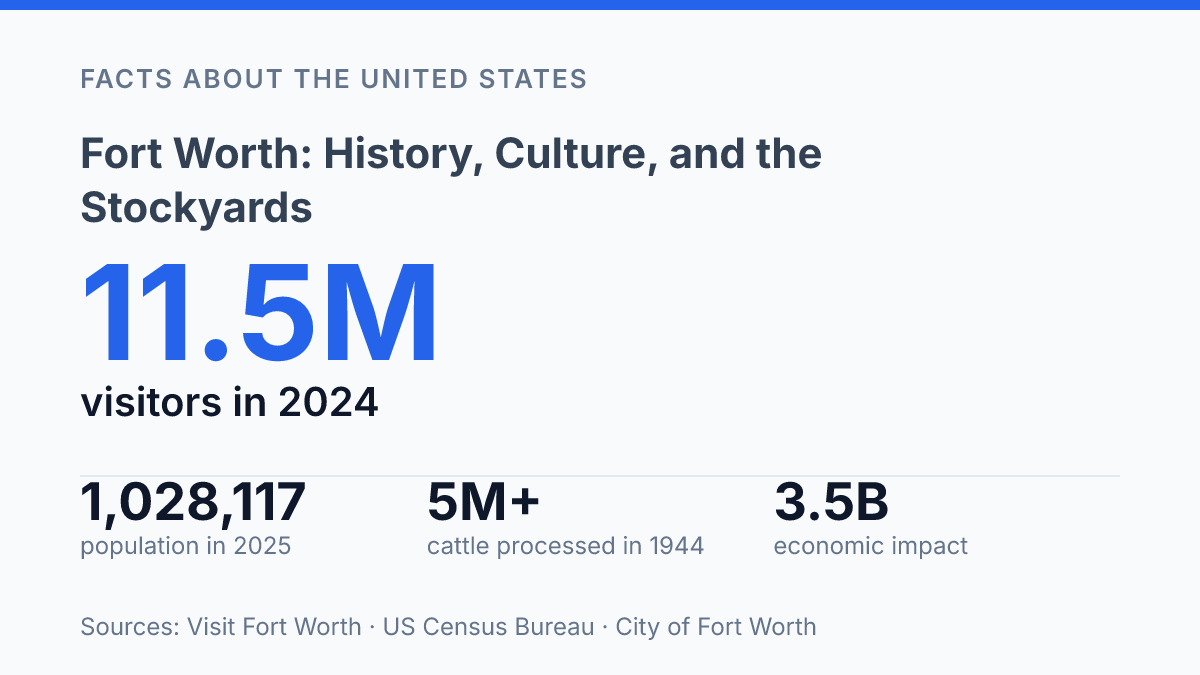
Fort Worth began in 1849 with 42 soldiers at a Trinity River post, yet by 1876 its first train had arrived and its future was tied to cattle, rail, and trade. That compressed timeline explains why the city can feel older than its official incorporation in 1873, when its population was only 500. The Stockyards add another layer: they are not merely a Western-themed district, but a 98-acre National Register historic district linked to an industry that processed more than 5 million cattle at its 1944 peak.
The city’s identity, however, does not stop at longhorns and brick pens. Its museums, population growth, and tourism economy show how a frontier origin became a metropolitan presence. A closer reading traces that shift through military beginnings, cattle commerce, preservation, art institutions, and the city’s current place in Texas.
How Fort Worth grew from a frontier post
Only 27 years separated a tiny Trinity River outpost from the arrival of the railroad, the event that began converting a cattle-trail stop into a regional market. This North Central Texas city began near the Trinity River as a U.S. military post, placed where soldiers could monitor movement across a contested frontier and where a civilian settlement could attach itself to military protection and river-adjacent travel routes.
According to the City of Fort Worth, in 1849, Maj. Ripley Arnold returned to the Trinity River site with 42 men of Company F, 2nd Dragoons; the nearby civilian settlement had no more than 100 people, and by 1873 the city incorporated with a population of 500; the first train arrived on July 19, 1876. Those figures show a slow beginning rather than an instant boom, but they also show why transport mattered: incorporation gave the settlement civic form, while the railroad gave it access to wider markets.
The late nineteenth-century cattle economy supplied the bridge between frontier post and commercial city. According to Fort Worth Heritage Trails, 360,000 “beeves” were driven through the city along the Chisholm Trail in 1871, part of a wider Texas cattle-drive era that moved more than 5 million head between 1866 and 1887. Herds needed rest, supplies, buyers, and services, so a settlement positioned on the route could earn money from trade even before large-scale urban industry took hold.
Rail connections changed the logic of that cattle commerce. Trail driving depended on moving animals overland toward distant railheads; once rail service reached the city itself, livestock, goods, and people could move with greater speed and predictability.
That shift helped turn a former military outpost and cattle stop into a regional city with stockyards, packing interests, merchants, banks, and supporting trades. The frontier identity remained central to the city’s public image, but its economic base increasingly rested on rail-linked commerce and urban growth rather than open-range cattle drives alone.
What the Stockyards preserve today
A protected district of only 98 acres now carries much of the city’s public memory of a cattle economy that once operated at industrial scale. The Fort Worth Stockyards Historic District was listed in the National Register of Historic Places on June 29, 1976, according to the Texas Historical Commission and National Park Service nomination, giving formal recognition to a place whose identity is tied to cattle trading, livestock handling, and western commerce rather than to a single monument or museum building.
That preservation is visible at ground level. Brick streets, historic corrals, and old stock pens make the district readable as a working livestock environment, even where the surrounding use has shifted toward restaurants, shops, music venues, and visitor services. These physical features matter because they keep the area from becoming only a themed entertainment zone; they provide material evidence of how animals, traders, rail connections, and market activity shaped the site’s daily function.
Live programming extends that material record into public ritual. Rodeos remain a central part of the Stockyards experience, while the Fort Worth Herd stages daily cattle drives at 11:30 a.m. and 4 p.m., weather permitting, according to the Stockyards’ visitor information.
The herd includes one Texas Longhorn for each decade of the city’s 170-year history, turning a scheduled event into a concise interpretation of local livestock heritage. The result is not a re-creation of the full cattle trade but a controlled, visible reminder of the skills, animals, and spectacle associated with it.
The district’s modern challenge is that preservation must operate inside an active commercial setting. The City of Fort Worth notes that the broader Stockyards project area covers almost 300 acres under form-based preservation and development rules adopted in May 2017. Those rules reflect a practical tension: the area must accommodate crowds and entertainment businesses while protecting the scale, street pattern, and historic character that make the Stockyards meaningful in the first place.
Art and museums beyond the cowboy image
A city commonly reduced to cattle-trail imagery also houses a museum district where a Louis I. Kahn building and a Tadao Ando building sit within the same cultural orbit. The Kimbell Art Museum is central to that identity, not because of size but because of selectivity: its collection contains approximately 375 works, according to the museum, with holdings that span European, Asian, African, ancient American, and classical art. Its Kahn-designed building, opened in 1972, is widely studied for its vaulted concrete forms and controlled natural light, making the architecture itself part of the institution’s reputation rather than a neutral container for art.
The Modern Art Museum of Fort Worth strengthens the city’s standing as a serious arts destination by focusing on postwar and contemporary work in a building designed for large-scale viewing and quiet reflection. Its presence beside older and more historically oriented institutions gives the city’s cultural district a range that many visitors do not associate with a place better known nationally for Western imagery. The result is not a rejection of cowboy history, but a broader civic identity in which international art and regional memory occupy the same public geography.
That balance is especially clear in the National Cowgirl Museum and Hall of Fame, which preserves Western heritage through a more specific lens: the women who shaped ranching, rodeo, agriculture, performance, and frontier life. By centering women’s contributions, the museum complicates the familiar masculine shorthand of the West without abandoning the region’s ranching culture. Together, these institutions show why the city’s cultural reputation is built on contrast: major art museums draw an international frame around the place, while Western heritage institutions refine rather than simply repeat the cowboy image.
Why Fort Worth still matters in Texas
A city with more than one million residents can no longer be understood mainly as a preserved cattle-trail memory. The U.S. Census Bureau estimated the city’s July 1, 2025 population at 1,028,117, up 11.9% from the 2020 estimates base, placing it among the largest and fastest-growing urban centers in Texas. That scale changes the city’s role from a historic western symbol into a major population anchor for North Texas.
Within the Dallas-Fort Worth metroplex, the city functions as more than the western half of a regional label. Its position along Interstate 20, Interstate 30, and Interstate 35W connects local commerce to statewide and interstate movement, while the broader metropolitan area’s airport, rail, and highway networks support logistics, corporate travel, and goods distribution. Business activity reflects that connectivity: aviation, defense, energy, health care, education, finance, and freight-related industries all help tie the city to the wider Texas economy.
Tourism remains a measurable part of that economy, but it is not the only measure of significance. The city’s tourism agency reported 11.5 million visitors in 2024, supporting more than 30,000 jobs and generating a $3.5 billion economic impact. Those figures show how heritage tourism, conventions, entertainment, and cultural institutions operate within the same metropolitan economy rather than as separate identities.
The city’s continuing relevance comes from that combination. Its public image still draws on ranching heritage, yet its present-day importance depends on urban development, regional transportation, population growth, and diversified employment. In Texas, it matters because it preserves a recognizable part of the state’s historical identity while also functioning as a large, economically integrated city in one of the country’s major metropolitan regions.
What growth changes about preservation
Preservation will matter most where the city is changing fastest. A population estimated above 1 million in 2025 and a visitor economy measured at 11.5 million annual travelers create pressure to make history legible without turning it into a fixed display.
The Stockyards’ form-based rules, the daily longhorn drives, and the museum attendance data point to a practical standard: history works best here when it remains tied to ordinary civic life, not separated from it. The next measure of success will not be whether the city can repeat its frontier story, but whether new growth leaves enough physical evidence for that story to stay readable on the ground.
Frequently Asked Questions
Q: Why is Fort Worth historically significant in Texas?
A: Fort Worth grew into an important trading post in the late 19th century because it sat at the end of the Chisholm Trail. That position made it a key stop for cowboys moving cattle through North Central Texas. The city’s early role in livestock trade still shapes how its history is understood today.
Q: What is the Fort Worth Stockyards known for today?
A: The Fort Worth Stockyards are best known for keeping the city’s cattle-era identity visible through rodeos and related attractions. They function as a historic district rather than a working cattle center, which makes them both a cultural site and a tourist draw. The area helps explain how Fort Worth’s frontier past remains part of its present-day image.
Q: Which museums are important in Fort Worth?
A: The city is home to major cultural institutions, including the Kimbell Art Museum and the National Cowgirl Museum and Hall of Fame. The Kimbell Art Museum gives Fort Worth an international art profile, while the Cowgirl museum recognizes pioneers and women associated with the American West. Together, they show that the city’s museum scene spans both global art and regional history.
Q: What kind of culture does Fort Worth have?
A: Fort Worth combines Western heritage with a modern arts and museum scene. Its cultural identity is shaped by the Stockyards, rodeo traditions, and institutions such as the Kimbell Art Museum. That mix makes the city distinct within North Central Texas.
Q: Is Fort Worth considered a modern city as well as a historic one?
A: Yes. Fort Worth is a modern city with major institutions, developed neighborhoods, and a strong cultural sector, but it still preserves its cattle-trail history through places like the Stockyards. The balance between preservation and growth is part of what defines the city today.