
Denver became Colorado Territory’s capital by a single vote in 1867, a narrow civic turn that still helps explain why the city reads as both frontier settlement and regional command center. Founded as Denver City on November 22, 1858, and named for James W. Denver, it grew from a gold-rush claim into a place where preservation, museums, and mobility carry unusual weight.
Larimer Square’s 22 historic buildings, the Molly Brown House’s rescue from demolition in 1970, and the Denver Art Museum’s Indigenous Arts collection of more than 18,000 works show how much of the city’s identity depends on what has been retained, not just what has been built. The same guide also follows the practical question that defines many visits: how a major U.S. city functions as a cultural base, airport hub, and launch point for the Rockies.
Colorado’s capital and Old West roots
Colorado’s capital secured territorial-capital status by a single vote in 1867, a narrow result that gave the young settlement unusual political weight early in its history. According to Colorado LegiSource, the city became the capital of Colorado Territory on December 9, 1867, then became the permanent state capital after an 1881 statewide referendum that counted more than 45,000 votes. That sequence matters because the capital role tied frontier growth to civic permanence, shifting the city from a speculative settlement into the administrative center of the state.
The city’s origins were rooted in gold-rush migration rather than planned government. According to the official visitor bureau, Denver City was founded and named on November 22, 1858, by William Larimer Jr., just as prospectors and town promoters were reshaping the South Platte River area. Although the formal founding date falls just before the 1860s, its early expansion belonged to the same gold-rush-era and Old West pattern: land claims, supply businesses, saloons, stage connections, and commercial streets serving miners and migrants moving through the region.
Elevation became one of the city’s most durable identifiers because the official height is 5,280 feet above sea level, exactly one mile. The nickname “Mile High City” is therefore not just promotional language but a geographic shorthand for a capital built on the High Plains at the edge of the Rocky Mountains. That altitude also helps explain why the city’s identity has long combined urban government, western migration history, and mountain proximity.
The frontier past remains visible in names and preserved nineteenth-century commercial blocks, but the modern capital is no longer defined by mining-era functions alone. Its early position as a service point for prospectors helped establish a pattern of trade and administration, while later growth broadened the economy far beyond the Old West foundations that first shaped its street grid and civic identity.
Historic blocks and signature museums
A single historic district can show the city’s preservation policy at work: Larimer Square contains 22 buildings, some dating to the 1870s, and Historic Denver identifies its 1971 designation as the city’s first historic district. The block matters because it preserves the commercial scale of the 19th-century core rather than presenting history as a detached monument. Its name also keeps the earliest civic naming story visible; the settlement was founded and named on November 22, 1858, by William Larimer Jr., with the name chosen for James W. Denver, according to Visit Denver, accessed.
The Denver Art Museum represents a different kind of landmark, one shaped as much by modern architecture and institutional collecting as by local memory. For the 2025 centennial of its Indigenous Arts of North America collection, the museum cited more than 18,000 works, over 20,000 square feet of Indigenous Arts gallery space, and an 8,000-square-foot reinstallation. Those figures place Indigenous art near the center of the institution’s identity, not as a peripheral specialty, and they help explain why the museum functions as one of the city’s signature cultural anchors.
Preservation takes a more domestic form at the Molly Brown House Museum, the former home associated with Margaret Brown, the activist, philanthropist, and Titanic survivor widely known as Molly Brown. The museum reports that the house was saved from demolition in 1970 and now receives an average of 50,000 guided-tour visitors a year. Together with Larimer Square and the art museum, it illustrates a useful contrast in the urban core: some landmarks protect 19th-century fabric, while others use contemporary museum space to interpret broader cultural histories.
Getting to ski country from the city
Breckenridge, Vail, Keystone, and Winter Park can all be reached from Denver, but the decisive variable on winter mornings is often the mountain corridor rather than the map distance. The city functions best as a departure point for Rocky Mountain ski areas: lodging, airport access, restaurants, and urban attractions are concentrated on the plains, while the ski terrain lies west in higher, snowier country. That arrangement gives visitors and residents flexibility, but it does not make the city itself a ski destination.
The most direct road access to many Summit County and Eagle County resorts follows Interstate 70, the main east-west route through the central Colorado mountains. Breckenridge and Keystone are common targets for travelers heading toward Summit County, while Vail sits farther west and usually requires a longer drive in ordinary conditions. Travel time can change sharply during storms, holiday periods, and weekend peak hours, when snow, chain-law restrictions, crashes, or heavy resort traffic can turn a simple day trip into a much less predictable journey.
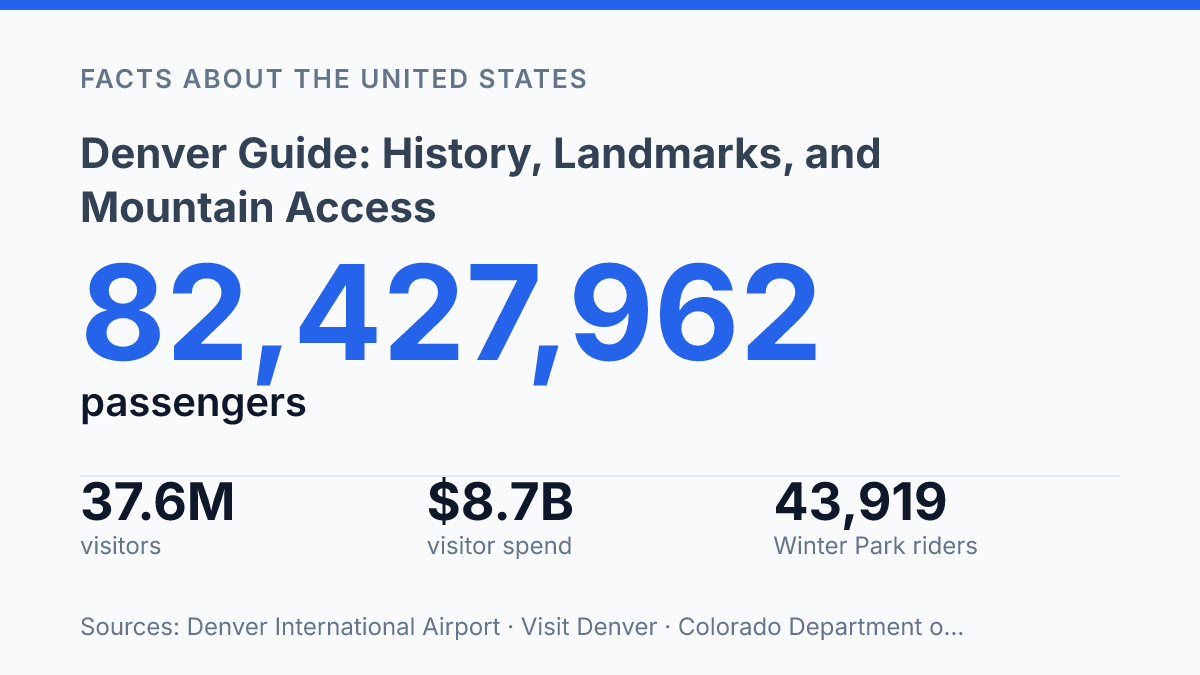
Rail service adds another option for one major mountain destination. According to the Colorado Department of Transportation, Winter Park Express ridership rose 153% in 2025 to 43,919 riders after expanded service and lower fares, with trains averaging 89% full.
Those figures show demand for alternatives to winter driving, especially when mountain roads are crowded or weather-affected. Rail does not replace access to every resort town, but it illustrates why the city’s role as a transport base matters as much as its geographic proximity.
Higher elevation also changes the practical planning. Mountain towns and ski areas sit well above the urban core, so colder temperatures, stronger winds, heavier snowfall, and thinner air can affect both driving and comfort. Sensible winter trips account for road forecasts, traction requirements, parking rules, early departures, and the possibility that returning the same evening may take longer than expected.
Why Denver stands out among U.S. cities
The region’s main airport, DEN, handled 82,427,962 passengers in 2025, a scale that helps explain why Colorado’s capital functions as more than a stopover near the Rockies. The airport ranked fourth busiest in the United States and tenth busiest globally that year, according to airport figures, giving the city national and international reach that reinforces its role as a government center, cultural hub, and mountain gateway.
That combination is the city’s clearest distinction among U.S. urban destinations. State institutions anchor its civic identity, while museums and preserved historic areas give visitors a concentrated way to engage with regional history and art before shifting toward outdoor travel. A single trip can therefore connect public history, major collections, and high-country recreation without requiring a separate base in a resort town or a second urban destination.
The metro area’s size also matters. Recent U.S. Census Bureau estimates place the metropolitan population at roughly 3 million residents, making it one of the largest urban centers in the Mountain West.
That scale supports air service, hotels, restaurants, museums, sports venues, and transportation links that smaller mountain-adjacent cities generally cannot match. It also explains why the city is not simply defined by proximity to peaks; it operates as a regional capital for business, government, culture, and travel.
Tourism data point to the breadth of that appeal. The city drew 37.6 million visitors in 2025, and overnight visitors spent $8.7 billion, including $828 million on recreation, according to tourism research from Longwoods International.
Those figures suggest that outdoor access is a major part of the draw, but not the only one. The destination works because historic interpretation, museum-going, urban amenities, and mountain outings can reinforce rather than replace one another.
The same mix creates practical limits. Growth increases demand on transport corridors and visitor infrastructure, altitude can affect comfort and pacing, and seasonal weather can shape when outdoor plans are realistic. The city stands out most clearly when understood through that balance: a large inland metro with formal civic weight, substantial cultural institutions, and unusually direct access to the Rocky Mountains.
What rising demand will test next
Scale is becoming the city’s clearest test. A destination that drew 37.6 million visitors in 2025 and moved 82,427,962 passengers through its airport cannot rely only on altitude, scenery, or heritage appeal; it has to make movement, preservation, and public space work under rising demand. The Winter Park Express offers one indicator of where pressure is heading: ridership rose 153% in 2025 after more service and lower fares, with trains averaging 89% full.
Denver’s advantage is not a single landmark or mountain view, but the way civic history, cultural institutions, and regional access meet in one place. That advantage will matter most if growth makes the city easier to understand, not harder to navigate.
Frequently Asked Questions
Q: What is Denver known for historically?
A: Denver dates to the Old West era and grew as a major city in Colorado. Its early development is still visible in preserved districts such as Larimer Square, which is the city’s oldest block. That history gives the city a strong link between frontier growth and later urban development.
Q: What are the main landmarks to see in Denver?
A: Larimer Square is one of the most notable historic sites because it contains landmark 19th-century buildings. The Denver Art Museum is another major stop, with an ultramodern design and a collection known for indigenous works. The mansion of famed Titanic survivor Molly Brown also draws visitors interested in local history.
Q: Is Denver a good base for visiting the Rocky Mountains?
A: Denver is widely used as a starting point for mountain trips because it sits close to the Rocky Mountains. The city provides access to ski resorts and other outdoor destinations in the nearby range. That location makes it practical for combining an urban stay with day trips or longer mountain visits.
Q: Why is the Denver Art Museum important?
A: The Denver Art Museum is notable for both its architecture and its collections. It is described as an ultramodern complex and is especially known for indigenous works. This combination makes it one of the city’s most significant cultural institutions.
Q: What can history-focused visitors do in Denver?
A: History-focused visitors can start with Larimer Square, where 19th-century buildings preserve part of the city’s early character. The Molly Brown house adds another layer by connecting Denver to a well-known figure from Titanic history. Together, these sites show how the city’s past is presented through architecture and preserved homes.