
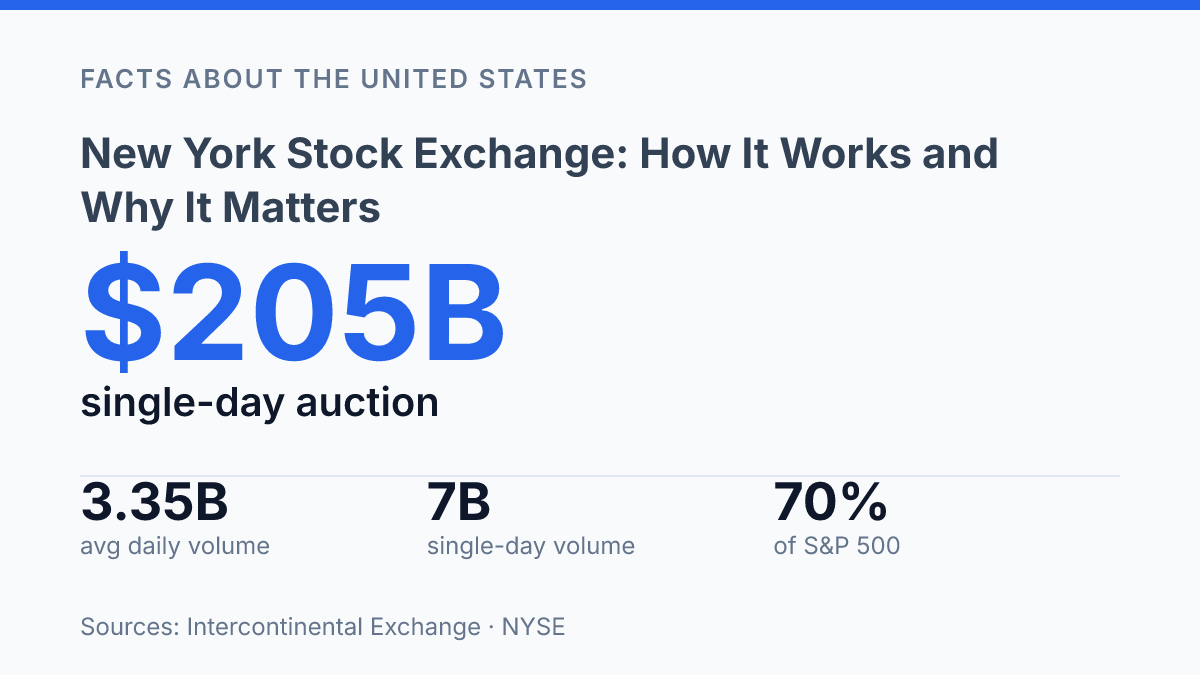
The New York Stock Exchange set a 2025 record average daily volume of 3.35 billion shares, showing that its auction model remains central even as equity trading becomes more automated. Its distinction is not nostalgia for a Wall Street floor, but a market structure that combines human floor brokers, electronic order flow, Designated Market Makers and formal opening and closing auctions. That structure helps explain why many large issuers still treat a listing there as a marker of scale and credibility, while Nasdaq competes with a larger listed-company count and a fully electronic identity.
The differences matter because exchange design affects liquidity, volatility controls, closing prices and the way capital reaches public markets. This article explains how the floor works, why companies choose to list there, how the exchange compares with Nasdaq, and why its role still extends well beyond the trading posts at 11 Wall Street.
How the trading floor operates
The New York Stock Exchange concentrates some of its most consequential price discovery into two scheduled auctions: one that starts the trading day and one that sets the official closing price. At the open, buy and sell interest is collected and matched through an auction process designed to establish an orderly first trade for each stock. At the close, a larger pool of market-on-close, limit-on-close, and other eligible orders is brought together to determine the final print, which is widely used by funds, indexes, and institutions that benchmark performance to end-of-day prices.
That auction model sits alongside continuous electronic trading, rather than replacing it. Orders can trade throughout the session, but the opening and closing auctions are structured moments when liquidity is concentrated and price formation receives extra attention.
Intercontinental Exchange reported that the three largest closing auctions in NYSE history occurred in 2025, including a single-day record of more than $205 billion in value traded. The scale of those auctions explains why the close is not just an administrative endpoint; it is a major pricing event for U.S. equities.
Human oversight remains part of the system at specific points where order flow, volatility, and price discovery are most sensitive. The exchange is based at 11 Wall Street in New York City and remains one of the major U.S. stock exchanges, but its floor is not a purely symbolic feature. Floor brokers can represent institutional orders during the day and participate around the open and close, where judgment about order handling and market conditions can still matter within a highly automated framework.
The central floor role belongs to the Designated Market Maker, or DMM, assigned to each listed security. A DMM is responsible for helping maintain fair and orderly trading in its assigned stocks, including by supplying liquidity, facilitating auctions, and reducing temporary imbalances between buyers and sellers when market conditions require attention. The NYSE says it is the only U.S. equities exchange operating both a physical trading floor and a parity/priority allocation model; each NYSE-listed security has one DMM, and the current DMM roster includes Citadel Securities, Virtu Americas, and GTS Securities, according to NYSE, 2026, NYSE Equities page.
This hybrid structure gives the exchange a distinct operating profile. Most activity is processed through modern electronic systems, yet the auction framework and assigned market-maker model create defined accountability for opening prices, closing prices, and liquidity support during the trading day. The result is neither a traditional floor market nor a fully electronic venue, but a market structure built around automated execution with targeted human and firm-level responsibility at critical moments.
Why companies choose to list there
Only about 40% of global IPOs met NYSE listing standards in 2025, according to Intercontinental Exchange’s 2026 Letter to Shareholders, which helps explain why admission to the exchange is often treated as a selectivity signal rather than a routine administrative step. The exchange still facilitated $25 billion in new IPO capital formation and hosted 7 of the top 10 IPOs that year, suggesting that its standards have not prevented it from attracting large public offerings.
What sets it apart from Nasdaq
Nasdaq reported 4,480 listed securities as of December 31, 2025, according to its 2025 Form 10-K, a reminder that the exchange is not a niche alternative but a parallel center of U.S. equity trading. The clearest practical distinction is market design: NYSE is built around an auction-centered model, while Nasdaq is known for an electronic dealer model in which multiple market makers compete by posting buy and sell quotes. Both systems are designed to bring buyers and sellers together, but they organize liquidity in different ways.
That structural contrast also explains the different public images of the two exchanges. NYSE is still associated with the visual language of finance: traders on a floor, auction calls, and televised market openings.
Nasdaq, which began in 1971 as an electronic quotation system, built its reputation around screen-based trading rather than a physical floor. The difference is partly symbolic, but not only symbolic; it reflects two distinct approaches to how trading interest is displayed, intermediated, and matched.
Investor perception often follows those histories. NYSE listings are commonly associated with mature blue-chip companies, dividend payers, and long-established corporate brands, while Nasdaq is frequently linked with growth companies in technology, biotechnology, software, and internet-related industries.
These are broad associations rather than rules. Many large, profitable companies trade on Nasdaq, and many NYSE-listed companies operate in fast-growing sectors.
Company movement between exchanges also shows that the distinction is not fixed or one-directional. Nasdaq said in its 2025 Form 10-K that 20 operating companies switched from NYSE or NYSE American to Nasdaq in 2025, representing more than $1.241 trillion in global equity market capitalization.
For most investors, the exchange venue is therefore secondary to the issuer’s business model, valuation, balance sheet, competitive position, and earnings outlook. Exchange structure can affect trading mechanics and market identity, but it does not replace company-level analysis.
Why it still matters to the U.S. economy
The Wall Street building is the symbol, but the exchange’s larger economic function is to convert investor demand into corporate capital at national scale. When a company sells shares to the public, the proceeds can fund expansion, research, acquisitions, hiring, debt repayment, or balance-sheet flexibility. The continuing presence of an active public market also matters after the initial sale: investors are more willing to supply capital when they believe they can later sell shares in a transparent, regulated venue.
>This capital-formation role links the exchange to household wealth as well as corporate finance. Public equities are held directly by individuals and indirectly through pensions, mutual funds, exchange-traded funds, insurance portfolios, and retirement accounts. That means the valuation of listed companies can affect both corporate financing conditions and the savings vehicles used by millions of Americans, even when those savers never trade individual stocks.
>Index influence gives the NYSE a wider economic footprint than its own listings alone suggest. The Dow Jones Industrial Average, first published in 1896, contains 30 large U.S. companies and remains one of the most cited gauges of American equity performance.
Many NYSE-listed companies also sit inside the S&P 500, a float-adjusted, market-capitalization-weighted benchmark used by index funds, asset managers, and institutional investors. Because these benchmarks guide portfolio allocation and performance measurement, the exchange’s listed companies help shape how capital is tracked across the broader market.
>Its physical location in Lower Manhattan reinforces that role without fully explaining it. The exchange sits within the Financial District, near banks, regulators, law firms, asset managers, and other institutions that support capital raising and securities markets. This concentration gives the area enduring symbolic force in American finance, but the economic significance comes less from geography than from the flow of capital, pricing information, and investor confidence associated with public markets.
Why market structure still carries economic weight
The exchange’s next test is less about whether a physical floor can survive and more about whether its hybrid model continues to improve price formation at moments when volume concentrates. That question grows sharper as index funds, exchange-traded products and algorithmic trading place more weight on closing prices and short windows of liquidity.
A single-day closing auction above $205 billion in 2025 shows why the mechanism is not a ceremonial feature; it influences valuations used across portfolios, benchmarks and retirement accounts. Nasdaq’s scale by listed securities will keep the comparison active, but the NYSE’s value rests on a narrower claim: structure can still shape market quality when trading speed alone is not enough.
Frequently Asked Questions
Q: How does the New York Stock Exchange work?
A: The New York Stock Exchange is an auction market where buyers and sellers trade listed securities through a regulated exchange process. Orders are matched electronically and, for some names, with the help of designated market makers that support orderly trading and price discovery. This structure helps create transparent pricing and deep liquidity for many large companies.
Q: What types of companies are listed on the NYSE?
A: The NYSE primarily lists large, established companies that meet its financial, governance, and disclosure requirements. These standards are designed to support investor confidence and maintain active trading in the listed shares. Many prominent U.S. and international corporations trade there because the exchange offers broad visibility and access to capital.
Q: Why do companies want to list on the New York Stock Exchange?
A: A listing can increase a company’s visibility, improve access to capital, and broaden its investor base. The exchange’s reputation and trading volume can also support share liquidity, which may make buying and selling easier for investors. In practice, these benefits can help firms raise money and attract long-term attention from the market.
Q: What is the difference between the NYSE and Nasdaq?
A: The main difference is market structure and the type of trading system used. The NYSE combines electronic trading with designated market makers, while Nasdaq is known for a fully electronic dealer market. Both are major U.S. exchanges, but the NYSE is often associated with larger, more mature companies.
Q: Is the New York Stock Exchange open to individual investors?
A: Individual investors can buy and sell NYSE-listed stocks through brokerage accounts, just like other exchange-listed securities. Trading access depends on the broker, the order type, and market hours, not direct membership in the exchange. The exchange itself sets the venue and rules, while brokers route orders into the market.