
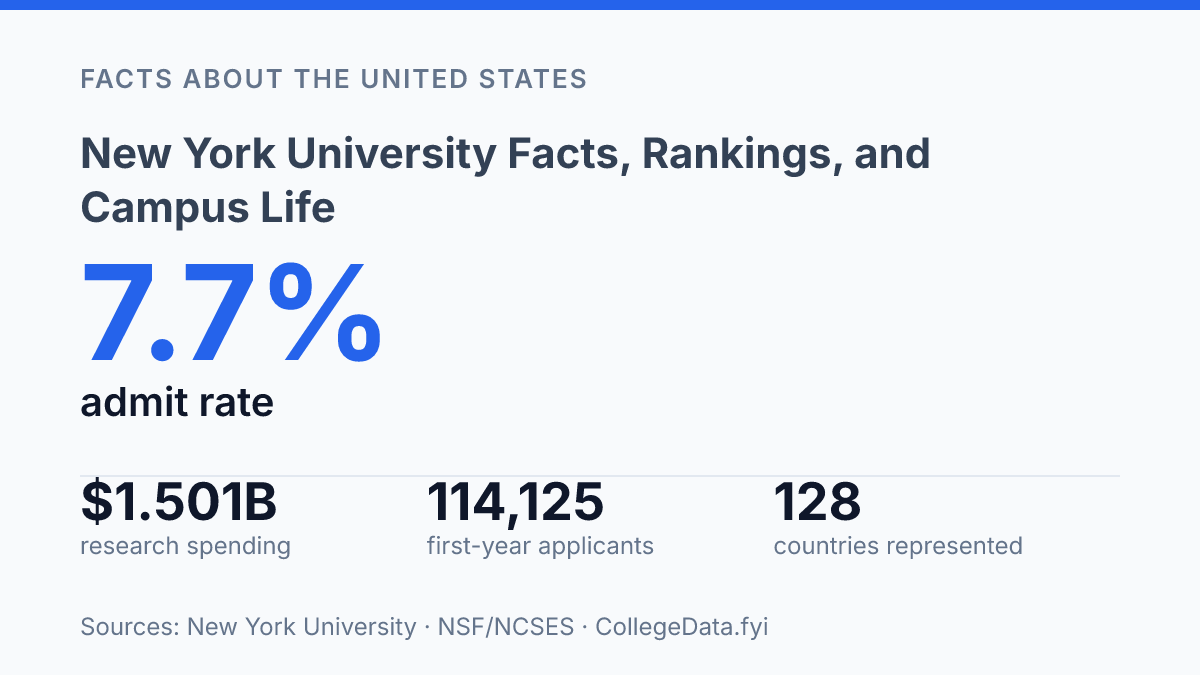
New York University admitted just 7.7% of more than 120,000 applicants to its New York campus for the Class of 2029, placing parts of the university in the same selectivity range as the country’s most competitive colleges. That number is only one part of the institution’s current profile. NYU also reported an incoming class expected to include students from 128 countries, about 20% Pell Grant recipients, about 20% first-generation students, and roughly 1,000 graduates of New York City public schools.
The result is a university defined by several forces at once: intense admissions demand, a global academic network, large-scale research activity, and a student experience shaped more by New York City than by a traditional enclosed campus. The facts behind NYU’s reputation show why it attracts applicants across disciplines, from business and nursing to film, public health, and the arts.
What New York University Is Known For
Few private research universities are as closely identified with a single neighborhood as New York University, which was founded in 1831 in Greenwich Village and still anchors much of its academic life in lower Manhattan. Its identity is tied not only to New York City as a location, but to the way the city functions as an extension of the institution’s academic, professional, and cultural environment.
NYU is best understood as a large private research university with a major urban footprint rather than a self-contained collegiate enclave. That structure gives the university immediate proximity to finance, media, publishing, technology, public policy, the arts, and health care institutions, which helps explain why its reputation often feels strongly connected to professional fields as well as traditional liberal arts study. The same geography also creates a different campus experience from universities organized around a central quad, because academic buildings, residence halls, libraries, studios, and student spaces are distributed through a dense city setting.
Several schools are especially central to NYU’s academic profile. The College of Arts and Science serves as the university’s core liberal arts college, while the Stern School of Business is one of its most widely recognized professional schools.
Tisch School of the Arts, the Rory Meyers College of Nursing, and other specialized divisions also contribute to a reputation that spans creative, scientific, business, health, and public-service fields. The breadth matters because NYU’s public image is not based on a single discipline; it is built from multiple high-profile schools operating within one research institution.
Research scale reinforces that institutional identity. National Science Foundation FY2024 HERD data ranked NYU 18th nationally for higher-education research and development expenditures, with $1.501 billion in research spending.
That figure places the university among major American research institutions, not merely among schools known for urban access or arts and business programs. Its visibility has also been intensified by demand: NYU admitted 7.7% of more than 120,000 applicants to its New York campus for the Class of 2029, while Arts and Science, Stern, and Rory Meyers Nursing each admitted fewer than 5% of applicants, according to a New York University press release via PublicNow.
Campus Layout and Student Experience
Few large urban universities make a public park function as their unofficial quad as completely as NYU does around Washington Square. The surrounding academic buildings, libraries, residence halls, dining spaces, and student-service offices form the main hub, but the area remains part of the city grid rather than a walled or gated campus. That layout makes daily life porous: students move between classrooms, apartments, coffee shops, performance venues, and public transit alongside residents, workers, and visitors.
The university’s footprint extends well beyond lower Manhattan. The Brooklyn campus, centered around the MetroTech area, gives the institution a major base across the East River and makes cross-borough commuting part of the student experience for many.
Internationally, NYU describes itself as a global network with degree-granting campuses in New York City, Abu Dhabi, and Shanghai, according to NYU Global Dimensions in 2024. That structure distinguishes the university from a study-abroad-only model because Abu Dhabi and Shanghai are full campuses rather than short-term satellite sites.
Housing follows the same distributed pattern as the academic buildings. Undergraduates may live in university residence halls, but those halls are placed across city neighborhoods rather than around one central lawn.
Transit access partly compensates for that spread: subway lines, buses, walking routes, and intercampus movement connect the Washington Square area with Brooklyn and other parts of the city. The practical result is a campus experience shaped by navigation, independence, and proximity to New York’s cultural and professional institutions.
Student life is broad, though not always spatially concentrated. NYU says students can choose from more than 300 university-wide All-Square clubs, with many more school-based organizations, a scale that helps create communities across a decentralized setting. The tradeoff is structural rather than simply social: access to internships, museums, media organizations, courts, hospitals, and arts venues is unusually direct, but the absence of a single enclosed campus can make school identity feel more dispersed than at residential colleges built around one continuous physical center.
Admissions Selectivity and Academic Reputation
A first-year admit rate of 9.1% in the university’s 2025 Common Data Set puts NYU in the same selectivity band as several of the country’s most sought-after private universities. CollegeData.fyi’s transcription of the 2025–26 Common Data Set reports 114,125 first-year applicants, 10,340 admits, and 5,662 enrolled students for fall 2025. The same figures imply a yield near 55%, meaning more than half of admitted first-year students chose to enroll, a sign that demand remains strong after admission offers are made.
Selectivity figures can vary by source because universities may report by campus, applicant pool, academic division, or admission round. Even with those differences, recent NYU data consistently point to a high-single-digit to low-teens admit-rate environment, with some academic entry points more competitive than the university-wide average. That pattern reflects both the size of the applicant pool and the institution’s visibility in fields where location, internships, research access, and professional networks carry unusual weight.
Standardized testing indicators require some caution because NYU has used test-optional admissions policies in recent cycles. Among applicants who did submit scores, U.S. News & World Report lists a middle range of 1470 to 1570 on the SAT and 33 to 35 on the ACT. Those ranges are best read as evidence of the academic profile among score submitters rather than a complete description of every enrolled student.
Major rankings reinforce the same picture of a highly visible institution with national and global reach. U.S. News & World Report ranked the university No. 30 among National Universities in its 2025 Best Colleges list, while QS placed it No. 50 worldwide in the 2026 QS World University Rankings. High rankings do not explain every admissions outcome, but they help sustain applicant interest; the result is a cycle in which reputation increases demand, and demand keeps admission highly competitive.
Notable Alumni and Academic Impact
At the 97th Academy Awards in 2025, NYU’s arts school reported that 6 alumni received 7 Oscars across 4 projects, with Sean Baker ’98 becoming the first person to win four Oscars individually for the same film in one ceremony. That outcome illustrates a broader pattern: the university’s public influence is unusually visible in fields where professional networks, urban institutions, and graduate pipelines intersect.
Its alumni base spans finance, government, music, and film rather than clustering in a single profession. Alan Greenspan, the former chair of the Federal Reserve, reflects the university’s reach into economic policy, while Martin Scorsese and Lady Gaga show its prominence in screen culture and popular music. These names matter less as isolated celebrity examples than as indicators of how graduates have shaped high-profile institutions, markets, and cultural production.
Academic impact is also reinforced through specialized research units. NYU Langone Health and the Grossman School of Medicine anchor biomedical research and clinical training, while the Volatility and Risk Institute connects business scholarship to financial-market measurement and systemic risk.
Public policy and legal research are represented through centers such as the Brennan Center for Justice and the Furman Center for Real Estate and Urban Policy, which focus on issues including democracy, courts, housing, and cities. In the arts, the university’s film, performance, and media programs maintain close ties to professional creative industries, a connection reflected in alumni outcomes as well as faculty practice.
Scale gives these networks unusual breadth. NCES College Navigator listed NYU enrollment at 59,144 students in fall 2023, a size that supports a deep graduate population, extensive professional schools, and a large alumni base.
That scale does not mean every school or department carries the same weight; NYU’s reputation is strongest where its disciplinary resources, faculty, clinical or professional partnerships, and location-sensitive fields reinforce one another. The result is an institution whose influence is broad, but unevenly concentrated across medicine, business, law and public policy, and the arts.
What the numbers suggest about NYU’s next phase
The next stage of NYU’s profile will likely be judged by how well its scale translates into access, academic depth, and student support. A university can draw applicants from 128 countries, spend more than $1.5 billion on research, and produce Oscar-winning alumni, yet still face close scrutiny over cost, competition, and the complexity of navigating a city-based campus.
The NYU Promise signals that affordability is now central to the institution’s public case, not a side issue. For students comparing selective universities, the most useful reading of NYU is not as a single statistic or brand name, but as a high-demand urban research university whose strengths are tied closely to the opportunities and pressures of New York City.
Frequently Asked Questions
Q: How selective is New York University for undergraduate admissions?
A: Admission is highly selective, with the university drawing far more applicants than it can admit. Selectivity varies by school and program, so acceptance rates are not uniform across the institution. The overall pattern is that entry is competitive across most undergraduate divisions.
Q: What are New York University’s strongest academic areas?
A: The university is especially well known for programs in business, the arts, law, and the social sciences. Its location in New York City also supports strong connections to internships, media, finance, and cultural institutions. Those links often shape both academic opportunities and career pathways.
Q: Where is New York University located?
A: The main campus is centered in Greenwich Village in Manhattan, with facilities and classrooms spread across nearby parts of the city. The urban setting means that campus life is closely tied to the surrounding neighborhood rather than confined to a single enclosed campus. This structure gives the university a distinctly city-based character.
Q: What is campus life like at New York University?
A: Campus life is shaped by the city, so student activities are distributed across residence halls, academic buildings, and off-campus venues. Housing, clubs, and events are available, but the experience is less traditional than at a closed-campus university. That setup tends to appeal to students who want a more independent and urban college experience.
Q: Is New York University expensive to attend?
A: The university is generally considered expensive, especially when tuition is combined with housing and other living costs in New York City. Financial aid and scholarships can reduce the total cost for eligible students, but affordability remains a major concern for many applicants. The overall expense is one reason families look closely at net price rather than sticker price alone.