
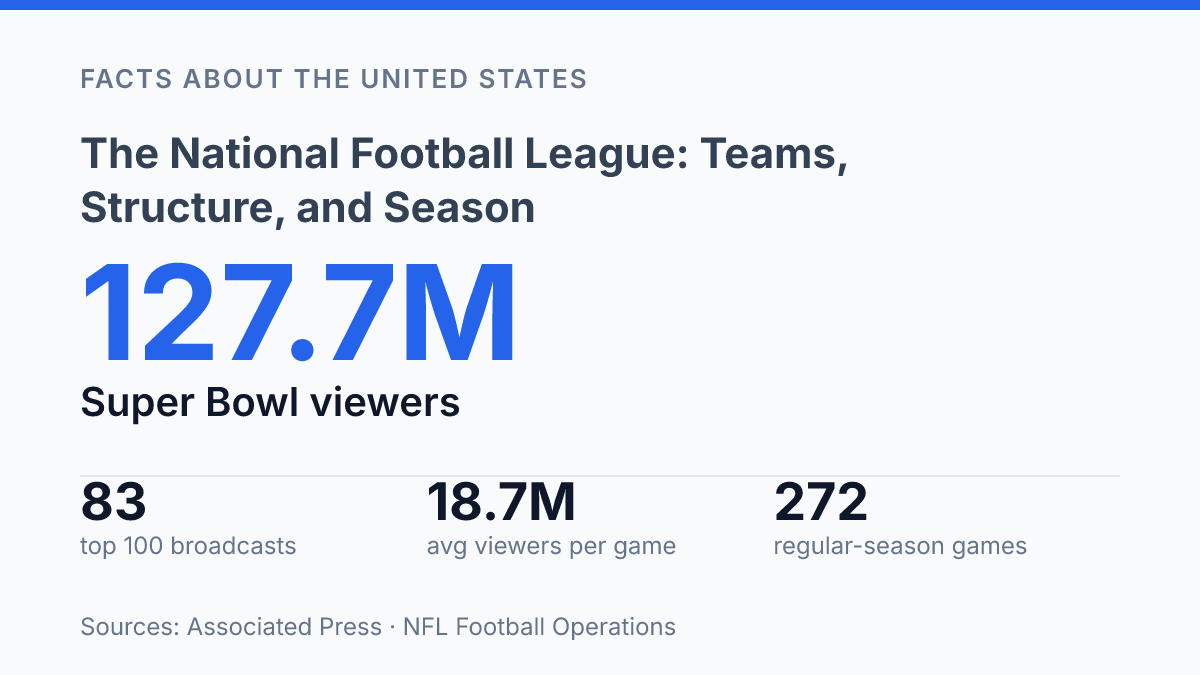
The National Football League turns a 32-team membership into 272 regular-season matchups, with each club playing 17 games across an 18-week schedule. That structure is compact compared with Major League Baseball’s 162-game season or the NBA’s 82-game slate, which helps explain why each football weekend carries unusual weight. The league’s design is also highly ordered: two 16-team conferences, four divisions per conference, and four teams in every division.
Those divisions do more than organise standings; they preserve repeat matchups, regional identities, and playoff paths that shape how the season is followed. The same structure now supports a much larger media and cultural machine, from 18.7 million average viewers per 2025 regular-season game to nine scheduled international games in 2026. Understanding the league means looking at both the framework on paper and the attention that framework reliably produces.
How the league is organised
A 32-team league becomes manageable because it is not organised as one continuous table, but as a layered competition system that narrows comparisons by conference and division. The National Football League has 32 teams in total, divided evenly between the American Football Conference and the National Football Conference. That split gives each side of the league the same number of clubs, which helps create a symmetrical framework for scheduling, standings, and postseason qualification.
The basic hierarchy runs from league to conference to division. According to NFL Football Operations, each of the 32 teams plays 17 regular-season games over 18 weeks, creating 272 regular-season matchups, while the league is split into two 16-team conferences and each conference has four four-team divisions. This arrangement keeps the schedule broad enough for interconference and cross-division games, but structured enough for divisional races to carry practical weight.
The conference format matters because postseason seeding is not determined by ranking every club against every other club on identical terms. Teams compete inside a framework where divisional standing, conference record, and relative performance within the AFC or NFC shape the path to the playoffs. The result is a clear competitive structure, but not a perfectly balanced round-robin model in which every opponent is faced equally.
The league’s headquarters and central operations are based in the United States, where it functions as the top tier of professional American football. That domestic base explains why its organisational model is tied closely to U.S. markets, travel patterns, broadcast windows, and long-standing conference alignment rather than to an international club pyramid or promotion-and-relegation system.
What each conference contains
The Dallas Cowboys can chase the same conference title as the Green Bay Packers while spending most of their rivalry energy on a different divisional race. Each conference contains 16 teams, and both the AFC and NFC are subdivided into East, North, South, and West divisions. The official NFL team directory, updated January 30, 2026, presents those same geographic labels across both conferences, according to NFL Support.
This arrangement gives the league a consistent internal map without requiring every club to be treated as part of one undifferentiated table. The Cowboys are a prominent example from the NFC East, the Green Bay Packers from the NFC North, and the New England Patriots from the AFC East. Those examples also show that divisional identity is not only geographic; long histories, repeated meetings, and playoff implications often make division games more emotionally and competitively charged than many cross-conference matchups.
Divisional alignment also helps organise the regular-season path by narrowing the most immediate competitive comparison for each club. A team can measure itself first against three familiar rivals, then against the wider conference field.
That structure simplifies standings and postseason qualification, but it does not make every division equally difficult in a given year. One division may contain several strong contenders while another may be led by a team with a less impressive overall record, which is why divisional context often matters as much as a raw win-loss comparison.
Why the season draws so much attention
A single loss carries unusual weight when a club has only 17 regular-season games to build a playoff case. That limited schedule helps explain why weekly results receive national attention: standings can change quickly, and one upset can alter playoff probability, seeding, or tiebreaker position. The same compression creates a genuine competitive constraint, because injuries or a slow opening month leave less time for correction than in longer professional seasons.
That structure also concentrates audience demand into a relatively small number of appointment-viewing windows. According to the Associated Press, the 2025 regular season averaged 18.7 million viewers per game across television and digital platforms, a 10% increase from the previous year and the second-highest average since tracking began in 1988. The figure shows that attention is not confined to the final weeks; regular-season games themselves operate as major national broadcasts.
Once the regular season ends, the postseason turns that weekly pressure into an elimination format. Qualifying teams advance through playoff rounds in which each game can end a season, and the process leads to the Super Bowl, which determines the league champion. This format is simple for broad audiences to follow while still preserving the importance of regular-season performance, because seeding and home-field positioning can materially affect the path through January football.
The championship game’s audience scale explains why it is treated as one of the most watched annual sporting events in the United States. Associated Press reporting found that Super Bowl LIX averaged a record 127.7 million U.S. viewers and peaked at 137.7 million. Those numbers place the final game beyond ordinary sports programming and show how the season’s structure, from weekly scarcity to postseason elimination, builds toward a national event with exceptional reach.
The league’s place in U.S. sports
NFL games filled 83 of the top 100 U.S. broadcasts in the prior year, according to a 2026 Associated Press report, a concentration that explains why the league occupies a different commercial tier from most domestic sports properties. This media dominance is the clearest reason the NFL is generally treated as the most commercially powerful professional sports league in the United States. The same report said the league’s media deals average nearly $11 billion per season and mostly run through 2033 or 2034, giving networks and streaming partners a long-term stake in keeping pro football at the centre of the American sports calendar.
That commercial position depends on a national fan base rather than only local market loyalty. Regular broadcasts create weekly appointment viewing across regions, while national windows give advertisers rare access to large, simultaneous audiences. Advertising revenue follows that scale: brands pay for the combination of reach, repetition, and cultural attention that surrounds marquee games, pregame programming, and postseason coverage.
Live demand reinforces the same pattern. Sports Business Journal reported that average NFL crowd size in 2025 was 69,055, with teams selling 97.6% of available capacity and 12 teams selling at least 100% of listed capacity. Those figures show that television strength has not replaced stadium demand; instead, the two channels support each other by turning games into both local events and national broadcasts.
The Super Bowl and league events also tie the NFL to major U.S. host cities, including New Orleans, Miami, and Los Angeles. These host markets provide large venues, tourism infrastructure, media facilities, and corporate-event capacity, which helps explain why the league’s championship week operates as more than a game.
Scale also raises the stakes of governance. Player safety, scheduling choices, and market balance receive heightened scrutiny because league decisions affect national media partners, advertisers, host cities, teams, and a broad public audience at the same time. The NFL’s visibility is therefore both a commercial advantage and a reason its operating decisions carry unusually wide consequences in U.S. sports.
What the schedule makes possible beyond the field
The league’s next stage will test how far a tightly scheduled domestic competition can stretch without weakening the features that make it valuable. International games in Melbourne, Paris, and Rio de Janeiro point to a wider audience strategy, but the core product still depends on scarcity, divisional familiarity, and appointment viewing.
That balance matters because the NFL is not only selling games; it is selling a calendar that broadcasters, sponsors, cities, and fans can plan around months in advance. A 17-game season leaves little room for disposable inventory, which is why one schedule release can shape travel plans, television windows, and local economic expectations before a ball is kicked.
Frequently Asked Questions
Q: How many teams are in the NFL?
A: The league has 32 teams in total. They are split evenly between the American Football Conference and the National Football Conference, which gives the league a balanced conference structure.
Q: What are the AFC and NFC in professional football?
A: The AFC and NFC are the two conferences that organize teams within the league. Each conference contains 16 teams, and the split helps determine regular-season scheduling and postseason qualification.
Q: Is the NFL only played in the United States?
A: The league is based in the United States and is described as a professional American football league there. While some games may be staged outside the country, its teams and core operations are American.
Q: Why does the NFL have conferences?
A: Conferences provide a clear way to group the league’s 32 teams into two large competitive sections. This structure supports scheduling, standings, and the path to the postseason.
Q: What kind of sport is the NFL?
A: The National Football League is a professional American football league. It represents the highest level of the sport in the United States and is organized around team competition across two conferences.