
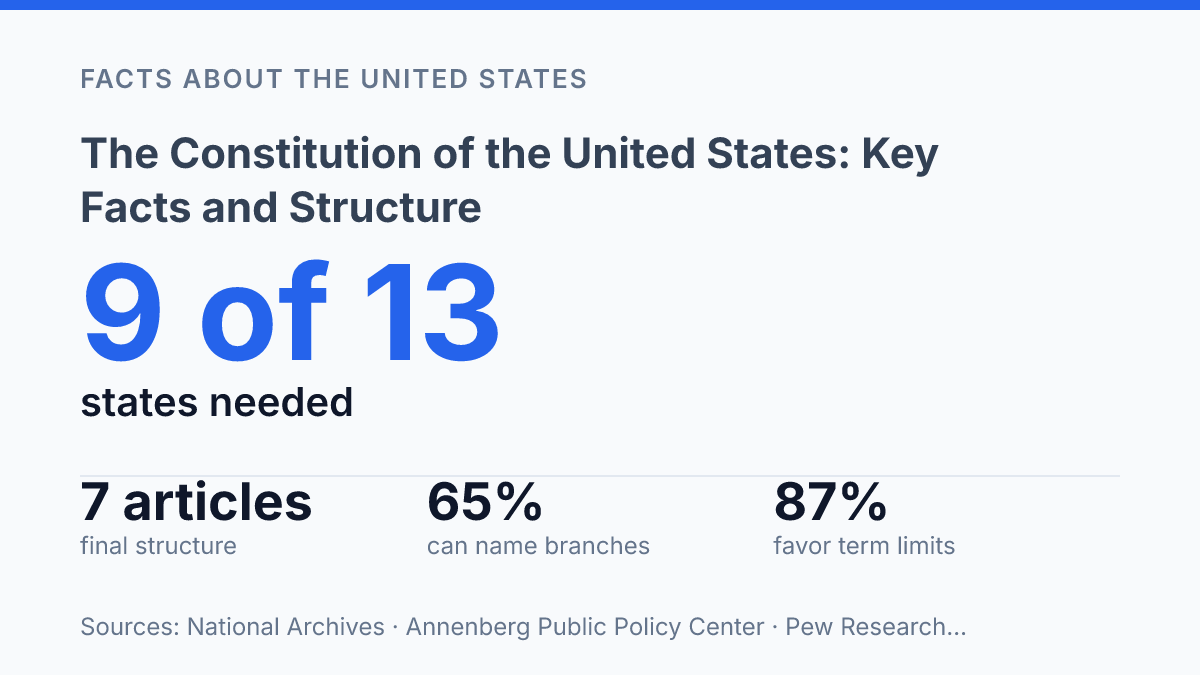
The Constitution of the United States lowered the threshold for creating a new national government from unanimous consent under the Articles of Confederation to ratification by 9 of 13 states. That change was not a technical footnote; only 6 of the 13 states reportedly had pro-Constitution majorities when the document went out for ratification, which made adoption uncertain rather than automatic.
The final text also emerged from sharp compression: on August 6, 1787, the Committee of Detail presented a draft with a preamble, 23 articles, and 57 sections, but the signed Constitution contained only seven articles. This article explains how that shorter framework replaced the Confederation system, organized federal power among institutions, gave federal law priority through the Supremacy Clause, and established a government that took shape in stages between March 1789 and February 1790.
What changed after the Articles of Confederation
The sharpest procedural break from the first national framework was that constitutional adoption no longer depended on every state saying yes: the Articles required unanimity among all 13 state legislatures for alteration, while the new charter could take effect after ratification by 9 of 13 states, according to the National Archives. That change mattered because the Articles of Confederation, the first U.S. governing document, treated the Union largely as a league of states rather than as a government with direct national authority.
Under the Articles, the central government had limited capacity to act on national problems without state cooperation. Congress could conduct certain national affairs, but the system made collective action difficult because major changes depended on state-level approval and the central authority lacked the stronger institutional machinery later associated with federal government. The Constitution of the United States replaced that model by creating a federal structure in which national power operated through defined institutions rather than mainly through requests to the states.
The transition became legally effective on March 4, 1789, when the new government began under the ratified framework. The National Archives notes that the change was not fully operational in a single day: Congress did not have quorums until April 6, George Washington was inaugurated on April 30, and the Supreme Court first organized on February 2, 1790. This sequence shows that legal replacement and practical implementation were related but distinct steps.
The move to a stronger federal system solved an evident governance problem, but it also sharpened a founding concern. National authority could now be more capable and coherent, especially where state-by-state consent had made action difficult. At the same time, the shift raised early questions about how much power the central government should hold and how that power should be limited within a republic built from existing states.
How the seven articles organize federal power
A working draft presented on August 6, 1787, contained a preamble plus 23 articles and 57 sections, but the signed Constitution originally contained seven articles. That compression mattered because Article VII set the threshold for putting the new frame into effect: the Articles of Confederation required unanimous approval by all 13 state legislatures for any alteration, while Constitution Article VII required ratification by 9 of 13 states, according to the National Archives, accessed.
The first three articles assign the central functions of federal government to separate institutions. Article I establishes Congress as the legislative branch, placing national lawmaking in a bicameral body rather than in a single executive council.
Article II creates the presidency and assigns executive power to that office, giving the national government a defined officer responsible for carrying federal law into effect. Article III establishes the federal judiciary, including the Supreme Court, and supplies the constitutional basis for federal judicial power.
Article VI gives the structure legal priority by declaring the Constitution, federal laws made under it, and treaties to be the supreme law of the United States. Its role is not to create another branch, but to make the federal charter authoritative when valid federal law conflicts with state-level legal rules. This provision helps connect institutional design to legal operation: federal power is divided among branches, yet the constitutional order itself sits above ordinary state law.
The design reflects a deliberate balance between separation and coordination. Dividing legislative, executive, and judicial authority limited the risk of concentrated power, while shared functions such as appointments, lawmaking procedures, and judicial review meant that the branches could not operate as sealed compartments. That structure could slow federal action, but the delay was part of a system built to require more than one institution to participate in major exercises of national authority.
Why the supremacy clause matters
A state law can be valid when enacted and still become unenforceable if it conflicts with a constitutionally authorized federal statute. That result comes from the Supremacy Clause in Article VI, which makes federal authority legally controlling when it is exercised within constitutional limits. The clause does not erase state governments, but it prevents each state from treating national law as optional.
The practical doctrine that grows from this clause is known as federal preemption. A 2025 Congressional Research Service report describes 2 general categories of preemption: express preemption, where Congress clearly says federal law displaces state law, and implied preemption, where displacement follows from the structure or effect of the federal statute. Implied preemption can arise when federal regulation occupies an entire field or when compliance with both state and federal law is impossible.
Examples show why the principle matters outside constitutional theory. A state cannot block collection of a valid federal tax, exempt its residents from federal regulatory duties, or enforce a rule that permits what federal law prohibits.
In civil rights, federal statutes can set a national floor that states may not undercut, even when states remain free to provide stronger protections. In commercial regulation, federal safety, banking, communications, or environmental rules may override inconsistent state requirements when Congress has acted within its delegated powers.
National supremacy is therefore a source of legal consistency in areas where fragmented rules would weaken a national system. Taxation depends on uniform enforceability, interstate markets depend on predictable regulation, and civil rights protections depend on rules that do not disappear at state borders. The balance is not absolute, however.
Federalism still leaves states with broad authority over local government, policing, education, property, and many health and safety matters unless a valid federal rule controls the specific question. The Supremacy Clause matters because it defines how those two levels of authority coexist when their laws point in different directions.
What the document established at the founding
The charter did more than launch offices: it made every national institution legally subordinate to a higher written rule. It served as the supreme law of the United States of America, giving public authority a source that was above ordinary statutes and temporary political control. That position made the document the core legal framework rather than merely a founding agreement, because the validity of governmental action had to be measured against the constitutional order it created.
The founding design combined federalism with separated powers. Federalism preserved a system in which state governments continued to exist as independent legal authorities while the national government received powers that could operate across the union.
Within the national government, separated powers divided lawmaking, execution, and adjudication among different institutions, while checks and balances gave each branch limited tools to restrain the others. The design did not assume that structure alone would remove political disagreement; it made disagreement operate through defined offices, procedures, and legal limits.
The original text also included a mechanism for change, which helps explain its durability. The amendment process in Article V made revision possible without making constitutional change as easy as ordinary lawmaking.
The first ten amendments, known as the Bill of Rights, were ratified in 1791, and the document has since been amended 27 times in total. That record shows continuity and adaptation at the same time: the basic federal structure remained in place, while later amendments altered rights, citizenship, elections, and governmental authority.
Judicial interpretation has also shaped the meaning of the founding framework. Courts have applied constitutional language to disputes the framers could not have specified in advance, which gives the text practical effect across changing legal and social conditions. The result is a document whose core architecture remains intact, but whose operation depends on amendments, statutes, institutional practice, and constitutional interpretation over time.
Why the structure still shapes reform debates
A short charter leaves large questions to institutions, elections, courts, and later generations. That design helps explain why constitutional debate remains active rather than confined to founding-era history. Pew Research Center reported in 2026 that 87% of Americans favored congressional term limits, while 63% in 2024 preferred choosing the president by national popular vote.
Those views point to a recurring tension in American constitutional life: the document provides a durable structure, but many citizens still seek changes to the rules that structure political power. The practical consequence is clear when civic knowledge is uneven. If 35% of adults cannot name all three branches, debates over amendment, federal power, and judicial authority begin with a structural knowledge gap.
Frequently Asked Questions
Q: What is the Constitution of the United States and why is it important?
A: The Constitution of the United States is the supreme law of the country, which means federal laws and government actions must conform to it. It established the basic framework for the national government and set the authority that later laws and institutions had to follow.
Q: When did the Constitution replace the Articles of Confederation?
A: It superseded the Articles of Confederation on March 4, 1789. That shift marked the transition from the first national framework to the governing document that still structures the federal system today.
Q: How many articles were in the original Constitution?
A: The original Constitution contained seven articles. These articles set out the core structure of the federal government and assigned responsibilities across its branches and functions.
Q: What does the Constitution define about the federal government?
A: It defines the foundational structure of the federal government, including how authority is organized at the national level. This framework gave the United States a more clearly defined system than the Articles of Confederation had provided.
Q: Why is the Constitution considered the supreme law?
A: It is considered the supreme law because it sits above ordinary federal legislation and guides how government power is exercised. If a law conflicts with the Constitution, the constitutional standard controls.