
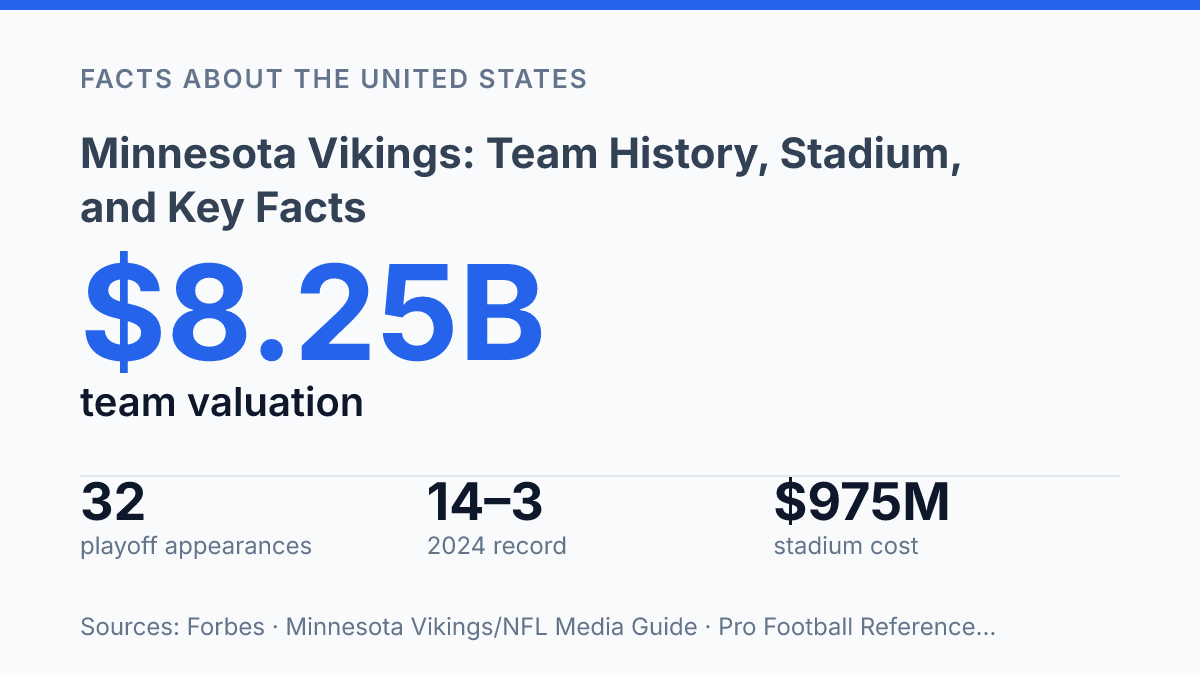
The Minnesota Vikings entered the NFL in 1961, one year after Minnesota was awarded a franchise on January 28, 1960, and the club’s profile now spans 32 playoff appearances, a $8.25 billion Forbes valuation, and a stadium era that began in 2016. That combination makes the franchise more than a simple expansion-team case study. Its history connects early ownership decisions, regional branding, divisional performance, and modern NFL economics in unusually clear ways.
The team’s name was chosen from alternatives such as Miners, Chippewas, and Voyageurs, while recent seasons have kept the club nationally relevant, including a 14–3 record in 2024 that still left Minnesota second in a highly competitive NFC North. The following sections trace how the organization formed, where it sits within its division, who has shaped its leadership, and how its mascots, colors, and home field became part of the club’s public identity.
Team origin and move into the NFL
Minnesota’s NFL franchise did not inherit another city’s record book; it entered the league as a new Upper Midwest club at the start of the 1960s expansion era. Founded in 1960 as an expansion team, the club was based in Minneapolis, Minnesota, and began play the following year rather than arriving through relocation from an existing market.
According to the Minnesota Vikings, Minnesota was granted an NFL franchise on January 28, 1960, and the team began play in 1961; the first ownership group included Max Winter, E. William Boyer, H.P. Skoglund, Ole Haugsrud, and Bernard H. Ridder Jr. That ownership structure matters because it tied the new team to local and regional backers from the outset, helping the franchise develop as Minnesota’s own NFL representative rather than as a transplanted club with an inherited identity.
The timing also placed the team within a wider period of professional football growth. During the early 1960s, the National Football League was adding markets and strengthening its national footprint at a time when demand for televised pro football was rising and rival professional competition was emerging. Minnesota gave the league a stronger presence in the Upper Midwest beyond its older established franchises, and the new club’s early formation created the foundation for the modern team’s regional following.
Where the club fits in the NFC North
A 14–3 record was not enough to win the division in 2024, a result that shows how demanding the club’s immediate competitive setting can be. The team competes in the National Football League as a member of the NFC North, alongside the Chicago Bears, Detroit Lions, and Green Bay Packers. That grouping creates a fixed set of annual rivalries rather than a rotating list of occasional opponents, so the divisional table often becomes the first measure of a season’s standing.
Divisional games carry added weight because they affect both the win-loss record and the head-to-head comparisons used in postseason ordering. In practical terms, beating a division opponent can improve one team’s playoff position while directly damaging a rival’s. This is why a strong divisional record can matter nearly as much as the overall win total, especially in seasons when two or more NFC North teams are competing for the same playoff spots.
Recent results illustrate the point. According to Pro Football Reference, Minnesota finished 2024 with a 14–3 record, an .824 winning percentage, and a +100 point differential, yet still placed second in the division behind Detroit. That kind of outcome is unusual in broad NFL terms but logical within a strong division race: excellence over the full schedule does not guarantee a division title if another club is even better in the same year.
Longer-term comparisons also place the franchise among the division’s most consistently relevant teams. The Minnesota Vikings/NFL Media Guide credits the club with 32 playoff appearances through the 2024 season, compared with 31 for Green Bay, 17 for Chicago, and 12 for Detroit. Those figures do not decide any current season, but they help explain why NFC North matchups involving this franchise are often framed around more than geography; they sit within a competitive history that regularly influences playoff access and seeding.
Leadership, ownership, and coaching
Forbes listed the Minnesota Vikings at $8.25 billion in 2026, a figure that reflects not only on-field visibility but also the franchise’s position as a major sports business. The club’s leadership is centered on President Mark Wilf, with ownership held by Mark Wilf, Zygi Wilf, and Leonard Wilf. Forbes also identifies the Wilf family as having purchased the team in 2005 for $600 million, giving the current ownership era a long enough span to support planning across executive hiring, commercial strategy, facilities, and fan-facing operations.
Day-to-day football direction is separated from that business structure through the head coach and football staff. Kevin O’Connell serves as head coach and the team’s primary on-field leader, responsible for game preparation, player deployment, staff coordination, and in-game decisions. According to the club, O’Connell was named the 10th head coach in franchise history on February 16, 2022; by the end of the 2024 season, he had a 34–17 regular-season record and had become the fastest coach in team history to reach 30 wins.
The distinction between ownership authority and coaching authority matters because each side controls different parts of the organization. Owners and senior executives set long-range priorities, approve major investments, and provide institutional continuity, while the coaching staff operates within the weekly rhythm of roster availability, opponent preparation, and performance management. Stable ownership can create conditions for consistent planning, but coaching outcomes remain tied to execution, personnel health, and competitive variables that change throughout a season.
Mascots, brand identity, and home base
Ragnar’s exit after a reported $20,000-per-game contract request shows how visible a fan symbol can become without being the franchise’s official identity. MPR News reported in 2015 that the motorcycle-riding Ragnar, associated with the team from 1994, left after a contract dispute. His long presence made him recognizable to many fans, but his unofficial status also illustrates the difference between a popular game-day character and the controlled identity of the franchise itself.
The official mascot is Viktor the Viking, who has represented the club since 2007 in team materials and public appearances. Viktor gives the organization a consistent character for stadium entertainment, youth outreach, digital content, and merchandise, while Ragnar remains part of the wider fan memory surrounding the club. Together, the two figures show how mascots can extend recognition beyond the field, especially through television shots, social media clips, licensed products, and pregame routines.
Based in Minneapolis, Minnesota, the team carries a statewide identity into a national sports market. Its home base is U.S. Bank Stadium, which opened on July 22, 2016, according to the stadium’s official history. The venue gives the franchise a fixed visual setting for broadcasts and game-day presentation, from crowd shots and branding placements to the repeated use of team colors, logos, and Norse-inspired imagery.
Mascots and location support brand recognition, but they do not replace the deeper sources of identity. The franchise’s public meaning is shaped by competitive performance, decades of regional support, and the continuity of its name, colors, and home market. Mascots make that identity easier to package and recognize; Minneapolis anchors it geographically and gives it a civic frame.
Why franchise value now changes the historical frame
Franchise history is often measured in wins, titles, and memorable names, but Minnesota’s case also shows how modern NFL identity depends on infrastructure and institutional continuity. A club purchased by the Wilf family for $600 million in 2005 was valued by Forbes at $8.25 billion in 2026, a shift that changes how stadium investment, media attention, and competitive stability are evaluated.
U.S. Bank Stadium gives the organization a fixed civic and commercial base, while the NFC North remains a demanding measure of football progress. The next useful comparison is not only whether Minnesota adds postseason success, but whether its brand strength and football operations continue to rise at the same time.
Frequently Asked Questions
Q: When were the Minnesota Vikings founded and when did they start playing?
A: The franchise was founded in 1960 as an expansion team. It began play the following year, so its first NFL season was 1961. That timeline places the team among the league’s modern-era expansion clubs.
Q: What city and state are the Minnesota Vikings based in?
A: The team is based in Minneapolis, Minnesota, in the United States. That location matters because the franchise is identified with the Twin Cities region even though it represents the state broadly. The club’s home identity has remained tied to Minnesota throughout its history.
Q: Which NFL division do the Minnesota Vikings play in?
A: The Vikings compete in the NFC North, which is one of the NFL’s four divisions in the National Football Conference. Division membership shapes their regular-season schedule and long-term rivalries. It also places them alongside other Midwestern teams in a familiar regional grouping.
Q: Who owns the Minnesota Vikings and who is the current president?
A: The team is owned by Mark Wilf, Zygi Wilf, and Leonard Wilf. Mark Wilf serves as president. That structure reflects family ownership, which has been central to the franchise’s recent era.
Q: Who is the current head coach of the Minnesota Vikings and what are the team mascots?
A: The current head coach is Kevin O’Connell. The team’s mascots are Viktor the Viking and Ragnar. Those names are part of the franchise’s public identity and are used regularly at games and team events.