
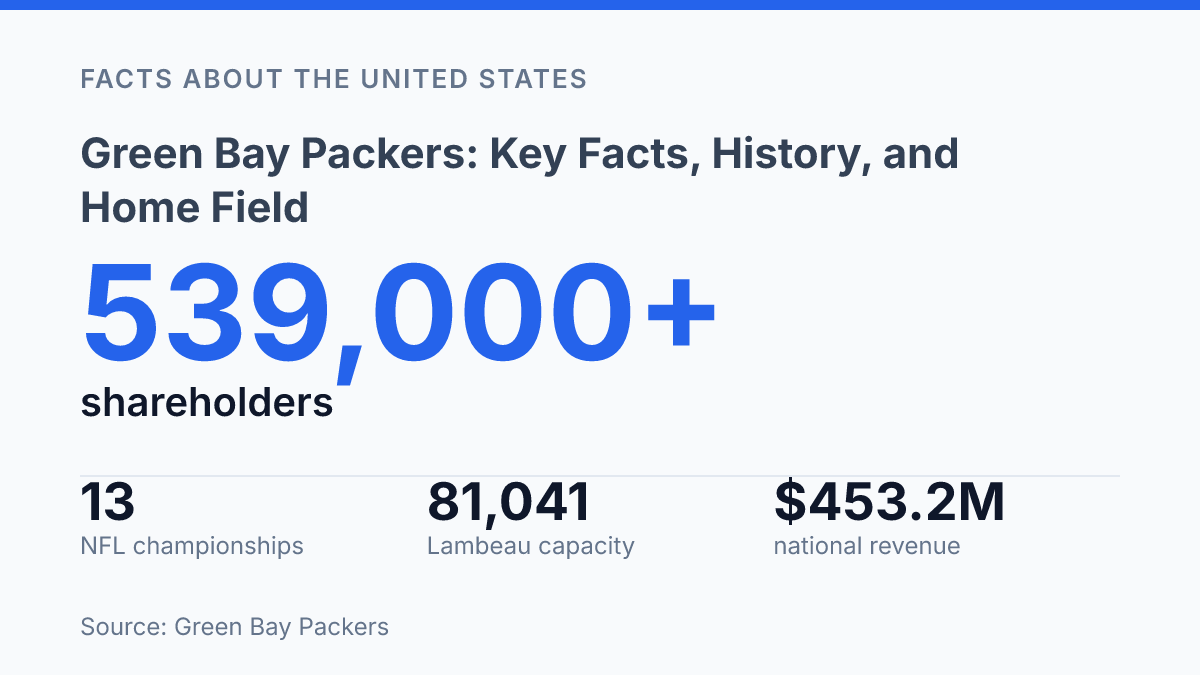
The Green Bay Packers are the NFL’s only community-owned franchise, and that status now spans more than 539,000 shareholders rather than a symbolic local club model. The structure shapes more than the team’s public identity: it affects governance, capital planning, stadium investment, and the way a small-market franchise competes inside a league driven by national revenue. In 2025, Ed Policy’s move into the president and CEO role marked a formal leadership transition before 6,529 shareholders at Lambeau Field, a setting that made the organization’s unusual structure visible.
The same franchise also reported record national revenue, a large reserve fund, and continued private funding for stadium work. Those facts frame a broader profile of the team: where it fits in the NFL, how it is run, why Lambeau Field carries measurable value, and how 13 championships still define its historical scale.
Team profile and NFL placement
A team based in one of the NFL’s smallest markets has remained one of the league’s most recognizable professional football franchises for more than a century. The Green Bay Packers are a professional American football team based in Green Bay, Wisconsin, giving the franchise a geographic identity that differs sharply from clubs located in larger metropolitan areas. That small-market setting has become part of the team’s profile rather than a limitation on its national standing.
Within the NFL, Green Bay competes in the National Football Conference North division, commonly referred to as the NFC North. That placement situates the club inside the league’s 32-team structure and defines its regular divisional alignment for scheduling, standings, and playoff qualification. The NFC North connection also frames many of the team’s recurring competitive relationships, although this section’s focus is the franchise’s structural position rather than specific rivalries.
The franchise traces its origin to August 11, 1919, making it one of professional football’s longest-running organizations. Its longevity matters because the team’s identity is not built only on recent performance or market size; it rests on continuous participation in the development of the sport’s modern professional structure. In that context, Green Bay’s profile is unusual: a team from a comparatively small city that occupies a central place in the NFL’s historical and competitive framework.
Ownership, leadership, and team structure
No single private owner controls the franchise; the formal owner is Green Bay Packers, Inc., a public corporation structured around shareholder participation rather than a controlling family or investor group.
In a team announcement, the Green Bay Packers described the organization as the NFL’s only community-owned team, with more than 539,000 shareholders. That scale gives the ownership model symbolic and practical significance: shareholders do not operate the club like conventional equity investors, but the structure embeds governance in a broad community base and distinguishes the franchise from privately held league peers.
Executive authority still follows a defined chain of command. Ed Policy became president and chief executive officer on July 25, 2025, succeeding Mark Murphy at the annual shareholders meeting, where the Associated Press reported that 6,529 shareholders were in attendance. The president and CEO role sits at the center of the business operation, connecting the board-governed corporate structure with league matters, long-term planning, and organizational administration.
Football operations are separate from shareholder ownership in day-to-day practice. Matt LaFleur serves as head coach, responsible for the team’s on-field program, staff coordination, and game preparation. His role reflects the distinction between governance and competition: the public ownership model shapes who owns the club, but football decisions remain concentrated among professional executives, coaches, and personnel leaders.
This arrangement is unusual in modern professional sports, where franchise control is typically tied to a single owner or ownership group. Its persistence shows that community ownership has not kept the organization from functioning as a major NFL enterprise; instead, it has created a different governance identity within the same competitive and commercial system.
Lambeau Field and the home-game experience
Few NFL venues combine age, identity, and current scale as directly as Lambeau Field, which reached its 70th season in 2026 while operating with a listed capacity of 81,041, according to Packers financial reporting. The stadium stands in Green Bay, Wisconsin, and serves as the franchise’s home field, but its significance extends beyond scheduling. It is closely tied to the club’s long-standing public identity, giving home games a setting that is nationally recognizable even to many casual NFL viewers.
That identity is reinforced by measurable football outcomes. Through the 2025 season, Green Bay had a 287-143-6 record at Lambeau Field, a .666 winning percentage, according to the team’s 2025 season review. Home-field advantage is often discussed in broad terms across professional sports, but this record gives the venue’s reputation a statistical basis: the site has not only symbolic value but a long record of competitive success attached to it.
National attention around games at the stadium also shows why the venue matters beyond Wisconsin. ESPN reported that the December 23, 2024 Monday Night Football game against New Orleans drew 14.6 million viewers across ESPN, ABC, and ESPN Deportes, up 33% from the comparable Week 16 Monday night game in 2022. A late-season national broadcast from Lambeau can function as both a football event and a brand showcase, linking the stadium’s cold-weather image, crowd presence, and franchise history in a single television product.
The stadium’s appeal depends partly on continuity, but continuity requires investment. The 2011 to 2015 renovation cost $312 million, added 7,947 seats, and formed part of roughly $720 million in stadium renovations and expansions since 2011 without public funding, according to Packers reporting. That pattern illustrates the practical tension around an older venue: its tradition is central to its value, while maintenance, capacity, and fan-experience upgrades are necessary to keep it viable in a modern NFL economy.
Championships and title era milestones
No NFL franchise has matched the Packers’ 13 league championships, a total the organization identifies as the most in league history on its official history page. That figure matters because it places the club’s best-known title seasons within a much wider record of competitive achievement, rather than treating one era as the whole story.
The championships recorded in 1967 and 1968 belong to the older national title run associated with Vince Lombardi and the NFL-AFL transition period. Those victories included the first two Super Bowls, before the merged NFL structure, modern free agency, and the salary-cap system reshaped how teams were built. The organization’s broader history also includes a rare benchmark from that period: according to the franchise’s history records, it is the only NFL team to win three straight league titles twice, in 1929–31 and 1965–67.
By comparison, the championships in 1997 and 2011 sit in the modern Super Bowl era, when postseason success required navigating a larger national league, more specialized roster management, and a championship game that had become one of the central events in American sports. The 1997 title connected the team’s earlier prestige to the Brett Favre era, while the 2011 championship did the same for the Aaron Rodgers era. These wins were not continuations of the same roster cycle; they were separated by different competitive systems and different generations of players.
Seen together, the four championship years show both durability and difficulty. The span from the late 1960s to the 2010s demonstrates that the franchise’s title identity has survived changes in league economics, postseason formats, and player movement. The long gaps between those championships are just as instructive, because they show that historic status does not remove the challenge of winning repeatedly in the NFL.
The financial test behind the ownership model
The next measure of Green Bay’s model will be whether internal capital can keep pace with a league that is expanding revenue, media reach, stadium expectations, and investor interest at the same time. A $701 million reserve fund gives the franchise unusual protection, but it also shows how carefully the organization must plan without a controlling owner able to inject private wealth on demand.
Lambeau Field’s continued draw, from attendance to national television audiences, makes that planning easier to justify. The practical consequence is clear: the franchise’s identity is not separate from its balance sheet, because community ownership only remains credible if it can keep funding NFL-scale ambition.
Frequently Asked Questions
Q: When were the Green Bay Packers founded?
A: The Green Bay Packers were founded on August 11, 1919. That early origin makes the franchise one of the oldest in professional American football. Its long history is a major part of the team’s identity and national profile.
Q: Where do the Green Bay Packers play home games?
A: The Packers play home games at Lambeau Field in Green Bay, Wisconsin. The stadium is closely associated with the team’s identity and remains one of the most recognizable venues in the NFL. Its location also reinforces the franchise’s strong link to its home city.
Q: What division are the Green Bay Packers in?
A: The Green Bay Packers compete in the NFC North. This places them in the National Football Conference alongside division rivals that shape their regular-season schedule and playoff path. Division standing is important because it directly affects postseason qualification.
Q: Who is the current head coach of the Green Bay Packers?
A: The current head coach is Matt LaFleur. His role is central to game planning, player development, and weekly roster decisions. The head coach has a strong influence on how the team performs over a season.
Q: How many NFL championships have the Packers won?
A: The Packers have won NFL championships in 2011, 1997, 1968, and 1967. These titles are part of the franchise’s long record of success in professional football. They also help explain why the team remains one of the league’s most followed organizations.