
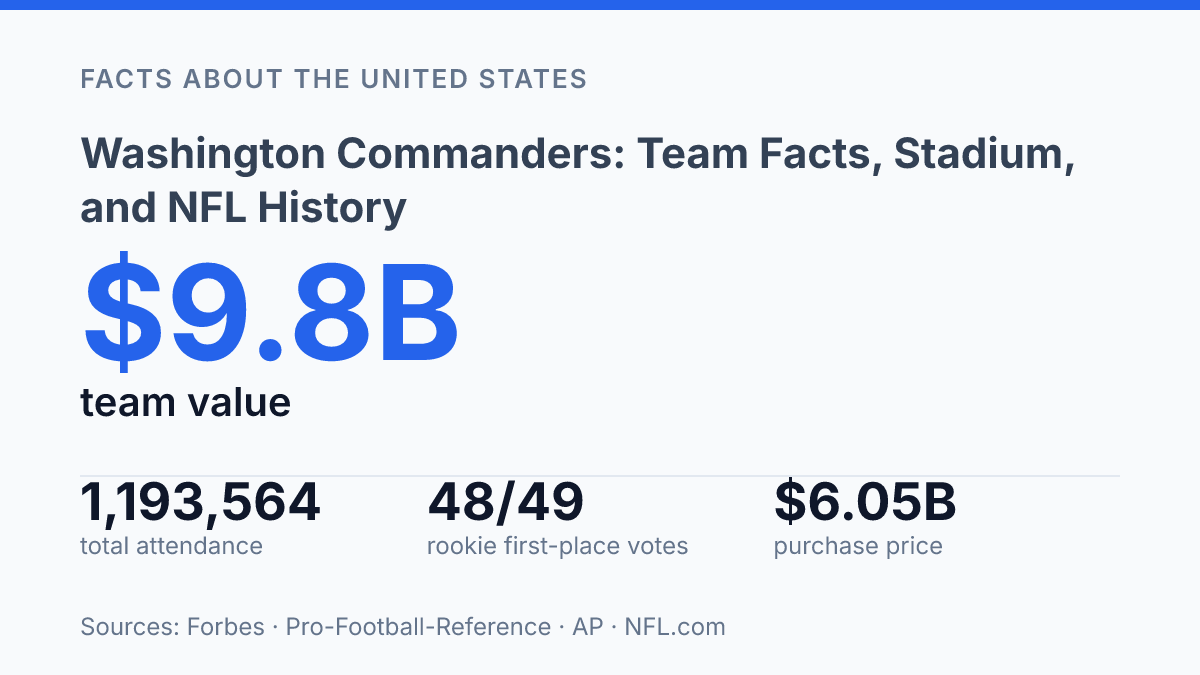
The Washington Commanders entered their 90th season under a new name on February 2, 2022, ending an 18-month rebrand and beginning one of the NFL’s most visible franchise resets. The shift did not stop with uniforms or logos: Josh Harris’s group bought the team in 2023 in a reported $6.05 billion deal, Dan Quinn arrived as head coach in 2024, and Forbes valued the club at $9.8 billion in 2026.
That combination of identity change, ownership transition, and rising valuation makes Washington a useful case study in how an NFL franchise can be redefined in a short period. The sections ahead examine the team’s present identity, Northwest Stadium, its Super Bowl-era peak, and the current roster direction shaped by quarterback Jayden Daniels.
Team overview and current identity
A 2022 rebrand and a league-record ownership transaction in 2023 mean Washington’s NFL team is now commonly discussed through a newer identity than many older records use. The franchise officially became the Washington Commanders on February 2, 2022, after an 18-month rebrand process, according to the team’s own announcement. That timing matters because references to current rosters, leadership, and league listings use the present name, while historical materials may use earlier branding without referring to a different franchise.
The team is based in the Washington, D.C. metropolitan area in Washington, D.C., United States, and competes in the National Football League as a member of the National Football Conference East division. The NFC East placement groups Washington with three long-running divisional rivals: the Dallas Cowboys, New York Giants, and Philadelphia Eagles. This divisional structure shapes the regular-season schedule and is the main competitive frame used in standings, playoff seeding, and media coverage.
Current leadership reflects the organization’s recent turnover at the top. NFL owners unanimously approved the purchase of the franchise by a group led by Josh Harris in 2023, with NFL.com reporting the agreement price at $6.05 billion.
Dan Quinn is the head coach, hired on February 3, 2024 as the 31st head coach in franchise history, according to the team’s coach biography. Together, those details define the club’s present operating identity: a Washington-market NFL team in the NFC East, under Harris ownership, with Quinn leading football operations on the field.
Northwest Stadium and home-field details
A stadium in Landover, Maryland, rather than inside the District itself, serves as the franchise’s weekly home base and helps explain why its local identity has always been metropolitan rather than city-only. Northwest Stadium hosts the team’s regular-season home games in the Washington area, placing game days within reach of fans traveling from Washington, suburban Maryland, and Northern Virginia. That geography matters because the club’s audience is not confined to one municipal boundary; its home market functions as a regional fan network tied together by proximity, media coverage, and long-standing family allegiances.
The stadium’s current name reflects a more recent commercial layer on top of that regional role. On August 27, 2024, the team announced that Commanders Field would be renamed Northwest Stadium through a multi-year naming-rights agreement with Northwest Federal Credit Union, describing it as the first NFL stadium naming-rights partnership involving a credit union. The wider identity reset was already underway when the franchise officially became the Washington Commanders on February 2, 2022, after an 18-month rebrand process and as it entered its 90th season.
Attendance gives a practical measure of the stadium’s role beyond naming and location. Pro-Football-Reference’s 2025 attendance table lists the club with 1,193,564 total attendance and 514,362 home attendance at Northwest Stadium, showing that home games remain a major gathering point even as the supporter base extends well beyond the stadium site. In that sense, the venue is less a stand-alone landmark than the physical meeting point for a fan base spread across the broader D.C. metropolitan region.
Super Bowl-era championships and franchise peak years
The franchise’s modern championship résumé is anchored almost entirely in one 10-year run, not in a steady accumulation of titles across generations. Its Super Bowl-era NFL championships came in 1983, 1988, and 1992, corresponding to victories after the 1982, 1987, and 1991 seasons. That clustering matters because it identifies the early Gibbs period as the clear high point of the club’s competitive history rather than one peak among several equal eras.
Under Joe Gibbs, Washington converted deep postseason rosters into three championships with different starting quarterbacks, a rare marker of organizational strength during that period. The 1991 team is the sharpest statistical shorthand for that peak: according to the Washington Commanders official history, it finished 17–2 and closed the season with a 37–24 win in Super Bowl XXVI on January 26, 1992. That result did more than add a third title; it confirmed that the franchise’s late-20th-century success was sustained rather than accidental.
The distribution of those championships also shapes how the team is discussed in NFL history. Many franchises with long histories have titles scattered across distant eras, but Washington’s Super Bowl-era crown years sit tightly between 1983 and 1992. The record is strong in absolute terms, yet its concentration gives the franchise a distinctive historical profile: a dominant stretch that still defines its reputation, followed by later decades measured against that standard rather than by comparable championship production.
What the franchise looks like now
Forbes’ 2026 NFL valuations placed the franchise at $9.8 billion, a figure that shows how quickly its business profile has expanded during a period of football and organizational reset. The same Forbes data listed $694 million in revenue for the 2025 season, giving the club a financial position that contrasts with the unfinished nature of its competitive rebuild. That combination helps explain the modern picture: a historically significant team operating with renewed resources, but still being judged by how effectively new leadership converts change into sustained performance.
The NFC East remains central to that evaluation because divisional games carry direct consequences for standings, tiebreakers, and public perception. Washington’s season outlook is shaped less by abstract league-wide comparisons than by how it handles familiar opponents with overlapping fan bases, media attention, and long-running rivalry stakes. In practical terms, the division provides the most immediate measuring stick for whether progress is structural or merely episodic.
Under Josh Harris, the franchise’s current era is defined by institutional reset rather than a single roster move. Dan Quinn’s role gives that reset a football framework, with coaching priorities, player development, and game management now tied to a new ownership cycle.
The emergence of quarterback Jayden Daniels has sharpened that focus; the Associated Press reported that he won Offensive Rookie of the Year after receiving 48 of 49 first-place votes, following a rookie season with 3,568 passing yards and 891 rushing yards. Those figures do not settle the team’s long-term direction, but they make the present roster conversation more concrete.
The franchise now sits at an intersection of memory and transition. Its championship history still gives the organization a substantial historical base, while the current name, ownership structure, coaching staff, stadium branding, and young offensive centerpiece all belong to a newer chapter. The result is a team whose identity is no longer only anchored in past success; it is also being defined by how the current regime performs in one of the NFL’s most scrutinized divisions.
What the reset has to prove next
Washington’s reset will be judged by whether the new structure turns short-term momentum into durable credibility. A new name, a record-setting ownership sale, and a rising valuation can change perception quickly, but sustained relevance in the NFL still depends on competitive stability, stadium experience, and a roster that can keep pace beyond one breakout season.
Jayden Daniels gives the franchise a clear football reference point, while the Northwest Stadium naming deal and attendance figures show that the business side is also being repositioned. The next meaningful measure is not another announcement; it is whether Washington can make its modern identity feel settled through repeated performance on the field.
Frequently Asked Questions
Q: Where are the Washington Commanders based?
A: The Washington Commanders are based in the Washington, D.C. metropolitan area. Their listed location is Washington, D.C., United States, which places them in the NFL’s Northeast corridor and within a large regional fan base.
Q: What stadium do the Commanders play in?
A: The team plays at Northwest Stadium. That venue serves as their home field for NFL games and is a central part of the franchise’s identity in the Washington area.
Q: Which division do the Washington Commanders belong to?
A: The Commanders compete in the NFC East. That division also shapes their regular-season schedule and rivalry structure because division games are a core part of the NFL calendar.
Q: Who is the head coach of the Washington Commanders?
A: The current head coach is Dan Quinn. His role is to lead the team’s football operations on the field, including game planning and player development.
Q: How many NFL championships have the Commanders won?
A: The Washington Commanders have won three NFL championships, in 1983, 1988, and 1992. Those titles remain the franchise’s most significant historical achievements and mark the team’s peak competitive period.