
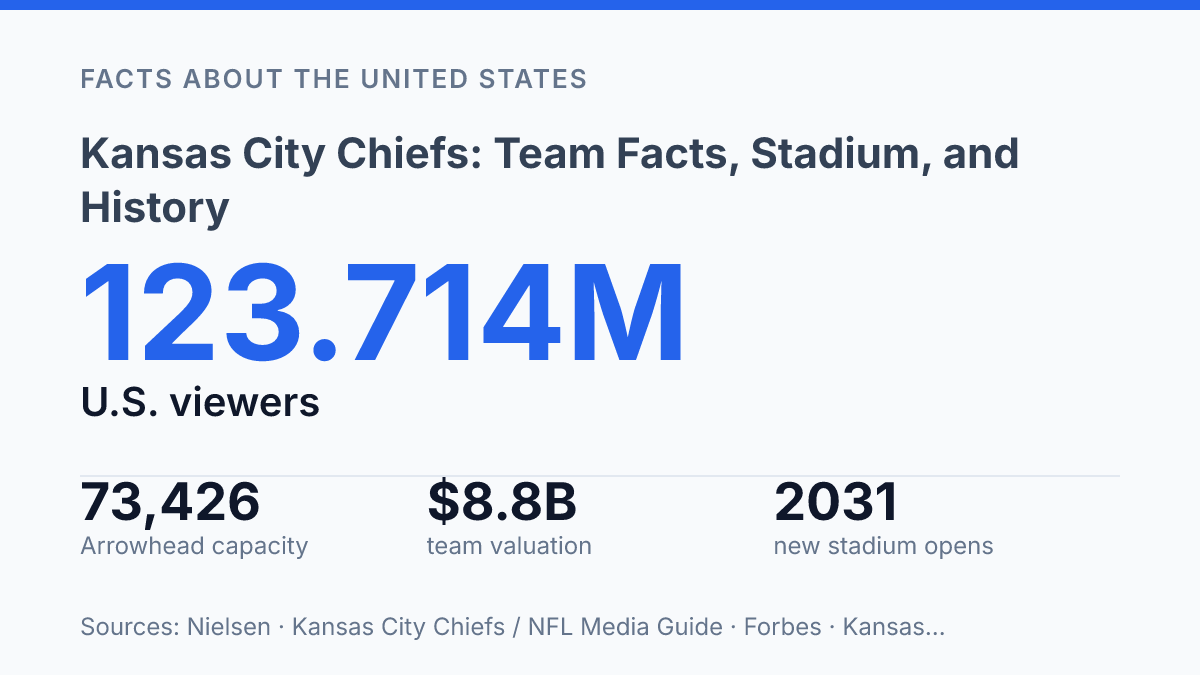
The Kansas City Chiefs entered the Nov. 2, 2026 NFL.com standings at 5–2 and second in the AFC West, while Forbes valued the Hunt family’s franchise at $8.8 billion, a pairing that shows both competitive strength and major business scale. That dual profile helps explain why the team is studied as more than a recent Super Bowl winner. Its place in the NFL is tied to league structure, ownership, media reach, and a home-field identity built around Arrowhead Stadium’s 73,426-seat capacity.
The next phase is already taking shape: a planned enclosed stadium in Kansas City, Kansas, targeted for 2031 as part of a larger $4.5 billion project. The story also includes championship cycles, brand symbols, and fan traditions that have carried the club from AFL origins to a Super Bowl LVIII broadcast watched by 123.714 million U.S. viewers.
Team identity and NFL placement
As of the Kansas City Chiefs page on NFL.com on Nov. 2, 2026, Kansas City was 5–2 and listed second in the AFC West, showing how the club’s national profile is still measured through divisional placement as well as overall record.
The team is based in Kansas City, Missouri, United States, and competes in the National Football League as part of the American Football Conference. Within that conference, it belongs to the AFC West, a division that frames its regular-season schedule, standings position, and rivalry context. Home games are associated with Arrowhead Stadium in Kansas City, but the franchise identity is broader than the venue: it is a Missouri-based NFL organization with a regional and national audience.
Ownership is centered on the Hunt family, with Clark Hunt serving as CEO and a leading public executive voice for the franchise. That family ownership is also reflected in business valuations; Forbes’ 2026 NFL valuations listed the team’s owner as the Hunt family and ranked the franchise No. 18 at $8.8 billion, with $644 million in revenue and $51 million in operating income. Those figures place the organization among major U.S. sports properties even without being one of the league’s top-valued clubs.
The club’s identity remains strongly tied to Kansas City, Missouri, yet its media footprint reaches well beyond the state. Sustained success on the field has expanded national attention, while formal NFL placement keeps the team grounded in the AFC West structure that determines weekly competitive context.
Arrowhead Stadium and the planned replacement venue
Arrowhead Stadium currently holds 73,426 spectators, a scale that places the Chiefs’ home field among the larger NFL venues and makes any replacement plan a major operational decision rather than a simple facilities upgrade. According to the Kansas City Chiefs / NFL Media Guide 2025, that capacity includes 30,884 upper-level seats, 31,972 lower-level seats, 7,790 club-level seats, and 2,780 suite or box seats. Those figures show why the stadium is both a competitive home-field asset and a complex building to replace: it is not only a playing surface, but a large event system built around seating mix, premium areas, circulation, concessions, parking, and broadcast infrastructure.
The planned New Chiefs Stadium is targeted to open in 2031 as an enclosed venue in Kansas City, Kansas, according to information released by the team in 2026. The project is described as a $3 billion stadium with approximately 70,000 seats, more than 20,000 parking spaces, and over 400,000 square feet of translucent roof panels. The capacity is projected to be slightly lower than Arrowhead’s current total, but the enclosed design points to a different priority: modern facilities, weather protection, premium hospitality, and a building capable of supporting a wider calendar of events beyond regular-season football.
The stadium plan also functions as a long-term franchise planning tool. The broader Kansas project has been projected at $4.5 billion in capital investment, including the stadium, a $300 million practice facility and headquarters, and $1.2 billion in private real estate development, according to the Chiefs and Econsult Solutions in 2026.
That scale links the venue decision to team operations, commercial development, and future revenue sources rather than seating count alone. The tradeoff is continuity: Arrowhead has defined the franchise’s home environment for decades, so a new building can modernize the business model while changing one of the most recognizable parts of the club’s identity.
Championship years and eras of success
A 50-year title gap separates the franchise’s first Super Bowl-era championship from the modern run that has redefined its national profile. The championship years are 1970, 2020, 2023, and 2024, a pattern that makes the historical arc unusually clear: one foundational breakthrough, followed by a long interval, then three titles in five calendar years. That contrast is central to understanding how the Kansas City Chiefs moved from a team with an important early-place in Super Bowl history to one associated with sustained contemporary dominance.
The 1970 championship came in Super Bowl IV, when the club defeated Minnesota and gave the American Football League a major validation point shortly before the AFL-NFL merger took full effect. That title remains more than a legacy marker because it connects the franchise to the formative years of the modern league. The next championship did not arrive until 2020, when Super Bowl LIV ended the long wait and created the bridge between the older achievement and the current era.
Recent success has been more concentrated and historically rare. According to the Kansas City Chiefs / NFL Media Guide, the club became just the second team this century to win back-to-back world championships and one of seven NFL franchises with at least four Super Bowl titles: IV, LIV, LVII, and Super Bowl LVIII. The 2023 and 2024 championships changed the scale of the achievement from a comeback story into a repeat-title era, placing the franchise among the league’s most decorated teams rather than simply among teams with a memorable peak.
The modern run has also carried a larger media footprint than the earlier championship could have produced. Nielsen reported that the Feb. 11, 2024 Super Bowl drew 123.714 million U.S. viewers, underscoring how the latest title was won on one of the largest television stages in American sports. The 1970 championship still anchors the team’s history, but the 2020, 2023, and 2024 titles are what have most strongly reshaped its contemporary reputation.
Mascots, branding, and fan culture
Few NFL mascots have been tied to one performer as closely as K. C. Wolf, whose longtime performer Dan Meers retired in 2025 after 35 years in the role. According to the Chiefs, Meers worked 375 total games, made about 10,000 appearances, visited 12 countries and 38 states, and appeared in five Super Bowl events since the 2019 season. Those figures show why the character functions as more than sideline entertainment: the mascot is a portable version of the franchise’s identity, visible at games, civic events, schools, charity appearances, and media settings where the team’s marks are instantly recognizable.
Warpaint represents an older strand of Chiefs symbolism. The horse tradition connected game-day ceremony with the team’s name, colors, and stadium rituals, especially through touchdown celebrations and field-level pageantry.
Its status has also reflected changing expectations around sports imagery and public presentation, since legacy symbols can carry strong emotional recognition while still being reassessed over time. In that sense, Warpaint illustrates how branding is not static; it is maintained, revised, or retired as the organization responds to audience expectations and cultural context.
At Arrowhead Stadium, recognition comes from repetition across multiple visual and sound cues rather than from a single logo or mascot. The red-and-gold color scheme, arrowhead mark, costumed mascot appearances, drum-led ceremonies, and coordinated crowd traditions make the venue legible even in brief television shots. These symbols help convert a large stadium event into a recognizable Chiefs setting, giving broadcasts, photographs, and in-person attendance a shared visual language.
The club’s place in Kansas City sports culture is shaped by both inherited identity and recent competitive relevance. Longstanding symbols give supporters continuity across generations, while present-day visibility broadens the audience and intensifies local identification. The result is a fan culture in which older branding elements still matter, but their meaning is reinforced whenever the team occupies the center of civic conversation, regional media coverage, and game-day routines around the city.
What the 2031 stadium shift could change
The next meaningful test for the franchise is whether continuity can survive a physical reset. Arrowhead Stadium’s scale, open-air setting, and decades of shared memory are not minor background details; they are part of how the club’s public identity is recognized. A proposed 2031 enclosed venue with about 70,000 seats, more than 20,000 parking spots, and 400,000 square feet of translucent roof panels would change the practical experience of attending games, even if the team name, colors, records, and traditions remain intact.
That makes the stadium plan more than a construction issue. It is a measure of how a modern NFL franchise converts history into a future asset without making the old symbols feel detached from the new address.
Frequently Asked Questions
Q: Where do the Kansas City Chiefs play their home games?
A: The team plays home games at Arrowhead Stadium in Kansas City, Missouri. A new Chiefs Stadium is slated to open in 2031, which would mark a major venue change for the franchise.
Q: What division do the Kansas City Chiefs compete in?
A: The Chiefs are part of the National Football League’s American Football Conference West division. That places them in the same division as other AFC West teams and shapes their regular-season schedule each year.
Q: How many NFL championships have the Kansas City Chiefs won?
A: The Chiefs have won four NFL championships: 1970, 2020, 2023, and 2024. This record reflects the team’s long history as well as its recent run of success.
Q: Who owns the Kansas City Chiefs?
A: The team is owned by the Hunt family. Clark Hunt serves as CEO, making the family central to the franchise’s long-term leadership and direction.
Q: What are the Kansas City Chiefs mascots?
A: The Chiefs’ mascots are Warpaint and K. C. Wolf. K. C. Wolf is the better-known modern mascot, while Warpaint is part of the team’s historical identity.