
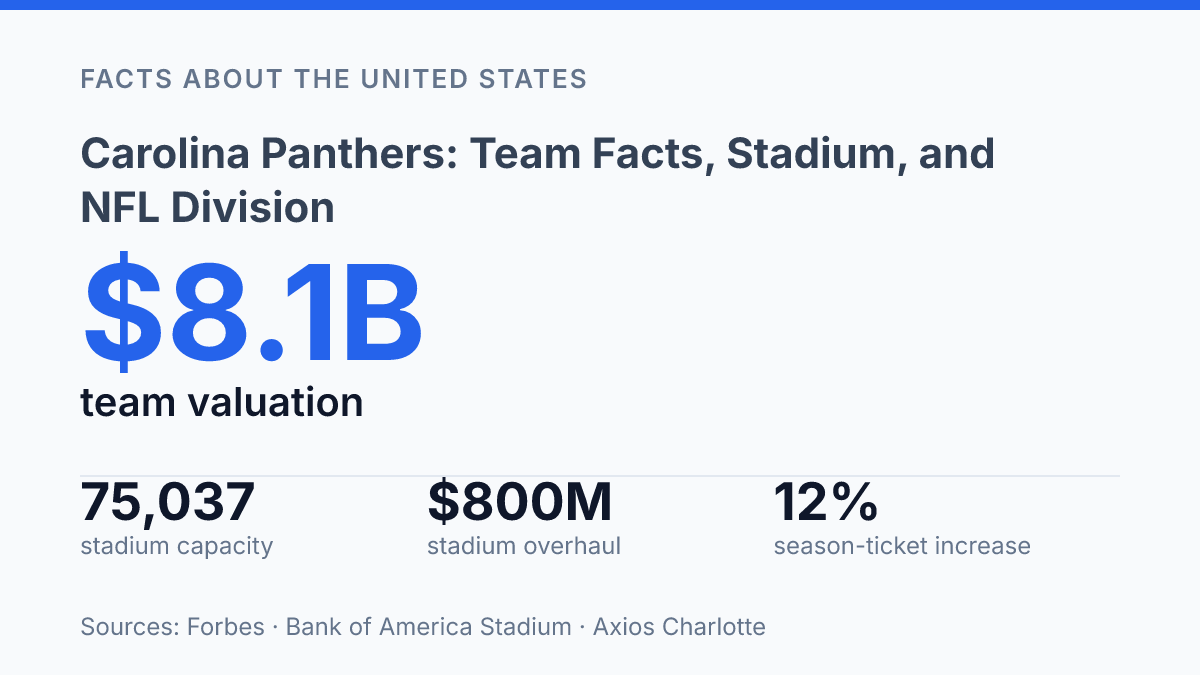
The Carolina Panthers entered NFL.com’s 2026 listing at 3–4 yet still sat 1st in the NFC South, a useful reminder that NFL standings can reveal as much about divisional context as team record. The franchise’s profile is shaped by that on-field placement, but also by a much larger Charlotte footprint: Bank of America Stadium seats 75,037, supports an estimated $1.1 billion annual metro-area economic impact, and is planned for an $800 million overhaul by 2030. Those figures help frame the team beyond scores and roster labels.
This guide explains the club’s basic identity, home base, stadium role, conference and division alignment, and mascot presence, with attention to the facts that define how the organization is positioned in the league and in North Carolina. The result is a clearer view of a 1995 expansion franchise that now functions as both an NFL team and a major local institution.
Team snapshot and home base
A Charlotte-based NFL club with a Carolinas-wide identity is unusual in a league where most franchises are tied primarily to a single metropolitan market. The Carolina Panthers are a professional American football team based in Charlotte, North Carolina, United States, but the team’s branding reflects a wider regional connection that reaches into parts of both North Carolina and South Carolina.
Within the league structure, the franchise competes in the National Football League as part of the National Football Conference. That placement situates the team inside one of the NFL’s two conferences, which matters because conference alignment determines regular-season scheduling patterns, playoff qualification routes, and the championship path to the Super Bowl.
The franchise dates to 1995, according to NFL.com, making it one of the NFL’s younger teams compared with clubs whose roots extend back to the early or mid-20th century. NFL.com also listed Dave Canales as head coach and David Tepper as owner in its 2026 team profile, details that help frame the current organizational snapshot without turning the section into a season history.
The team’s scale is also visible in business terms. Forbes ranked the Panthers No. 26 in its 2026 NFL valuations, estimating the franchise at $8.1 billion. That figure reflects the financial size of modern NFL franchises and reinforces the team’s position as a major professional sports organization anchored in Charlotte while serving a broader Carolinas audience.
Home field at Bank of America Stadium
A 75,000-seat NFL venue in central Charlotte gives the Panthers a home field that is physically tied to the city’s business and entertainment core rather than separated from it by a suburban campus. Bank of America Stadium is the team’s home stadium and is located in Charlotte, North Carolina, making it one of the most visible sports landmarks associated with the franchise.
The venue’s scale helps explain its prominence in the southeastern United States. Bank of America Stadium lists a seating capacity of 75,037, a size that places regular-season home games among the largest recurring sports gatherings in the region. NFL.com lists the team as 1st in the NFC South at 3–4, with Bank of America Stadium as its home field, alongside Dave Canales as head coach, David Tepper as owner, and 1995 as the franchise establishment year.
Its downtown setting strengthens the club’s Charlotte identity because home games occur close to hotels, restaurants, offices, transit points, and other civic gathering spaces. That location also makes the stadium more than a game-day backdrop: the venue reports an estimated $1.1 billion annual economic impact for the Charlotte metro area and has expanded from roughly 12 football-focused events per year to close to 40 ticketed events annually.
The same setting creates practical dependencies. Attendance, transportation patterns, local event scheduling, and late-season weather all shape the matchday experience at an open-air stadium. Planned investment reinforces the venue’s long-term importance, with the stadium agreement keeping the Panthers and Charlotte FC in the city through 2045.
Division and conference placement
NFL.com listed the Panthers first in the NFC South at 3–4 in 2026, a useful example of how division placement can matter as much as overall record. The club belongs to the National Football Conference, and its divisional grouping places it alongside three recurring rivals: the Atlanta Falcons, New Orleans Saints, and Tampa Bay Buccaneers. That structure gives the regular season a fixed competitive core rather than a schedule made entirely from rotating opponents.
Divisional alignment shapes the calendar because NFL teams face each division opponent twice, once in each venue. For the Panthers, that means six regular-season games every year are reserved for Atlanta, New Orleans, and Tampa Bay. These matchups carry extra weight because they influence both the standings inside the division and the tiebreaking context that can decide playoff seeding or qualification when records are close.
Conference placement also determines the broader postseason route. The NFC South champion qualifies through the conference playoff bracket, while non-division winners must compete for wild-card places against teams from the other NFC divisions.
A weaker year across the division can make a modest record more competitive for first place, but a strong division year can create the opposite effect, leaving even a capable team with a harder path into January football. This is why divisional performance is not just a rivalry issue; it is one of the main structural forces behind the Panthers’ schedule, standings position, and playoff outlook.
Mascot and team identity
A 30-minute school program built around a mascot shows that the franchise’s identity work extends beyond sideline entertainment. Sir Purr is the Panthers’ official mascot, and the character gives the club a recognizable, approachable expression of its panther-based name and visual branding. The team’s broader identity is anchored in the panther image, which supports a consistent public profile across logos, in-stadium presentation, media appearances, and community-facing activity.
On game days, the mascot functions as part of the club’s presentation rather than as a sporting factor. Costumed mascots help animate breaks in play, engage younger fans, and give the franchise a visible personality that is easier to recognize than a roster that changes from season to season. That visibility can strengthen family appeal and brand recall, but it does not affect scheme, player development, or results on the field.
The mascot’s community role is more structured than occasional appearances. According to the team’s official Sir Purr page, the “SACK THE TEST” school program is designed for students in grades 3–5 and is available in April and May.
The same page says appearance requests should be made at least 30 days in advance, which indicates that mascot activity is managed as part of the club’s organized outreach calendar. In that sense, Sir Purr operates as a brand ambassador: useful for recognition, education-focused programming, and public engagement, while remaining separate from the competitive side of the franchise.
Why the stadium plan matters beyond Sundays
The next Panthers chapter will be shaped as much by infrastructure as by division tables. An $800 million stadium plan through 2030, a commitment tying the team and Charlotte FC to the city through 2045, and rising 2026 season-ticket prices all point to a franchise being built for a larger event calendar, not only eight or nine regular-season home games.
That creates a practical tension for Charlotte: the same venue upgrades that can protect NFL status and attract more events also raise questions about access, public funding, and the cost of attendance. The clearest marker to watch is not only the scoreboard on Sundays, but how Bank of America Stadium changes its role in the city once the renovation phases begin.
Frequently Asked Questions
Q: What city are the Carolina Panthers based in?
A: The Carolina Panthers are based in Charlotte, North Carolina, in the United States. Charlotte has served as the team’s home city since the franchise joined the NFL, making it the center of the club’s operations and fan base.
Q: Which NFL division do the Carolina Panthers play in?
A: The Panthers compete in the NFC South. That places them in the National Football Conference and against other division rivals from the same regional group during the regular season.
Q: What stadium do the Carolina Panthers use for home games?
A: The team plays home games at Bank of America Stadium in Charlotte. The venue is the Panthers’ primary home field and is one of the city’s major sports facilities.
Q: Are the Carolina Panthers part of the NFC or AFC?
A: The Carolina Panthers are in the National Football Conference. Their conference alignment matters because it determines their division structure, playoff path, and most regular-season opponents.
Q: What is the Carolina Panthers’ mascot?
A: The Panthers’ mascot is Sir Purr. He is the team’s long-running mascot and appears at home games and team-related events.