
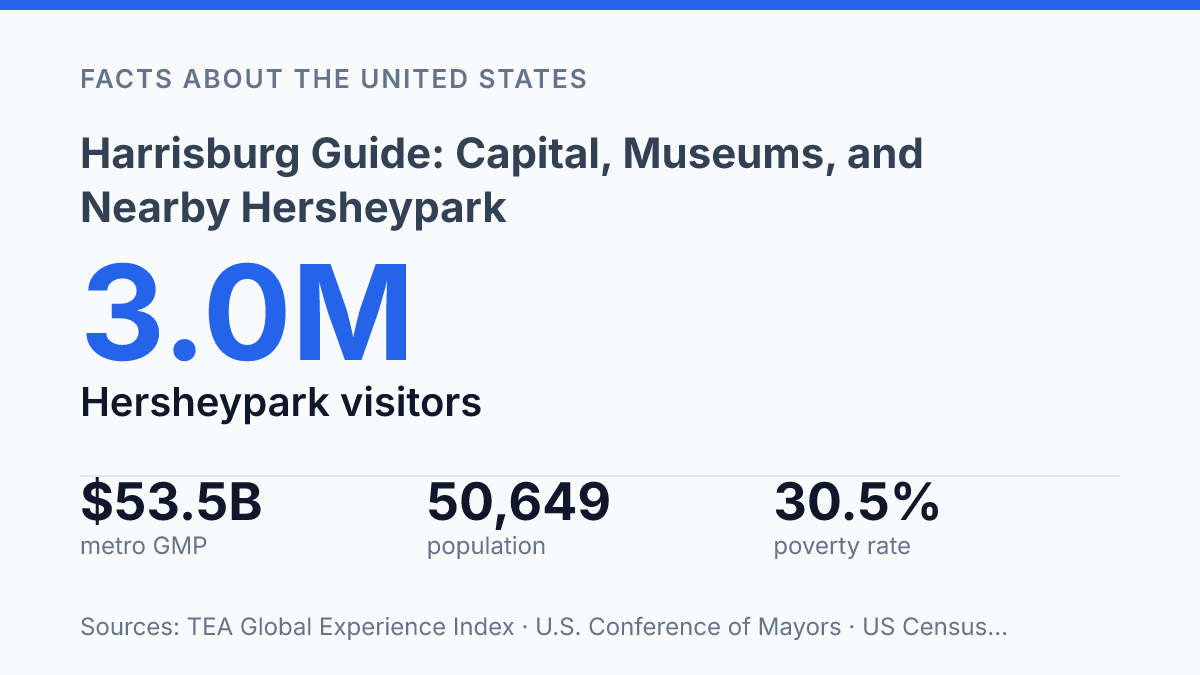
Harrisburg anchors a $53.5 billion metro economy while fitting 50,649 residents into just 8.12 square miles, a contrast that explains much of its role in Pennsylvania. The city is both a seat of government and a compact urban center shaped by everyday commuting, modest household incomes, and a poverty rate above 30 percent. That practical context matters when assessing its visitor appeal: the capital is not a resort town, but a working city with institutions that interpret state and national history at unusual depth.
The National Civil War Museum offers a substantial self-guided visit in Reservoir Park, the State Museum of Pennsylvania is tied to one of the commonwealth’s largest public collections, and Hersheypark adds a major day-trip option east of the city. Together, they show how a small capital can carry regional, historical, and recreational weight.
Why Harrisburg matters in Pennsylvania
A city of just 50,649 people carries Pennsylvania’s statewide seat of government from an 8.12-square-mile footprint on the Susquehanna River. The U.S. Census Bureau’s 2024 population estimate underscores the contrast that defines Harrisburg: it is compact in scale but central to how Pennsylvania is governed. Its status as the state capital places it in a different category from larger Pennsylvania cities whose identities are more strongly tied to population size, universities, corporate headquarters, or major-league tourism.
The Susquehanna River is more than a scenic boundary in this civic geography. It frames the city’s western edge, gives the capital a clear physical setting, and helps explain why the downtown government district feels closely connected to bridges, riverfront routes, and views across to the West Shore. This river setting makes the capital legible to visitors: the core institutions are not scattered across a vast urban area but concentrated within a relatively small city beside one of the major waterways of the eastern United States.
The Pennsylvania State Capitol building anchors that role in practical and symbolic terms. As the seat of state government, it makes the city the place where statewide legislative work, public administration, and official civic ceremonies converge. That political function gives the capital a level of relevance that is not dependent on the volume of leisure travel it receives.
Economic data adds a wider regional context to the city’s political importance. The Harrisburg-Carlisle metro area ranked 84th among U.S. metropolitan areas in 2024 gross metropolitan product, at $53.5 billion, with a forecast of $59.1 billion by 2026, according to the U.S. Conference of Mayors, Metro Economies Annual Report and Forecast. That figure helps explain why the capital functions not only as a government center, but also as the hub of a broader Central Pennsylvania economy whose scale exceeds the city’s modest footprint.
What the National Civil War Museum shows
Nearly 850 artifacts give the museum its weight, but its more distinctive feature is the decision to interpret the war through both Union and Confederate material culture. The National Civil War Museum presents uniforms, weapons, documents, personal objects, and gallery narratives as evidence of how soldiers, civilians, political leaders, and enslaved people experienced the conflict. That structure makes the museum more than a collection of military objects; it frames the Civil War as a national crisis shaped by politics, slavery, battlefield strategy, home-front hardship, and memory.
According to the museum’s 2026 visitor information, the site contains more than 25,000 square feet of exhibition space and recommends 2 to 4 hours for a self-guided visit. That time estimate is useful because the exhibits are designed for close reading rather than a quick pass through display cases. Interactive exhibits help visitors connect chronology with individual experience, while re-enactments and live interpretation add a human scale to uniforms, camp life, military drills, and wartime decision-making.
The dual-perspective approach is the museum’s central interpretive choice, and it can broaden understanding when handled with clear context. Showing Union and Confederate viewpoints side by side can clarify why different groups believed they were fighting, how military and political aims changed, and how ordinary people were drawn into a conflict larger than themselves.
The method also requires care, because presenting opposing perspectives without explaining power, slavery, and secession risks flattening the causes and consequences of the war. The strongest reading of the museum is therefore not that it treats both causes as equivalent, but that it uses both sides’ records to examine how the conflict was argued, fought, endured, and later remembered.
The museum has occupied a city-owned, 66,000-square-foot building in Reservoir Park since opening in 2001, and its own visitor materials report more than 1 million visitors from all 50 states. That reach helps explain why it remains one of the area’s key cultural stops: it offers enough scale for a substantial visit while keeping the focus on interpretation rather than spectacle.
Inside the State Museum of Pennsylvania
Few museum stops in the capital compress geology, paleontology, archaeology, art, industry, and public memory into the same Capitol-adjacent visit. The State Museum of Pennsylvania sits next to the Pennsylvania State Capitol, which makes it a logical companion to the formal government buildings nearby: one site shows where state power is exercised, while the museum explains the deeper environmental, cultural, and economic forces that shaped the Commonwealth.
Its broad interpretive range is the main reason the museum adds useful context to a city visit. Exhibits and collections connect Pennsylvania’s natural heritage, including geology, paleontology, and natural history, with cultural heritage such as archaeology, art, and everyday material life.
Industrial heritage is part of that same story, since mining, manufacturing, transportation, and labor history help explain how the state developed beyond its political institutions. According to the Pennsylvania Historical & Museum Commission’s 2022–23 annual report, the commission maintains more than 12 million artifacts across art, history, archaeology, geology, paleontology, and natural history, with nearly 160,000 square feet of exhibit space across its system.
That breadth gives the museum a different purpose from a single-subject attraction. A focused institution can carry visitors through one topic in depth, while this museum works more like a statewide reference point, linking land, people, work, and public life across long time periods. The tradeoff is that the experience may feel less concentrated, but it is especially useful for understanding why the capital region is more than a seat of government.
Practical planning should account for a major change in access. PHMC announced on August 3, 2026 that the museum had closed temporarily from August 2 for a $79.73 million multi-year renovation, with plans for new collections storage, a fifth-floor event space, and an observation level on the 16th floor of the PHMC Tower. That project underscores the scale of the institution and its collections, while also making current hours and reopening information essential before building an itinerary around the site.
Day trip to Hersheypark east of the city
Hersheypark drew 3.0 million visitors in 2024, ranking No. 20 among North American amusement and theme parks in the TEA Global Experience Index. That scale helps explain why the park broadens the region’s visitor appeal: it adds a high-volume leisure destination to an itinerary otherwise shaped by government, history, and museums. Its attendance was unchanged from 2023, according to the same report, suggesting a steady draw rather than a one-season spike.
The park sits east of Harrisburg in Hershey, making it a nearby day-trip option rather than a downtown attraction. That distinction matters for planning and for understanding the area’s tourism geography. The capital city supplies civic and cultural stops, while Hershey adds a separate resort-town attraction built around rides, shows, seasonal programming, and a chocolate identity associated with the Hershey name.
Rides are the main reason many families make the trip, and recent additions show the park continuing to invest in thrill attractions. Hersheypark opened Twizzlers Twisted Gravity on May 24, 2025, describing it as a 137-foot Screamin’ Swing reaching 68 mph during a 70-second ride cycle. The candy-branded name fits the larger chocolate-and-confectionery theme, where amusement-park experiences are packaged with recognizable sweets and family entertainment.
Entertainment gives the destination a broader role than a coaster stop alone. Live performances, character-style experiences, and seasonal events help spread visits across age groups, while the chocolate theme provides a unifying identity for food, merchandise, signage, and attraction branding. For the wider capital-region trip, the practical result is a clear contrast: museum-heavy days can be paired with a full amusement-park day without treating Hershey as part of the city itself.
What the capital’s next investment changes
A $79.73 million State Museum renovation signals that the capital’s visitor story is still being revised, not merely preserved. Temporary closures can complicate planning, but they also point to a larger public investment in collections, storage, event space, and views from the PHMC Tower.
That matters because the city’s strongest appeal depends on proximity: government buildings, museum collections, Civil War interpretation, and a major amusement park all sit within a short regional orbit. As redevelopment and institutional upgrades continue, the practical question is less whether the city can compete with larger destinations and more how well it connects its compact center to the broader places that already draw millions nearby.
Frequently Asked Questions
Q: What is Harrisburg best known for?
A: Harrisburg is best known as the state capital of Pennsylvania and for its location on the Susquehanna River. Its civic role gives the city an important government presence, while its riverfront setting adds geographic significance. The city is also associated with nearby cultural attractions and family destinations.
Q: What can visitors see at the National Civil War Museum in Harrisburg?
A: The National Civil War Museum presents both sides of the conflict through interactive exhibits and re-enactments. That approach gives visitors a broader historical perspective rather than a one-sided interpretation. It is one of the city’s most prominent history-focused attractions.
Q: Is the State Museum of Pennsylvania worth visiting?
A: The State Museum of Pennsylvania highlights the area’s natural, cultural, and industrial heritage. Its location next to the Capitol building makes it easy to pair with other central Harrisburg sights. The museum is especially useful for visitors interested in how the region developed over time.
Q: How far is Hersheypark from Harrisburg?
A: Hersheypark is east of Harrisburg, making it a nearby day-trip destination. The park is chocolate-themed and combines rides with entertainment, which broadens its appeal beyond younger visitors. Its proximity allows travelers to combine a city visit with a theme park experience.
Q: What is the best way to spend a day in Harrisburg?
A: A practical day plan usually combines the Capitol area, the State Museum of Pennsylvania, and a riverfront stop if time allows. History-focused visitors may also include the National Civil War Museum. If a family outing is the priority, Hersheypark can anchor a separate day east of the city.