
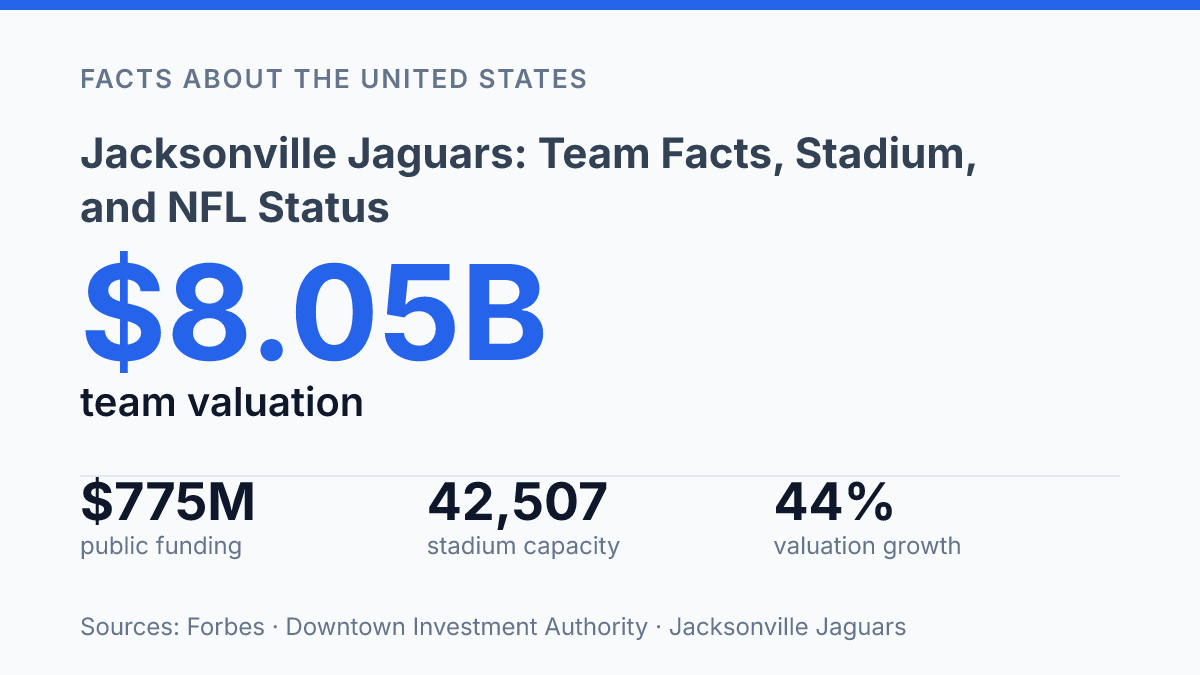
The Jacksonville Jaguars enter 2026 as an $8.05 billion franchise, a 44% year-over-year increase in Forbes’ estimate, while preparing to play in a sharply reduced 42,507-seat EverBank Stadium during reconstruction. That contrast captures the club’s current position: still one of the NFL’s smaller-market teams by ranking, but tied to one of Jacksonville’s largest civic investments and a widening media profile.
The franchise dates only to the NFL’s November 30, 1993 expansion approval, yet its timeline already includes AFC South titles in 2017, 2022, and 2025, a new coaching era under Liam Coen, and business continuity through Mark Lamping’s extension into 2030. The facts behind the team now stretch beyond wins and losses, linking NFL affiliation, leadership, stadium planning, local economics, and international exposure through London games.
Team overview and NFL affiliation
The NFL granted Jacksonville its franchise on November 30, 1993, and the club began play in 1995; the Pro Football Hall of Fame also lists AFC South titles in 2017, 2022 and 2025 and an all-time record of 215-286-0 entering the 2026 season. That short timeline makes the franchise one of the league’s more recent additions while still placing it firmly within the modern NFL structure.
The Jacksonville Jaguars are a professional American football team based in Jacksonville, Florida, United States. Their league membership is national rather than regional: the club competes in the National Football League as part of the American Football Conference’s South division, commonly referred to as the AFC South.
Jacksonville is not only the team’s home city but also the franchise identity used in the supplied source context. That distinction matters because NFL teams often represent a local market while operating within a league that schedules, markets, and governs competition nationally. In this case, the club’s listed base remains Jacksonville, and its competitive placement is defined by the AFC South rather than by geography alone.
Who leads the franchise today?
Jacksonville’s football operation entered a new coaching cycle on January 24, 2025, when the team named Liam Coen head coach, according to the club’s official announcement. The team’s coaching page later described Coen as entering his second season with the organization in 2026, which places him at the center of the current on-field leadership structure without requiring assumptions about scheme, roster control, or long-term results.
Shahid Khan remains the owner, giving the franchise a clear line between ownership authority and day-to-day football leadership. That distinction matters because NFL clubs are public-facing entertainment businesses as well as competitive sports organizations: the owner sets the broader institutional direction, while the head coach is the most visible football decision-maker during the season. President Mark Lamping also forms part of the current executive picture on the business side, with the team announcing a contract extension that keeps him in charge of business operations through the 2030 NFL season.
The club’s public identity is not limited to executives and coaches. Jaxson de Ville, the Jaguars’ mascot, remains one of the most recognizable parts of the team’s branding, appearing in the space where football operations, fan entertainment, and local recognition overlap.
This separates the franchise’s stable outward identity from the normal turnover that can occur in coaching and executive roles. In practical terms, the names attached to leadership may change over time, but the symbols associated with the team continue to give fans, broadcasters, and sponsors a consistent reference point.
Home venue and game-day setting
A franchise can change coaches, rosters, and schedules, but its clearest fixed address is the place printed on every home ticket: EverBank Stadium. The Jaguars play their home games at the stadium, which is located in Jacksonville, Florida, making it the team’s primary physical anchor in the city rather than just a neutral event site.
That role matters because an NFL stadium concentrates several parts of a franchise’s public identity in one place. It is where local fans see the team most directly, where broadcast crews frame the home setting, and where the organization’s branding becomes part of a recurring civic routine on game days. For the Jaguars, EverBank Stadium connects the club’s national NFL presence with a specific local address.
The venue should be understood first as the team’s home field, not as a collection of architectural claims or seating figures. Stadium details can change over time, but the central fact remains stable for this purpose: home games in Jacksonville are associated with EverBank Stadium. That makes the site both a sporting venue and a civic marker, linking the club’s schedule, fan attendance, and local visibility to one recognizable location.
Why the Jaguars matter in NFL coverage
A quick reference to the Jaguars works only when three identifiers stay connected: Jacksonville, the AFC South, and EverBank Stadium. The Jacksonville Jaguars are a professional American football team, and their core profile is defined less by a single headline than by the combination of league affiliation, divisional placement, and home-field identity.
That combination is what makes the franchise straightforward to classify in NFL coverage. The team is based in Jacksonville, competes in the AFC South, and uses EverBank Stadium as its home venue, giving basic references a clear geographic, competitive, and venue framework. Those facts are especially useful in informational coverage because they identify the club without moving into predictions, fan arguments, or evaluation of results.
The team’s relevance in a reference context is therefore practical rather than exaggerated. For readers checking basic NFL information, the Jaguars represent Jacksonville’s professional football franchise, an AFC South member, and a club tied to a named home stadium in its city. Keeping those details together gives the franchise a precise place in professional football coverage while staying within the verified profile rather than overstating broader competitive significance.
What the 2028 stadium could change
The next stage of the franchise will be measured less by a single season than by whether its football operation, stadium plan, and market strategy begin to reinforce one another. A rebuilt venue scheduled for August 2028, with 63,000-plus seats and room to expand above 70,000 for major events, gives Jacksonville a larger platform than its traditional market size suggests.
The reduced-capacity seasons before then create a practical test of demand, pricing, and fan continuity. If the organization converts that transition into stronger local support and sustained national relevance, the team’s status in NFL coverage will rest on more than novelty, expansion history, or London exposure.
Frequently Asked Questions
Q: Where are the Jacksonville Jaguars based?
A: The Jaguars are based in Jacksonville, Florida, in the United States. That location places them among the NFL’s southeastern-market teams and gives the club its city identity.
Q: What NFL division do the Jacksonville Jaguars play in?
A: The Jaguars compete in the AFC South. That division alignment determines their regular divisional opponents and shapes a large part of their annual schedule.
Q: What stadium do the Jacksonville Jaguars use for home games?
A: The team plays its home games at EverBank Stadium. The venue is the Jaguars’ primary home field and the site for all regular home matchups.
Q: Who owns the Jacksonville Jaguars?
A: The Jaguars are owned by Shahid Khan. Ownership influences the club’s long-term direction, including football operations, facilities, and organizational strategy.
Q: Who is the Jaguars’ current head coach and mascot?
A: The current head coach is Liam Coen, and the team’s mascot is Jaxson de Ville. Those details identify the current football leadership and one of the franchise’s most visible public symbols.