
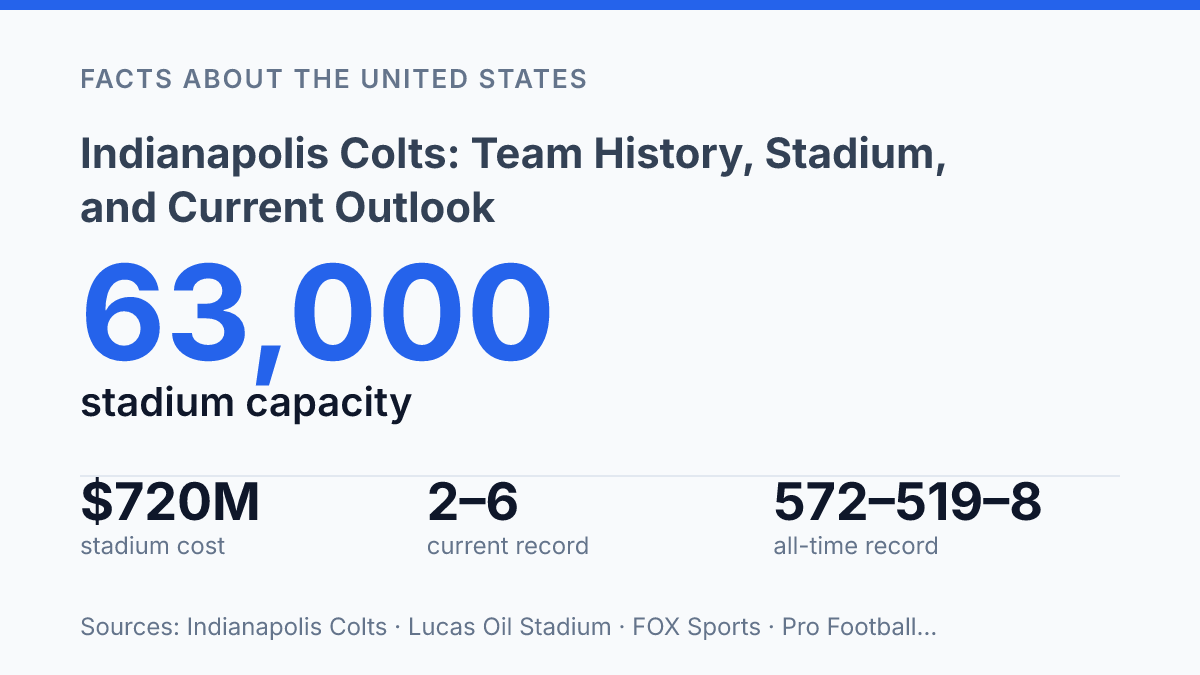
The Indianapolis Colts enter 2026 at 2–6, third in the AFC South, with a -61 point differential and a general manager search already underway after Chris Ballard’s dismissal. That current record is only one layer of a franchise profile shaped by relocation, ownership continuity, and a home venue built for modern NFL economics. The club’s official timeline runs from the Baltimore Colts era of 1953–1983 to Indianapolis from 1984 onward, with Robert Irsay’s March 28, 1984 move still defining how the team’s history is organized.
Its present setting is just as concrete: Lucas Oil Stadium opened in 2008 as a $720 million venue with a retractable roof and 63,000-seat football capacity. The sections ahead connect the standings, the franchise timeline, the stadium, and the current leadership structure to explain where the Colts stand now and why the next phase carries unusual pressure.
How the Colts fit into the AFC South
Six of the Colts’ 17 regular-season games are fixed before any rotation is considered: home-and-away meetings with the same three division opponents every year. The Indianapolis Colts are based in Indianapolis, Indiana, United States, and compete in the National Football League as a member of the AFC South, one of four divisions in the American Football Conference. That placement defines a large share of the team’s schedule and creates direct annual comparison points with the Houston Texans, Jacksonville Jaguars, and Tennessee Titans.
The divisional format matters because it turns rivalry games into standings leverage. A win over Houston, Jacksonville, or Tennessee does more than improve the Colts’ record; it also denies a direct competitor the same result inside the division table. Across a 17-game NFL season, those six AFC South games can heavily influence tiebreakers, playoff seeding, and whether a team remains in the race even when its overall record is uneven.
As of the current 2026 standings, FOX Sports lists the Colts third in the AFC South at 2–6, with 161 points scored, 222 allowed, and a minus-61 point differential, while Jacksonville leads the division at 5–2. That gap shows the practical consequence of division structure: Indianapolis is not only measured against the league at large, but also against a smaller group of opponents it sees repeatedly.
This structure can make recent records less straightforward than they appear in a balanced schedule. A team’s position may reflect injuries, timing, and repeated matchups against familiar opponents as much as general strength. For the Colts, the AFC South is therefore both a competitive neighborhood and the most immediate route back into playoff relevance.
From Baltimore to Indianapolis: the franchise timeline
A franchise that left Baltimore in 1984 still counts a 1971 Baltimore title and a 2007 Indianapolis-era title in the same historical ledger. The Pro Football Hall of Fame classifies the club’s timeline as Baltimore Colts from 1953 through 1983 and as the Indianapolis franchise from 1984 onward; the same Hall of Fame entry listed the club’s all-time record at the start of 2026 as 572–519–8. That continuity is central to how NFL franchise history is recorded, even though the team’s civic identity changed sharply after relocation.
According to the club’s 2025 media guide, professional football arrived in Indianapolis on March 28, 1984, when owner Robert Irsay moved the franchise from Baltimore. The move is often remembered as a single overnight event, but historically it marks a broader transition from a long-established Baltimore era into a new market, new fan base, and eventually a new competitive identity. The official record traveled with the franchise, while local memory remained divided between the city that lost the team and the city that inherited it.
The earlier championship came in Super Bowl V, played in January 1971, when the Baltimore Colts defeated the Dallas Cowboys 16–13. The later title came in Super Bowl XLI in February 2007, when the Indianapolis-era team beat the Chicago Bears 29–17 behind quarterback Peyton Manning, who was named the game’s Most Valuable Player, and head coach Tony Dungy. That 2007 championship became the defining achievement of the Manning-Dungy period, when the club moved from relocation-era uncertainty into one of the NFL’s most recognizable offensive identities.
Comparing the 1971 and 2007 championships requires some care because they belong to different competitive and cultural settings. The first title was tied to the Baltimore version of the franchise and an earlier NFL structure; the second reflected a mature Indianapolis period shaped by modern passing offense, salary-cap roster construction, and national television visibility. Together, they show why the club’s history is continuous on paper but not simple in memory.
Lucas Oil Stadium and the team’s home setup
A roof panel of 176,400 square feet can be opened or closed in about 9 to 11 minutes, making the Colts’ home field one of the NFL venues where weather can be partly managed rather than simply endured. Since the 2008 season, the Colts have played at Lucas Oil Stadium, their home venue in downtown Indianapolis. According to the team’s 2025 media guide, the building seats 63,000 and spans 1.8 million square feet across seven levels, giving the franchise a large but enclosed home environment built for both football and year-round public use.
The stadium’s scale is tied closely to the way the club presents its home identity. Its retractable roof and large windowed end give games a different feel from fully enclosed domes, while still reducing the uncertainty that affects open-air stadiums in colder or wetter markets. That balance matters operationally: controlled conditions support broadcast planning, crowd comfort, and event scheduling, while the option to open the roof can preserve some connection to outdoor football when weather allows.
The venue also reflects the economics of modern NFL facilities. Lucas Oil Stadium officially opened on August 16, 2008, at an approximate cost of $720 million, and its naming-rights agreement was valued at $122 million over 20 years, according to Lucas Oil Stadium’s own public information. Beyond Colts home games, the downtown site has functioned as a major-event venue, which helps explain why the building was designed with extensive suites, concession points, and flexible indoor infrastructure rather than as a football-only structure.
Who runs the Colts now
A family ownership transition and an open general manager search now frame the club’s decision-making more than any single coaching hire. According to the team’s announcement on June 9, 2025, Carlie Irsay-Gordon became Owner & CEO and principal owner after Jim Irsay’s death, with Casey Foyt serving as Owner & Executive Vice President and Kalen Jackson as Owner & Chief Brand Officer. That structure keeps control within the Irsay family while assigning clearer executive titles across ownership, operations, and brand leadership.
The football staff is led by head coach Shane Steichen, who remains the central figure on the sideline and in week-to-week team preparation. The broader football operation, however, has been in transition since the organization announced on October 19, 2026, that it had relieved general manager Chris Ballard of his duties and would conduct a search for his replacement. A change at general manager can affect roster-building philosophy, draft priorities, and the alignment between coaching preferences and personnel decisions, though its practical effect is usually clearer across multiple seasons rather than immediately.
Blue is the team’s official mascot and one of the club’s most visible public-facing symbols. The character functions less as a football-operations figure than as a brand and community presence, appearing in fan engagement settings and helping make the organization recognizable beyond helmets, uniforms, and game results. In that sense, the current identity of the club is shaped by three layers at once: ownership setting direction, football leadership managing performance, and Blue carrying a consistent public image for families and casual fans.
What the next Colts reset will test
The next phase is less about a single roster fix than about alignment between ownership, football operations, and expectations. Carlie Irsay-Gordon’s elevation to Owner & CEO in 2025 kept control within a family structure that had already been involved for years, but the 2026 general manager search creates a more visible decision point. The standings make the urgency clear, while the 2025 collapse shows that point differential alone cannot define organizational health.
A franchise with a 572–519–8 all-time record entering 2026 is not starting from institutional obscurity; it is trying to convert continuity into better choices. The practical consequence is measurable: the next hire will be judged not by biography, but by whether the AFC South gap begins to close.
Frequently Asked Questions
Q: Who owns the Indianapolis Colts now?
A: The team is owned by Carlie Irsay-Gordon. She is part of the Irsay family ownership group that has long controlled the franchise. Current ownership matters because it shapes the club’s long-term direction and administrative continuity.
Q: Where do the Indianapolis Colts play home games?
A: The Colts play at Lucas Oil Stadium in Indianapolis. The team has used the stadium since the 2008 season, giving it a long established home base. The venue is central to the franchise’s identity and game-day operations.
Q: What division do the Colts compete in?
A: The Colts are in the AFC South of the National Football League. That places them against division opponents with whom they share a regular schedule each season. Division alignment is important because it affects playoff paths and tiebreakers.
Q: How many NFL championships have the Colts won?
A: The Colts have won 2 NFL championships, in 1971 and 2007. Those titles mark the franchise’s most significant achievements to date. They also frame the team’s historical standing within the league.
Q: Who is the current head coach of the Colts?
A: The current head coach is Shane Steichen. Coaching changes can influence offensive identity, player development, and short-term results. His role is especially important as the team evaluates its competitive outlook in the AFC South.