
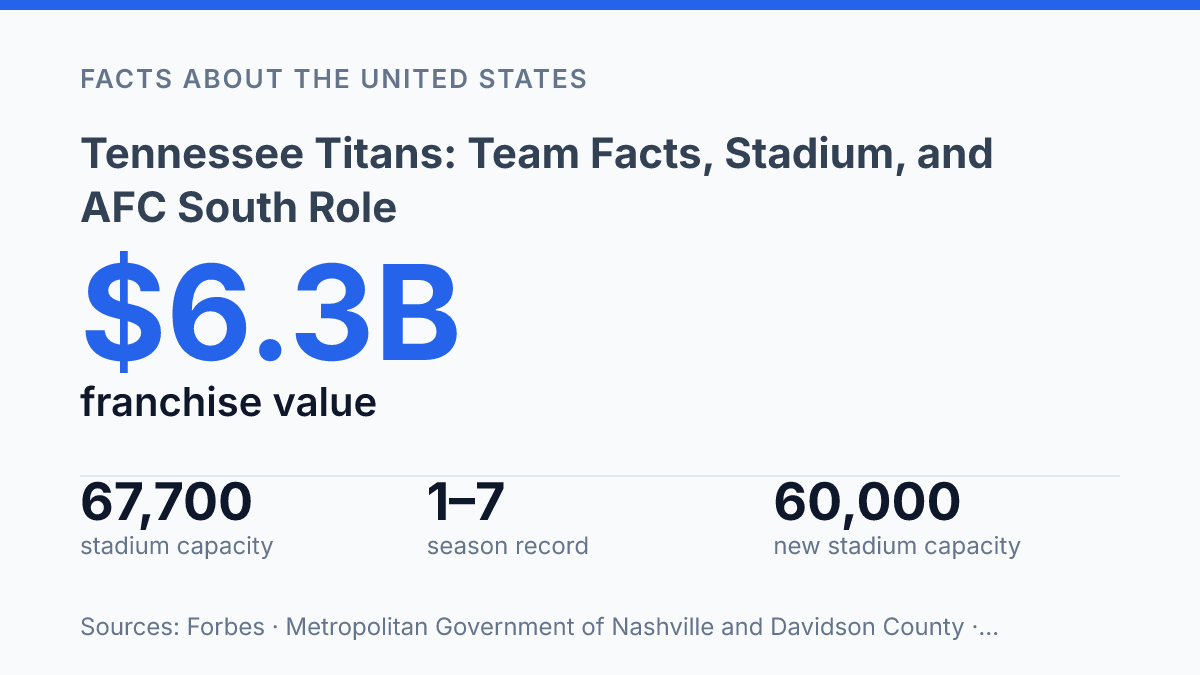
The Tennessee Titans enter November 2026 with one of the NFL’s starkest current profiles: 1–7, fourth in the AFC South, a .125 winning percentage, and no home wins through four games in Nashville. That record sits beside a wider period of organizational change, including Robert Saleh’s January 2026 hiring as the franchise’s 22nd head coach, a planned 2027 stadium east of the current Nissan Stadium, and a uniform and logo redesign tied more directly to Nashville and Tennessee imagery. The result is a team profile that cannot be read only through the standings.
League placement, venue plans, ownership structure, football-operations authority, and public identity all shape how the franchise is understood by fans, media, and researchers. This article places those facts in context, separating stable reference points from developments that are still reshaping the club’s AFC South role.
Team snapshot and league placement
As of November 2, 2026, the Titans sit 4th in the AFC South at 1–7, with a .125 winning percentage, 144 points scored, 199 allowed, and an 0–4 home record, according to FOX Sports. That current placement gives the team snapshot a competitive reference point rather than only an administrative label.
The Tennessee Titans are a professional American football team based in Nashville, Tennessee, United States. They compete in the National Football League as a member of the American Football Conference, which is one of the NFL’s two conferences. Within that conference, their divisional home is the AFC South.
Division alignment matters because it determines the standings table in which the club is measured during the regular season. The AFC South label is a league-structure category, not a simple geographic description of Nashville or Tennessee. For readers tracking results, schedules, or playoff positioning, the most relevant placement is therefore conference first, division second, and city identity alongside both.
Home field, mascot, and public identity
A 67,700-seat stadium and a raccoon mascot do more than fill profile boxes; they give the club two of its most visible non-roster identity markers. The team’s home field is Nissan Stadium, a venue that, according to the Metropolitan Government of Nashville and Davidson County, includes 143 luxury suites and 11,492 club seats, opened in August 1999, and cost about $264 million to build. Those details explain why the stadium is usually included in basic team references: it identifies where home games are staged, how the franchise is physically presented to fans and broadcasters, and which venue name appears across schedules, maps, highlights, and official listings.
Mascot identity works differently because it is attached less to infrastructure than to recurring brand recognition. T-Rac is the Titans’ mascot, and WSMV/WAFF reported that the character received a new look on August 7, 2026, as part of the broader visual rebrand. That kind of update can refresh the mascot’s presentation without replacing its role as a familiar public-facing symbol at games, community appearances, youth events, and team media.
The contrast between stadium and mascot helps clarify why both are treated as standard facts in NFL reporting. A stadium name may shift over time through naming-rights agreements or venue replacement, so references often require current verification.
A mascot, by comparison, tends to remain a steadier branding marker even when costumes, colors, or logos are revised. Together, the home field and T-Rac connect the franchise’s public identity to both place and personality, which is why they regularly appear beside roster, ownership, and coaching information in team profiles.
Ownership and leadership structure
Robert Saleh entered the role on January 22, 2026 as the franchise’s 22nd head coach, making him the most visible football authority in the organization’s weekly operations, according to the club’s 2026 announcement. His official profile cites 21 NFL coaching seasons and a résumé tied to nine top-10 defenses, which frames his appointment around coaching experience rather than ownership control.
The ownership structure sits above that football role and is responsible for business governance, long-range strategic direction, and senior executive accountability. The team’s latest official leadership materials identify Amy Adams Strunk as controlling owner and co-chairman, with Barclay Adams, Kenneth S. Adams, IV, and Susan Lewis also listed in ownership or board roles. That structure matters because ownership authority is tied to the franchise as an enterprise: capital planning, executive oversight, brand direction, league representation, and major organizational appointments.
Day-to-day football authority is more distributed than a simple owner-coach chart suggests. In a January 2026 update, the club said general manager Mike Borgonzi has final say on the 53-man roster, while Borgonzi and President of Football Operations Chad Brinker report to Adams Strunk. This places roster control and football administration within the executive football staff, while leaving the head coach responsible for preparing the team, directing practices, shaping game plans, managing the coaching staff, and making sideline decisions.
The practical distinction is that ownership controls the institution, while the head coach is judged most directly through the team’s week-to-week football presentation. Saleh’s role is public and tactical; the owners’ role is structural and strategic. Both influence the franchise’s direction, but they do so through different channels of authority.
What fans and researchers usually look for next
The next question after a short team profile is usually not who the Titans are, but how that identity connects to division context, venue changes, and longer performance history. Quick-reference entries normally preserve the same core identifiers because they make the franchise easy to index across schedules, standings pages, media guides, and stadium information.
- Team name: Titans
- City: Nashville, Tennessee
- Division: AFC South
- Stadium: Nissan Stadium
Divisional context usually places the club alongside the Houston Texans, Indianapolis Colts, and Jacksonville Jaguars rather than treating it as an isolated NFL entry. That comparison matters because AFC South placement affects recurring opponents, standings interpretation, playoff-path analysis, and how season results are read against clubs with the same divisional schedule framework. A compact profile can identify the division, but a fuller reference page normally adds head-to-head records, annual division finishes, and changes in competitive position over time.
Venue research can also move beyond the current stadium name. The club has said the new Nissan Stadium is planned for 2027, east of the existing venue, with an approximate capacity of 60,000. That type of facility detail often appears in expanded team profiles because stadium changes affect ticketing, fan access, event planning, and the long-term public profile of the franchise.
Short profiles are useful for confirming identity facts quickly, but they usually leave out the material many researchers expect from a complete franchise page. Expanded entries often add season-by-season records, playoff results, championship history, notable seasons, retired or honored figures where documented, and major era changes supported by league or team records.
What the next phase will reveal about Tennessee’s NFL footing
The next useful comparison will be between the franchise’s public reset and its competitive evidence on the field. A new stadium, revised visual identity, and clarified reporting structure can sharpen a club’s direction, but they do not by themselves settle questions about roster quality, coaching fit, or divisional standing.
The 2027 venue plan also means future evaluations will include civic and economic measures, not only attendance and wins. For researchers tracking the club, the most revealing data points may be the ones that connect categories: how football decisions under Mike Borgonzi and Chad Brinker translate into results, and how Nashville’s new stadium era changes the scale of the organization around the team.
Frequently Asked Questions
Q: Where do the Tennessee Titans play home games?
A: The team plays home games at Nissan Stadium in Nashville, Tennessee. The venue has been the club’s primary home field and is central to its identity in the city.
Q: Which NFL division are the Tennessee Titans in?
A: The Titans compete in the AFC South division of the National Football League. That places them alongside division rivals in the same conference, which shapes much of their regular-season schedule.
Q: Who is the head coach of the Tennessee Titans?
A: The current head coach is Robert Saleh. The head coach is responsible for game planning, staff leadership, and overall team direction on and off the field.
Q: Who owns the Tennessee Titans?
A: The franchise is owned by Barclay Adams, Kenneth S. Adams, IV, and Susan Lewis. NFL teams are typically controlled by a small ownership group, which oversees major business and football decisions.
Q: What is the Tennessee Titans mascot?
A: The team’s mascot is T-Rac. Mascots are part of a club’s public identity and are commonly used at games and team events to represent the franchise.