
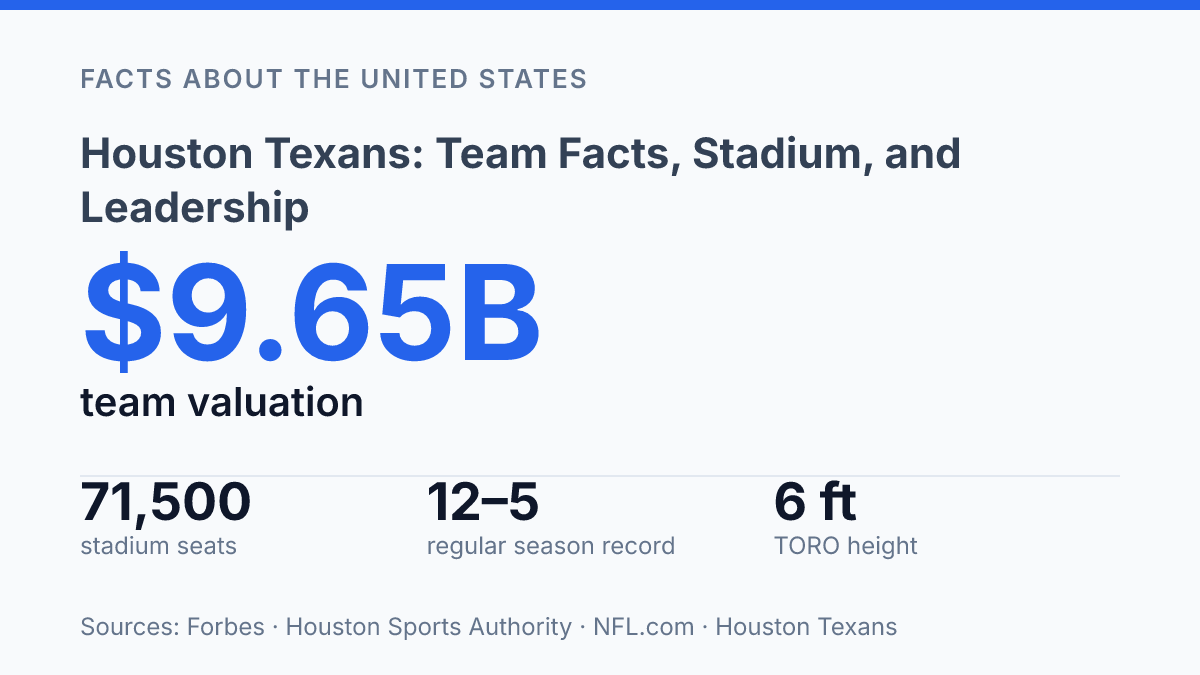
The Houston Texans went 12–5 in 2025, finished second in the AFC South, and still posted a +109 point differential with a 5–1 division record. That combination makes the franchise harder to read through standings alone: Houston was not merely competitive, but statistically strong in a division where placement did not fully capture performance. The team’s current profile also depends on context beyond the win column, including DeMeco Ryans’ rapid start as head coach, Cal McNair’s formal role as principal owner, and a home venue that returned to the Reliant Stadium name in 2026.
The same period has brought a major valuation snapshot, a fan-informed uniform redesign, and a public identity built around TORO, team colors, and community programming. Together, those details show how Houston’s football operation, business structure, stadium presence, and branding now reinforce one another.
Team profile and place in the AFC South
In 2025, the Houston Texans went 12–5, finished second in the AFC South, posted a +109 point differential, and went 5–1 within the division, according to NFL.com. That combination gives useful context for the team’s current profile: Houston was not merely occupying a divisional slot, but competing near the top of one of the NFL’s eight divisions with a strong record against familiar opponents.
The franchise is a professional American football team based in Houston, Texas, United States. It competes in the National Football League as a member of the American Football Conference South division, placing it within the AFC side of the league’s two-conference structure. The AFC South groups Houston with the Indianapolis Colts, Jacksonville Jaguars, and Tennessee Titans, creating a regular competitive frame in which divisional games carry direct standings implications.
Division placement matters because NFL teams are evaluated not only by overall record, but also by how they perform against opponents they face repeatedly. A strong divisional mark can affect playoff positioning, tiebreakers, and perceptions of whether success is sustainable within the team’s closest competitive group. For Houston, the AFC South identity is especially relevant because the franchise is newer than several of its division counterparts, so present-day results and divisional performance help define its standing more than a long inherited legacy.
Home field at Reliant Stadium
The venue’s name has not been static: according to the team’s stadium page, the building was called NRG Stadium from 2014 until it returned to Reliant Stadium in August 2026. That naming history matters because stadium names are often tied to sponsorship agreements, so the current home venue should be identified by the name associated with the franchise at the relevant time rather than treated as permanent terminology.
The Texans play their home games at Reliant Stadium, which is located in Houston, Texas. The venue therefore anchors the team’s public presence in the same city used to identify the franchise, connecting game days, local media coverage, and fan activity to a specific Houston site rather than only to the broader metropolitan market.
The surrounding complex was also renamed Reliant Park again on August 1, 2026, according to the team’s stadium information. This reinforces the current public-facing use of the Reliant name around the club’s home setting, while still leaving room for the fact that venue branding can shift over time.
Ownership and head coach
Cal McNair’s formal elevation to principal owner came in March 2024, a relatively recent designation for a franchise whose leadership had already been under his direction for several years. According to the team, McNair became chair in July 2018 and chief executive officer in January 2019 before being voted and named principal owner. That sequence matters because ownership authority is not limited to public representation; it also frames executive accountability, investment priorities, and the long-term stability of the organization.
The business scale behind that role is substantial. Forbes listed the franchise at $9.65 billion in its September 2026 valuation, ranking it No. 13 in the NFL, with reported revenue of $722 million and operating income of $160 million. Those figures do not describe football tactics, but they show the size of the enterprise that ownership oversees, from commercial operations to major organizational decisions.
On the football side, DeMeco Ryans is the head coach and is responsible for directing the team’s on-field preparation, game management, and football culture. The coach’s authority is different from the owner’s authority: Ryans leads the locker room and staff on competitive matters, while ownership sits above the football operation and affects broader direction through executive structure, resources, and leadership continuity.
This separation is central to understanding how the club is run. A head coach can strongly influence style of play, standards, and week-to-week identity, but ownership remains the controlling level of the organization. In practical terms, the franchise’s public leadership rests with McNair, while Ryans is the central football figure charged with translating organizational support into team execution.
Mascot, branding, and public identity
More than 10,000 fan surveys helped shape the franchise’s 2024 uniform redesign, according to the team, showing that its public image is not limited to logos chosen internally. The same process included 30 focus groups and produced the club’s first new uniforms since its 2000 inception, a useful example of how the organization has tied visual branding to supporter feedback rather than treating identity as a fixed asset.
At games, Toro gives that brand a personified form. The mascot connects the bull-themed name and Houston football identity to crowd interaction, sideline entertainment, and family-facing presentation. According to the team’s mascot information, TORO is listed as 6 feet tall and was “drafted” in 2001, details that frame the character as part of the franchise’s own storytelling without turning the mascot into a measure of football performance.
Community appearances extend that identity beyond game day. The team lists mascot-led school programs, including anti-bullying and STAAR-prep assemblies, which means the character functions as a public-facing representative in civic and educational settings as well as inside the stadium. That visibility can strengthen recognition and fan engagement, but it should be read as brand infrastructure rather than evidence of competitive quality on the field.
Why stability is the next measure of Houston’s rise
The next phase of the franchise will likely be judged by how well stability turns into durability. A $9.65 billion valuation, a renamed Reliant Stadium, and a coach with three playoff appearances in three seasons all point to an organization with momentum, but sustained relevance in the NFL usually depends on converting short periods of alignment into repeatable systems.
The 2024 uniform redesign offers a useful clue: more than 10,000 surveys and 30 focus groups suggest the team is treating identity as something to be managed, not assumed. If that approach carries into football operations, venue strategy, and community visibility, Houston’s rise will be measured by more than a single standings line.
Frequently Asked Questions
Q: Who owns the Houston Texans?
A: The Houston Texans are owned by Cal McNair. Ownership matters because it shapes major organizational decisions, including leadership appointments and the long-term direction of the franchise.
Q: Who is the current head coach of the Houston Texans?
A: The team’s head coach is DeMeco Ryans. His role centers on preparing the roster, setting the weekly game plan, and guiding on-field performance.
Q: What division do the Houston Texans play in?
A: The Texans compete in the AFC South. Division placement determines their regular-season rivals and has a direct effect on playoff positioning.
Q: Where do the Houston Texans play home games?
A: The Texans play their home games at Reliant Stadium in Houston, Texas. The stadium serves as the team’s base for regular-season games and other home events.
Q: What is the Houston Texans’ mascot?
A: The Houston Texans’ mascot is Toro. Mascots are part of a team’s public identity and are commonly used in stadium events, promotions, and fan engagement.