
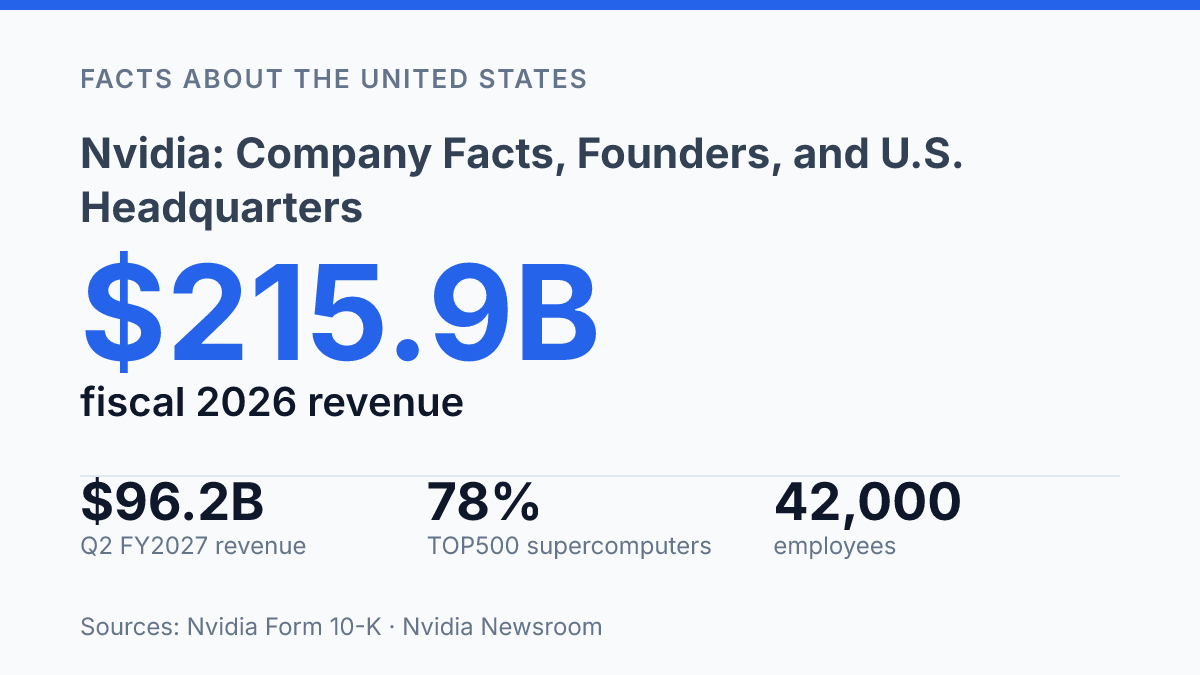
Nvidia’s fiscal 2026 revenue reached $215.9 billion, a 65% year-over-year increase that shows how far the company has moved from its 1993 graphics origins into AI compute infrastructure. Founded on April 5, 1993 by Jensen Huang, Chris Malachowsky, and Curtis Priem, the company began with a clear commercial target: 3D graphics for gaming and multimedia. The facts now point to a much wider role, including data center hardware, accelerated computing, supercomputing systems, and core technology used across U.S. industry.
A current company profile also requires governance context, because the board accepted Huang’s resignation on November 11, 2026 and appointed Colette M. Kress as interim CEO. The result is a company story shaped by founders, headquarters, leadership structure, revenue concentration, and a scale of influence that extends beyond consumer graphics.
Nvidia overview and company profile
Nvidia Corporation reported approximately 42,000 employees across 38 countries at the end of fiscal 2026, a scale that makes its U.S. identity only one part of its corporate profile, according to the company’s fiscal 2026 Form 10-K. Nvidia Corporation is an American multinational technology company, meaning it is headquartered and legally rooted in the United States while maintaining operations, markets, and business relationships that extend well beyond the country.
The company was founded on April 5, 1993, and its early market focus was graphics for gaming and multimedia, according to its corporate timeline. That founding context is useful because it places the company within the American technology sector of the early 1990s, while leaving room to distinguish its current scale from its original commercial focus. The details of its founders and their roles are separate from this baseline profile, but the date establishes the company’s origin point.
Corporate headquarters are located in Santa Clara, California, in the United States. This location places the company within one of the country’s most concentrated technology regions, but its classification as a U.S.-based company should not be confused with a purely domestic business model.
Its products, customers, workforce, and supply chain relationships operate across international markets, which is why the company is commonly described both as American and as a global technology enterprise. That distinction matters for understanding public discussions of the company, since regulatory, economic, and strategic questions often depend on whether the focus is its headquarters, its markets, or its international operating network.
Who founded the company and why it matters
Public coverage often reduces the company’s origin to Jensen Huang, but its formation was a three-founder story involving Chris Malachowsky and Curtis Priem as well. That distinction matters because the early company was not built around a single public personality; it combined technical judgment, market timing, and a focused bet on graphics processing at a moment when personal computing, gaming, and multimedia were beginning to demand more visual performance.
According to the NVIDIA corporate timeline, the company was founded on April 5, 1993 by Jensen Huang, Chris Malachowsky, and Curtis Priem, with the original aim of bringing 3D graphics to gaming and multimedia markets. That founding purpose helps explain why the company’s early identity centered on graphics rather than general-purpose computing. The initial market was narrower than the company’s later reach, but it gave the business a clear technical problem to solve: making advanced visual computing practical for mass-market systems.
The founding history is easy to oversimplify because Huang became the most visible and best-known founding figure in public coverage of the company. His prominence, however, should not obscure the collaborative origin of the business. Malachowsky and Priem were part of the founding team that set the technical and commercial direction at inception, and the company’s later expansion grew from those early assumptions about specialized processors and high-performance graphics.
The link between the 1993 launch and the company’s rise is not just chronological. The founders’ decision to focus on 3D graphics placed the business in a field where software demands, entertainment markets, and hardware performance were advancing together. That early specialization created a platform from which the company could move beyond its startup phase and develop into a major technology firm with influence well outside its original gaming and multimedia focus.
Leadership and executive roles
The same executive name appears in two different roles in the supplied leadership material, which makes title verification the central issue for this profile. Colette Kress is listed as chief financial officer and, in the supplied notes, as chief executive officer from Nov. 12, 2026. That latter listing should be treated as a source note rather than a standalone confirmation unless it matches the company’s latest official disclosures.
According to a 2026 SEC Form 8-K referenced in the research notes, the board accepted the prior chief executive’s resignation on November 11, 2026, and appointed Kress as interim CEO while she continued to serve as executive vice president and chief financial officer. The word “interim” matters because it describes the capacity in which the role was assigned and prevents a temporary governance arrangement from being overstated as a permanent succession outcome. The same filing also reported Harvey C. Jones as chair of the board, adding a separate governance role that should not be confused with day-to-day executive management.
Leadership listings can differ across databases, company profiles, news summaries, and regulatory filings because they may update on different schedules or simplify formal titles. For a current company profile, executive roles should be checked against the latest Form 10-K, Form 8-K, proxy statement, and investor relations leadership page. These titles are not merely biographical details: the CFO is central to financial reporting, controls, and investor communication, while the CEO role is associated with enterprise strategy, operational direction, and accountability to the board.
Why the company is significant in U.S. tech
A Santa Clara headquarters gives the chipmaker more than a mailing address: it places one of the best-known U.S. technology companies inside Silicon Valley’s dense network of semiconductor, cloud, software, and venture-backed firms. That location matters because the region concentrates technical labor, supplier relationships, capital markets attention, and corporate partnerships in a way few American technology clusters can match. The company’s base in Santa Clara therefore reinforces its role as both a hardware-centered business and a participant in the wider software and compute infrastructure economy.
Its prominence in U.S. technology coverage is also supported by documented financial scale rather than broad reputation alone. In fiscal 2026, the company reported $215.9 billion in revenue, up 65% year over year, according to its FY2026 Form 10-K. That figure helps explain why its earnings reports, regulatory filings, and executive updates receive close attention from business media and U.S. equity-market observers, even without relying on valuation claims or unsourced market-share rankings.
The company’s significance also extends into American computing infrastructure. Its FY2026 Form 10-K states that its GPUs and networking technologies power more than 78% of systems on the global TOP500 supercomputer list, including nine of the top ten systems on the Green500 list. Those figures do not make every claim about influence equally precise, but they provide a concrete basis for understanding why the company is discussed alongside the largest names in U.S. technology.
A balanced reading should separate documented corporate importance from promotional superlatives. The company is widely recognized because of its Silicon Valley location, scale of reported revenue, centrality to compute infrastructure, and visibility in public markets. Those factors are enough to establish its significance in American technology without turning the discussion into a product catalog or making unsupported claims about dominance.
Why the company profile keeps changing
A company profile of this scale is not fixed for long. Revenue growth, executive succession, customer concentration, and research staffing can change the interpretation of the same basic facts within a single reporting cycle. The most useful view treats founding history and headquarters location as anchors, while SEC filings and quarterly results supply the moving parts.
That matters because the company’s influence is now measured not only by products sold, but by where its chips sit inside AI factories, supercomputers, cloud platforms, and national technology plans. The next meaningful shift may appear first in a filing footnote, not a product launch.
Frequently Asked Questions
Q: Where is Nvidia headquartered in the United States?
A: Nvidia Corporation is headquartered in Santa Clara, California. The company’s U.S. base places it in Silicon Valley, which is closely associated with semiconductor and computing firms. This location is central to its identity as an American multinational technology company.
Q: Who founded Nvidia?
A: Nvidia was founded by Jensen Huang, Chris Malachowsky, and Curtis Priem. Their collaboration in 1993 set the company’s direction in graphics and accelerated computing. The founding team remains one of the most commonly cited parts of Nvidia’s corporate history.
Q: When was Nvidia founded?
A: Nvidia was founded on April 5, 1993. That founding date places the company in the early period of modern GPU development, before graphics hardware became central to gaming and AI workloads. Its age helps explain why it has had time to expand beyond its original market.
Q: Who is Nvidia’s CEO?
A: Nvidia’s CEO is Colette Kress, according to the supplied company data. Kress is also listed as the CFO, which makes her role unusual compared with many large public companies. Readers should note that corporate leadership details can change over time, so current filings are the best source for confirmation.
Q: Is Nvidia an American company?
A: Yes. Nvidia Corporation is an American multinational technology company with its headquarters in Santa Clara, California. Its U.S. headquarters and incorporation in the American tech sector are key parts of how the company is classified in business and financial references.