
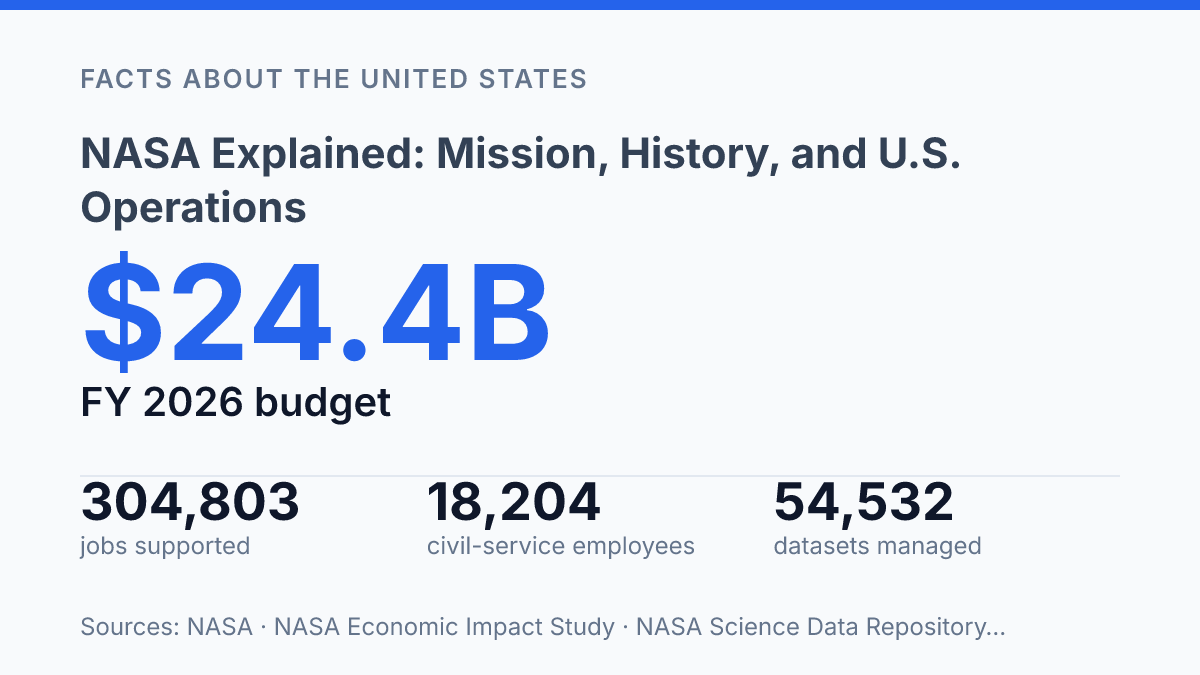
NASA’s FY 2026 budget assigns $12.5 billion of its $24.4 billion total to Research, Engineering & Development, a 51% share that makes the agency look less like a launch office and more like a national R&D institution. That distinction matters because the agency’s work extends from crewed missions and planetary probes to climate data, aeronautics research, software, materials science, and technology transfer.
Its modern structure also reflects a specific historical choice: a civilian space agency created after President Dwight D. Eisenhower signed the National Aeronautics and Space Act on July 29, 1958, with operations beginning on October 1 of that year. Understanding the agency requires looking at its legal mission, Cold War origins, 10 field centers, and measurable effects on science, industry, and public data access.
What NASA Does and Why It Exists
In FY 2026, the agency’s budget was $24.4 billion, with 51% ($12.5 billion) categorized as Research, Engineering & Development, according to the NASA FY 2026 Agency Financial Report. That budget profile helps explain the agency’s core identity: it is not only a launch organization, but a federal research institution whose work spans engineering, science, operations, and long-term technology development.
The National Aeronautics and Space Administration is an independent agency of the U.S. federal government, headquartered in Washington, D.C. Its independence means it is not housed inside a Cabinet department, though it remains accountable through federal budgeting, congressional oversight, executive branch priorities, and public reporting requirements. From Washington, the agency sets policy direction, manages major programs, coordinates with other federal bodies, and represents the United States in civil space cooperation.
Its work is usually grouped into three broad mission areas: the national civil space program, aeronautics research, and scientific exploration. The civil space program covers human spaceflight, robotic missions, space transportation, and related mission operations.
Aeronautics research focuses on flight safety, aircraft efficiency, air traffic systems, and technologies that can later influence commercial and public aviation. Scientific exploration includes the study of Earth, the Sun, planets, moons, asteroids, and the wider universe through missions, instruments, data systems, and research grants.
A civilian mandate gives the agency a wider public-research role than a military space organization. It can pursue open science, international partnerships, education, climate and Earth observation, and aeronautics work whose benefits extend beyond national security.
The same mandate also places practical limits on ambition: exploration plans must fit within appropriated funding, technical risk, political priorities, and long development timelines. The result is an agency designed to convert public investment into scientific knowledge, aerospace capability, and national research infrastructure.
How the Agency Began
Less than 12 months after the Soviet Union placed Sputnik in orbit, the United States had authorized a new national space agency and reorganized major parts of its federal research structure. The satellite’s launch on October 4, 1957, did not simply demonstrate a new technical capability; it exposed a strategic gap in rockets, satellites, and public confidence at a moment when space achievements were closely tied to Cold War prestige and security concerns.
The federal response moved through legislation rather than through a single military order. President Dwight D. Eisenhower signed the National Aeronautics and Space Act on July 29, 1958, and the National Aeronautics and Space Administration began operating on October 1, 1958, according to the agency’s Origins history. That timing shows how rapidly space policy changed after Sputnik, but the law also reflected a deliberate choice: the United States would place much of its nonmilitary space work under a civilian institution, even while defense agencies continued their own missile and reconnaissance programs.
The new organization was not built from nothing. Its core came from the National Advisory Committee for Aeronautics, the long-running federal aviation research body whose laboratories, personnel, and technical culture were transferred into the new agency.
Early space-related work from other federal programs was also folded in, including satellite and propulsion expertise that had developed through military-linked projects. This consolidation mattered because it gave the agency established engineers, test facilities, and research practices from its first day rather than forcing it to create a technical workforce after the political mandate had already been set.
That origin created a durable tension in the agency’s early identity. The urgency of national competition gave the new institution unusually strong political backing, but it also attached public expectations to quick and visible results. The early agency therefore inherited both capability and pressure: mature aeronautics research on one side, and a newly urgent space race on the other.
Major Centers and Facilities Across the Country
The agency’s day-to-day technical work is divided among 10 field centers, a structure that makes its national footprint operational rather than merely administrative. Its own headquarters materials describe these centers, along with other installations, as the places where much of the practical work is carried out. That distribution matters because spacecraft, aircraft, science instruments, mission software, test stands, launch systems, and operations teams require different physical environments and engineering specialties.
Several centers are associated with distinct mission functions rather than duplicate versions of the same office. Kennedy Space Center in Florida is closely tied to launch processing and launch support, while Johnson Space Center in Texas is a major hub for human spaceflight operations, astronaut training, and mission control functions. Aeronautics research is concentrated in facilities such as Langley Research Center in Virginia, Ames Research Center in California, and Glenn Research Center in Ohio, where wind tunnels, propulsion laboratories, and flight research capabilities support aircraft and aerospace testing.
The staffing pattern also shows that the field network is not symbolic. In FY 2026, the agency reported 18,204 civil-service employees, with Johnson Space Center accounting for 3,928 employees and Kennedy Space Center for 3,499, according to the Agency Financial Report. Those figures indicate that large technical workforces are embedded near specialized infrastructure, not gathered in a single central office.
A distributed system broadens technical capacity because no single site has to contain every laboratory, test range, launch asset, and operations room. It also spreads federal research activity into multiple regional economies and university-industry networks.
The same structure requires close coordination across centers, since a mission may involve hardware testing in one state, launch preparation in another, and science or operations support elsewhere. That coordination is part of how complex civil space and aeronautics programs move from design to testing to flight.
How NASA Affects Science, Technology, and Daily Life
53.24 million unique users a year accessed the agency’s science data repositories, a scale that makes open data one of its most direct public outputs. In FY 2024, the Science Mission Directorate managed 54,532 datasets totaling 150,616 terabytes across 10 repositories, according to the 2025 Science Data Repository Metrics release. Those records support research on the atmosphere, oceans, land, ice, solar activity, and distant objects, giving universities, public agencies, companies, and international researchers a common evidence base for climate analysis, disaster monitoring, and space science.
Aeronautics research affects daily life less visibly, but it can shape how aircraft are designed, tested, and operated. Work on aerodynamics, propulsion efficiency, aircraft noise, icing, turbulence, automation, and air traffic management helps industry and regulators assess risks before new systems reach passengers. The practical result is often incremental rather than dramatic: a safer operating procedure, a quieter aircraft concept, a better simulation method, or design data that helps reduce fuel burn and emissions over time.
Technology transfer is another route from federal research to public use, though the path is rarely a simple one-project-to-one-product story. The Spinoff 2025 publication featured more than 40 commercial infusions of agency-related technologies and highlighted 20 technologies available for licensing, with applications spanning medicine, agriculture, sanitation, construction, energy, and other sectors. Many of these outcomes come from adapting technical capabilities developed for demanding conditions, such as compact sensors, durable materials, imaging systems, thermal control, or reliable communications, rather than from products originally built for consumer markets.
The economic effects are measurable as well as scientific. The FY 2023 Economic Impact Study estimated that the agency’s activities generated $75.6 billion in U.S. economic output, supported 304,803 jobs, and produced $9.6 billion in federal, state, and local tax revenues.
These figures show that the benefits extend through contractors, research institutions, suppliers, and local economies, but they do not mean every research effort produces an immediate consumer product. The agency’s impact is real but uneven: some work quickly improves tools, data, and industrial methods, while other work primarily expands knowledge that may become useful only after years of further research and private-sector adaptation.
Why the agency’s structure matters beyond spaceflight
The agency’s value is easiest to misread when it is judged only by launches, astronauts, or deep-space imagery. Its less visible infrastructure may prove just as consequential: open repositories containing more than 150,000 terabytes of science data, regional workforces tied to major centers, and technologies that move from public research into commercial use.
The harder question is not whether space activity produces benefits, but how those benefits should be measured across decades, industries, and public needs that do not fit a single mission timeline. A budget line for exploration can also support climate records, medical tools, aircraft research, and local employment, which makes the agency a continuing part of U.S. science policy rather than a standalone symbol of space ambition.
Frequently Asked Questions
Q: What does NASA do in the United States?
A: NASA is the U.S. federal agency responsible for civil space activity, aeronautics research, and scientific exploration. Its work includes running space missions, supporting research on flight and aviation, and coordinating scientific programs across the country.
Q: Is NASA part of the military?
A: No. NASA is an independent agency of the U.S. federal government, not a military branch. That structure places it in civilian government and focuses its mission on research, exploration, and space operations.
Q: Where is NASA headquartered?
A: NASA is headquartered in Washington, D.C. The headquarters provides central oversight for the agency’s national program while its technical work is distributed across field centers and other facilities.
Q: How many field centers does NASA have?
A: NASA operates ten major field centers across the United States. These centers support different parts of the agency’s work, which allows responsibilities such as research, mission operations, and engineering to be spread across specialized sites.
Q: What is the difference between NASA and private space companies?
A: NASA is a public agency with a government mandate to conduct civil space exploration and aeronautics research, while private companies are driven by commercial goals. In practice, NASA often sets scientific priorities and works with contractors or industry partners to carry out parts of its missions.