
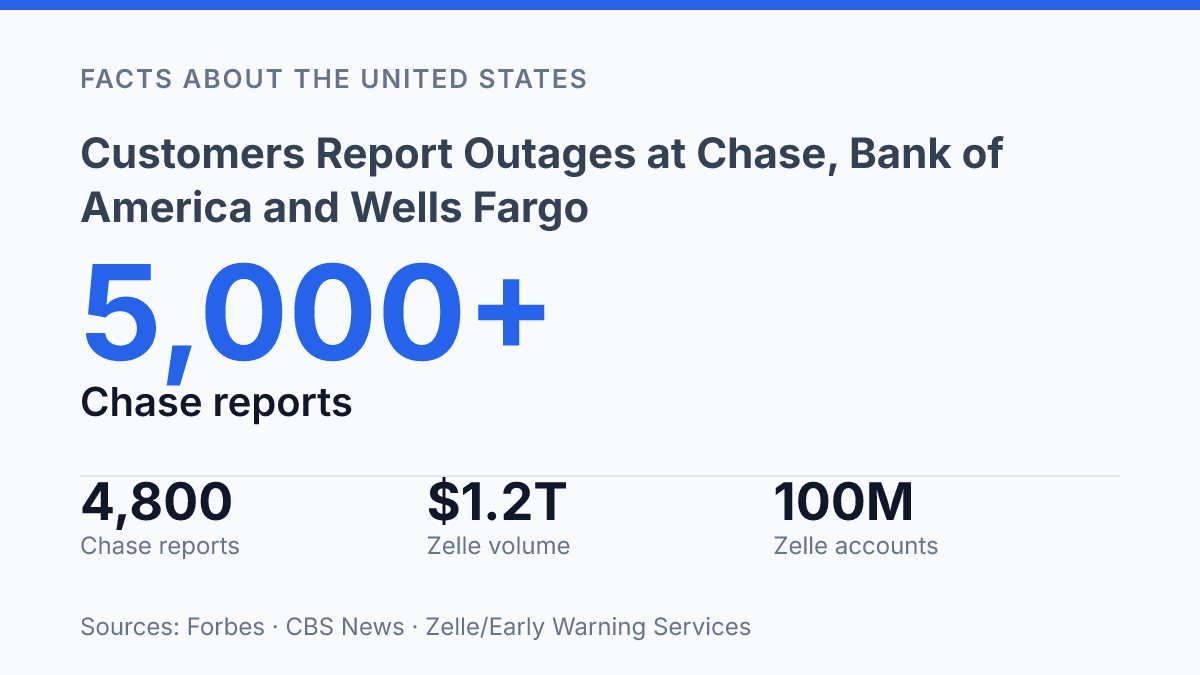
Customers report outages at Chase, Bank of America and Wells Fargo on November 16, 2026, but the complaint data pointed first to Chase: Downdetector showed more than 4,000 Chase reports by early afternoon, rising to nearly 4,800 by 2 p.m. ET in CBS News reporting. Customers described trouble checking balances and completing transfers or wire transfers, while reports at Bank of America, Wells Fargo, Zelle, and other institutions created a broader appearance of banking disruption. The evidence released during the day narrowed the explanation.
JPMorgan Chase attributed the problem to a software bug in an on-premise hardware system, not a cyber event, and said it was not systemic. The wider effects were tied to transaction dependencies, including cases where other banks were party to transfers involving Chase and where Zelle’s large role in person-to-person payments made delays more visible.
What customers experienced on Monday
By early afternoon, Chase alone had drawn more than 4,000 customer outage reports, making it the clearest center of a disruption that customers also associated with several other major banks. Customer reports began around 9:48 a.m. ET on Monday, November 16, 2026, and Downdetector showed the complaint volume rising sharply by early afternoon, according to Fast Company.
The reported problems were concentrated in digital banking activity rather than a complete inability to reach accounts. Customers described delayed transfers, failed or pending payments, problems sending money between people, and trouble completing transactions that crossed from one bank to another. Some users also reported difficulty viewing balances or initiating wire transfers, but the pattern of complaints pointed more toward transaction processing disruption than a broad shutdown of online banking access.
Accounts at Bank of America, Wells Fargo, U.S. Bank, Capital One, and Truist also appeared in customer complaints, though the public reports did not show that every institution had the same type or scale of internal disruption. That distinction matters because consumer-facing payment problems can appear simultaneously across banks when transactions involve more than one institution. A failed or delayed transfer may be visible to both the sender and recipient even if the underlying problem is not identical on each side.
Peer-to-peer transfers were a major part of the customer experience because those payments depend on coordination among bank systems, payment networks, and account-level processing. As a result, the disruption felt wider than a single-bank login issue: customers could often identify the problem only when a transfer stalled, a payment remained pending, or a cross-bank transaction did not complete as expected.
What Chase said caused the disruption
The explanation from JPMorgan Chase narrowed the disruption to a software bug inside an on-premise hardware system, not a breach or a failure of the banking system. According to the Associated Press, the bank said the problem came from a temporary internal issue caused by “a software bug in an on-premise hardware system.” That description places the cause within Chase’s own technology environment rather than in an external payments network or a market-wide financial mechanism.
Chase also stated that the incident was not cyber-related. That distinction matters because customer-facing delays in banking systems can resemble the early symptoms of a security incident from the outside, especially when transactions slow or remain pending. In this case, the bank’s public explanation ruled out a cyberattack as the cause and framed the outage as an operational technology failure.
The bank separately said the disruption was not a systemic financial failure. In practical terms, that means Chase was not describing a solvency problem, a liquidity event, or a breakdown in the wider banking system. The issue was presented as a temporary technical fault affecting processing, rather than evidence that funds or institutions were financially impaired.
A localized fault can still appear broader when payment activity depends on routing between institutions. If one major bank’s internal processing is delayed, transfers that involve that bank can slow even when the other side of the transaction is functioning normally. That distinction helps explain why a Chase-centered technical issue could be visible beyond Chase without changing the bank’s core explanation of the cause.
Why other banks and Zelle were affected
A Zelle payment can be delayed even when Zelle’s central network is functioning, if one of the connected banks cannot process its side of the transaction at normal speed. That distinction helps explain why a Chase-centered processing issue was visible to customers at Bank of America, Wells Fargo, U.S. Bank, Capital One, and Truist when payments or transfers crossed institutional lines or touched affected bank connections.
The Associated Press reported that other banks could see slower activity when they were a party to a transaction involving Chase, which points to an interbank processing problem rather than a separate outage at each institution. In practical terms, a transfer can depend on more than the app a customer opens: authorization, routing, posting, and settlement steps may involve multiple bank systems. If one participant is slowed, the customer-facing result can appear as a delay at the sending bank, the receiving bank, or the payment service used to initiate the transaction.
Early Warning Services, the bank-owned operator of Zelle, said the service’s core network was operating normally. That statement does not conflict with reports of delayed Zelle payments tied to affected banks, because network availability and bank-side processing are related but not identical measures of service health. A central payment network can continue accepting and routing messages while a connected financial institution takes longer to complete its part of the payment flow.
Zelle’s scale also made the disruption more visible across bank brands. Early Warning Services said Zelle moved $1.2 trillion across 4.2 billion transactions in 2025, with 100 million bank and credit union accounts using the service in December of that year. With that level of integration into major-bank apps, even a limited slowdown tied to certain bank connections can generate a broad pattern of complaints without meaning that the payment network itself is the source of the problem or that all Zelle transfers are failing.
Account safety and recovery by evening
The clearest practical reassurance was not that payments moved normally, but that banks said the money itself was not at risk. According to the Associated Press, Chase said customers still had access to their accounts and funds, while reporting indicated that the disruption was being treated as temporary rather than as a continuing outage. That distinction matters because a delay in routing or posting a payment is different from a loss of account access, missing deposits, or compromised balances.
By Monday evening, transaction processing speeds were recovering, though the available statements supported a gradual improvement rather than an instant return to normal for every affected payment. Chase expected the issue to be resolved by the end of Monday, AP reported, which framed the incident as a same-day operational disruption. The practical effect for customers, however, could still be significant where timing mattered, including scheduled bill payments, time-sensitive transfers, or peer-to-peer payments that remained pending during the slowdown.
The recovery period also underscored why payment delays can feel more serious than a typical app error even when account security is intact. CBS News reported that Zelle said consumers do not have separate Zelle accounts and that the service does not hold consumer funds, a point that helped clarify why delayed peer-to-peer activity did not mean funds were parked in a separate Zelle balance. Taken together, the banks’ statements pointed to a temporary processing problem with improving service levels, not an ongoing account-safety event.
Why attribution matters when one bank’s issue looks wider
A disruption of this kind shows why public outage reporting now has to separate three questions that often look identical to customers: whether account access is impaired, whether money is at risk, and whether a payment network is actually down. Zelle’s structure makes that distinction especially relevant because consumers do not hold separate Zelle accounts and the service does not hold consumer funds.
The next standard for bank incident communication is likely to be more precise attribution across institutions, payment apps, and transaction partners. When a single bank’s technical fault can appear across several consumer touchpoints, speed matters, but so does naming exactly where the failure sits.
Frequently Asked Questions
Q: What caused the banking outages reported at Chase, Bank of America and Wells Fargo?
A: JPMorgan Chase said the disruption came from a temporary internal issue caused by a software bug in an on-premise hardware system. The bank stated that it was not a cyberattack or a broader financial system failure. That explanation points to a technical processing problem rather than a security breach.
Q: Were customer accounts or funds put at risk during the outage?
A: Banks said customer accounts and funds remained secure throughout the incident. The problem affected transaction processing and online access speed, not the underlying safety of deposits. Recovery was reported by Monday evening as systems returned toward normal operation.
Q: Why were other banks affected if the issue started at Chase?
A: Chase was the primary source of the glitch, but cross-bank transactions and peer-to-peer transfers created ripple effects at other institutions. Customers at Bank of America, Wells Fargo, U.S. Bank, Capital One, and Truist reported delays when transfers interacted with Chase systems. The impact was therefore distributed through payment flows, not through a separate outage at each bank.
Q: Was Zelle down during the banking disruption?
A: Zelle said its core network was operating normally. Even so, customers linked to affected banks could still see delayed or failed transactions because the issue sat with bank-side processing, not the central Zelle network. That distinction explains why some transfers were affected while the service itself remained up.
Q: When did the outages happen and how many customers were affected?
A: Thousands of customers at major U.S. banks reported online banking delays and transaction problems on Monday, November 16, 2026. The issue was reported during the day and began recovering by Monday evening. The volume of complaints indicates a sizable but temporary disruption rather than a prolonged shutdown.