
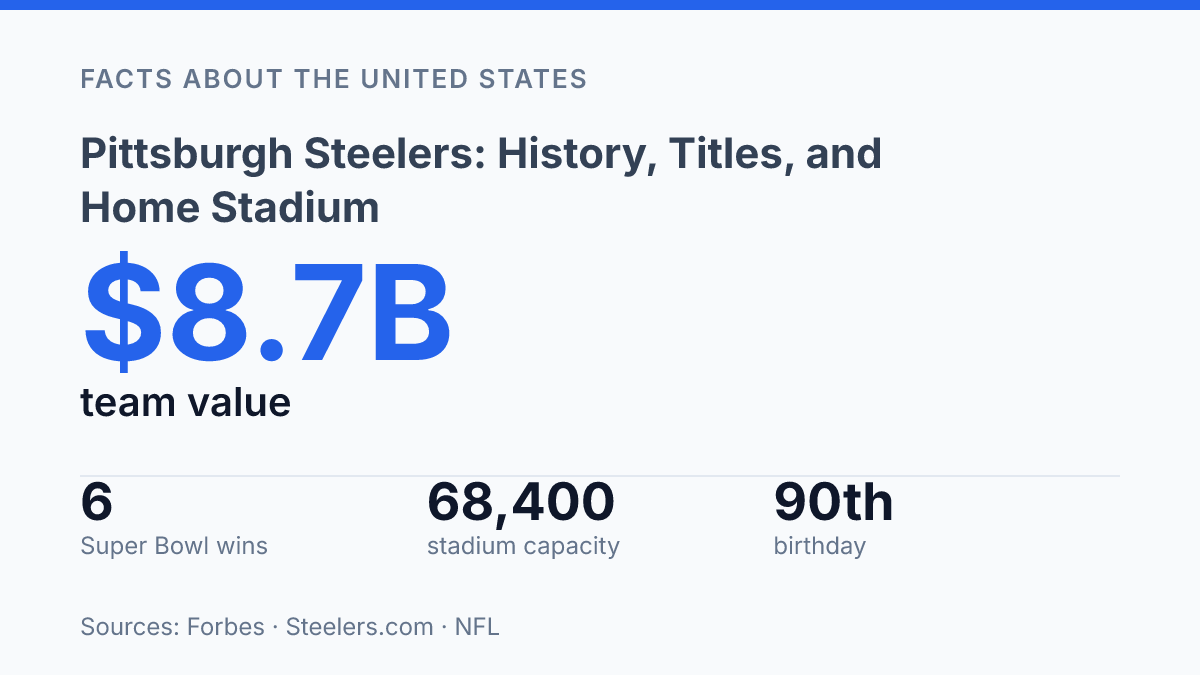
The Pittsburgh Steelers reached their 90th birthday on July 8, 2023, as the NFL’s fifth-oldest franchise and one of its most titled organizations. That combination of age and achievement gives the club an unusual place in league history: it began in 1933, built its national identity through six Super Bowl-winning seasons, and still operates from a home stadium that regularly draws more than 60,000 fans per game.
The record also shows a franchise shaped by continuity rather than constant reinvention, from its long-term ownership identity to rare coaching turnover across recent decades. This article explains how the team started, where it fits in the AFC North, what its championship seasons reveal about its status, and how Acrisure Stadium anchors the club’s modern home base.
How the franchise began in 1933
Pittsburgh’s NFL club arrived in 1933, the same year the league introduced a championship game format that began to make professional football look more like the modern competition. The Pittsburgh Steelers were founded on July 8, 1933 in Pittsburgh, Pennsylvania, with Art Rooney as the central founding figure. The official team site says the franchise began on that date and marked its 90th birthday on July 8, 2023; Steelers.com also describes Pittsburgh as the fifth-oldest franchise in the league, reflecting how historical rankings can vary depending on counting methods.
The team’s early identity was not yet the one recognized today. Rooney’s club originally entered the league as the Pittsburgh Pirates, sharing a name with the city’s baseball team, before adopting the Steelers name in 1940 as a clearer reference to the region’s steel industry. That change tied the franchise’s public identity more directly to Pittsburgh’s industrial character, a connection that helped distinguish it from clubs whose names were less rooted in local economic history.
Within current NFL framing, the franchise is commonly listed as the seventh-oldest franchise in the NFL and as the oldest franchise in the AFC. Its continuity is also closely associated with the Rooney family, whose long stewardship has given the organization an uncommon ownership through-line across multiple eras of league expansion and realignment. Longevity alone does not explain later prominence, but it does establish why the franchise is often discussed as part of the league’s foundational history rather than only as a successful modern club.
Where they compete in the AFC North
AFC North membership gives the Steelers six divisional games before the rest of the schedule is even considered, making their league setting a practical force in how each season develops. The team is based in Pittsburgh, Pennsylvania, United States and competes in the National Football League as a member of the AFC North, placing it within the American Football Conference’s northern division structure rather than treating it as an independent regional brand.
Divisional placement matters because standings, playoff seeding, and head-to-head tiebreakers are shaped partly by repeated games against the same set of rivals. The Steelers’ 2026 standings snapshot on Steelers.com listed the team at 6–2 with a .750 winning percentage, 180 points scored, 144 allowed, and a +36 point differential, showing how early divisional and conference results can frame a season’s trajectory before the full schedule is complete.
Leadership provides a second layer of context beyond the schedule. The current head coach listed in the source notes is Mike McCarthy; Steelers.com reported that he was named the franchise’s 17th head coach on Jan. 24, 2026, arriving with a 174–112–2 regular-season record, 12 postseason appearances, and eight division titles. That résumé is relevant because division competition rewards week-to-week preparation as much as broad roster quality, especially when familiar opponents repeatedly test adjustments.
The club’s current NFL identity is therefore defined by both structure and stability. Its Pittsburgh base anchors the team geographically, the AFC North determines a significant share of its competitive calendar, and coaching leadership influences how that structure is managed across a season. Division placement shapes the weekly path, but organizational decision-making determines how well the team responds to it.
Six championship seasons and what they show
Four championships in a six-year span turned the franchise’s title history from a record of success into one of the NFL’s clearest measures of sustained dominance. The team’s NFL championships are listed in 2009, 2006, 1980, 1979, 1976, and 1975, giving it six wins in eight Super Bowls, according to the team’s official Super Bowl page. That total matters not only because of the number itself, but because it places the franchise among the league’s most decorated organizations in the modern championship era.
The 1970s run is the foundation of that profile. Titles in 1975 and 1976 formed the first back-to-back pair, while the 1979 and 1980 championships created another consecutive sequence before the decade closed. Winning once can reflect a peak roster or a favorable postseason path; winning repeatedly across several seasons points to a deeper structure of roster quality, coaching consistency, and performance under playoff pressure.
Later championships in 2006 and 2009 extended that legacy beyond a single historical window. That distinction is important because championship counts can lose some meaning when they are concentrated entirely in one era. In this case, the title record shows both an exceptional 1970s dynasty and the ability to return to the top level decades later.
A strong title count is not a complete measure of a franchise by itself. League size, postseason format, competitive balance, and the standards of different eras all shape how championships are interpreted. Even with that qualification, six championships create a durable national identity: the franchise is not remembered only for longevity or regional loyalty, but for repeated success at the highest stage of professional football.
Acrisure Stadium and the team’s home base
Acrisure Stadium gives the Steelers a fixed North Shore address even as venue branding has changed around the franchise’s longer historical record. The stadium is in Pittsburgh and serves as the team’s primary game site, placing regular-season home football within the city rather than treating the club as only a regional or national brand. According to the NFL Record & Fact Book, the venue opened in 2001, has a capacity of 68,400, and uses a natural grass surface, details that place it firmly in the modern stadium era while keeping the playing environment relatively traditional.
Attendance data helps explain why the building is more than a scheduling location. The Steelers drew 535,045 fans across eight home games in 2024, an average of 66,880 per game, according to the Pittsburgh Steelers 2025 Media Guide. The same guide reports that since the stadium opened, Pittsburgh has averaged at least 62,000 fans per game in 19 seasons, a pattern that points to durable local demand rather than occasional crowd spikes.
Venue names can change through sponsorship agreements, but the stadium’s civic function is steadier: it concentrates game days, fan rituals, broadcast imagery, and club operations in one recognizable Pittsburgh setting. That distinction matters for understanding identity. The franchise’s official record is carried by seasons, championships, owners, coaches, and players; the home stadium gives that record a physical setting in the city, making the team’s presence visible on the skyline and recurring in the weekly rhythm of Pittsburgh football.
What continuity means for Pittsburgh’s next era
A franchise this old is not measured only by titles or by a single season’s standings. The more durable question is how much continuity can survive while the league around it keeps changing. Pittsburgh entered 2026 with a new head coach, Mike McCarthy, yet he was only the fourth head coach hired by the organization since 1969.
Forbes also valued the club at $8.7 billion in 2026, a figure that reflects brand strength as much as recent performance. The practical consequence is clear: coaching changes, divisional races, and stadium economics in Pittsburgh are judged against an unusually stable institutional baseline, not a short-term cycle.
Frequently Asked Questions
Q: When were the Pittsburgh Steelers founded?
A: The Pittsburgh Steelers were founded on July 8, 1933, in Pittsburgh, Pennsylvania. That makes them the seventh-oldest franchise in the NFL and the oldest in the AFC.
Q: How many NFL championships have the Pittsburgh Steelers won?
A: The Steelers have won 6 NFL championships. Their title years are 1975, 1976, 1979, 1980, 2006, and 2009.
Q: What division do the Pittsburgh Steelers play in?
A: The Steelers compete in the American Football Conference North division. That places them in the AFC alongside other long-running rivals in the same regional group.
Q: Where do the Pittsburgh Steelers play their home games?
A: The team plays home games at Acrisure Stadium in Pittsburgh, Pennsylvania. The stadium is the Steelers’ primary venue and is tied closely to the franchise’s identity in the city.
Q: Who owns the Pittsburgh Steelers?
A: The Steelers are owned by the Rooney family. The family has been central to the franchise’s long-term leadership and continuity.