
Rockstar Games, Inc began less as a garage start-up than as the product of a March 1998 New York deal: Take-Two, then headquartered at 575 Broadway, acquired BMG Interactive assets that included worldwide Grand Theft Auto rights. That origin matters because the publisher’s identity was shaped at the junction of creative leadership, rights ownership, and public-company governance rather than by a single founding myth. Securities filings place Sam Houser inside Take-Two by March 1998 and identify him as president of the Rockstar label from its November inception.
Reporting later tied the New York move to five names: Sam Houser, Dan Houser, Jamie King, Terry Donovan, and Gary J. Foreman. The company’s formation, headquarters logic, founder roles, and BMG’s early stake show why Rockstar’s corporate story begins with paperwork as much as with games.
How the company was formed in New York
Rockstar Games, Inc did not begin as a standalone startup; it was created in December 1998 as a Take-Two Interactive subsidiary built from BMG Interactive assets. That origin matters because the publisher’s early structure came through corporate formation and asset transfer, not through an independent company later acquired by a larger parent.
Take-Two’s role was direct. Earlier in 1998, it acquired substantially all of BMG Interactive’s assets, giving it the material base from which to establish a dedicated publishing label.
When Take-Two acquired those assets in March 1998, the company was headquartered at 575 Broadway, New York, NY 10012, according to its Take-Two Interactive SEC Form 8-K. The transaction placed the company’s prehistory within a New York corporate setting before the publishing label itself was formally established.
The founding location is therefore more than a mailing address: the company was formed in New York, New York, United States, inside the operating structure of Take-Two Interactive. This helps explain why the early identity of the publisher combined creative branding with the administrative framework of a public-company subsidiary. Its creation linked personnel, intellectual property assets, and corporate oversight from the start, making New York the organizing point for the new label rather than a later headquarters choice.
Who founded the publisher and what each name adds
Five names, not one, sit behind the publisher’s launch: Sam Houser, Dan Houser, Terry Donovan, Gary Foreman, and Jamie King. Wireframe reported in 2021 that Sam Houser, Dan Houser, Jamie King, Terry Donovan, and Gary J. Foreman moved to New York to start a U.S. publishing label for Take-Two, a detail that places the founding group inside a publishing operation from the beginning rather than treating the company as a purely studio-led creation.
Sam Houser is the clearest documented executive figure in the available filings. Take-Two’s fiscal 1998 filing, published in 1999, described him as 27, president of the Rockstar publishing label since its November 1998 inception, and Take-Two vice president of worldwide product development since March 1998. That record makes his name central to the company’s early direction because it links the label’s identity to both publishing leadership and product oversight within the parent company.
Dan Houser’s inclusion adds another Houser name to the founding group, but the supplied evidence does not justify assigning him a specific operational title in this context. The same caution applies to Terry Donovan, Gary Foreman, and Jamie King: their importance is established by their presence in the founding cohort, not by detailed individual job descriptions in the provided record.
The five-founder structure still matters because it shows that the early publishing identity was not attached to a single founder mythology. It was associated with a small group involved in establishing a U.S. label under Take-Two, combining creative direction, publishing positioning, and business formation in a way that shaped how the brand was presented from its earliest phase.
Why New York remains central to the company profile
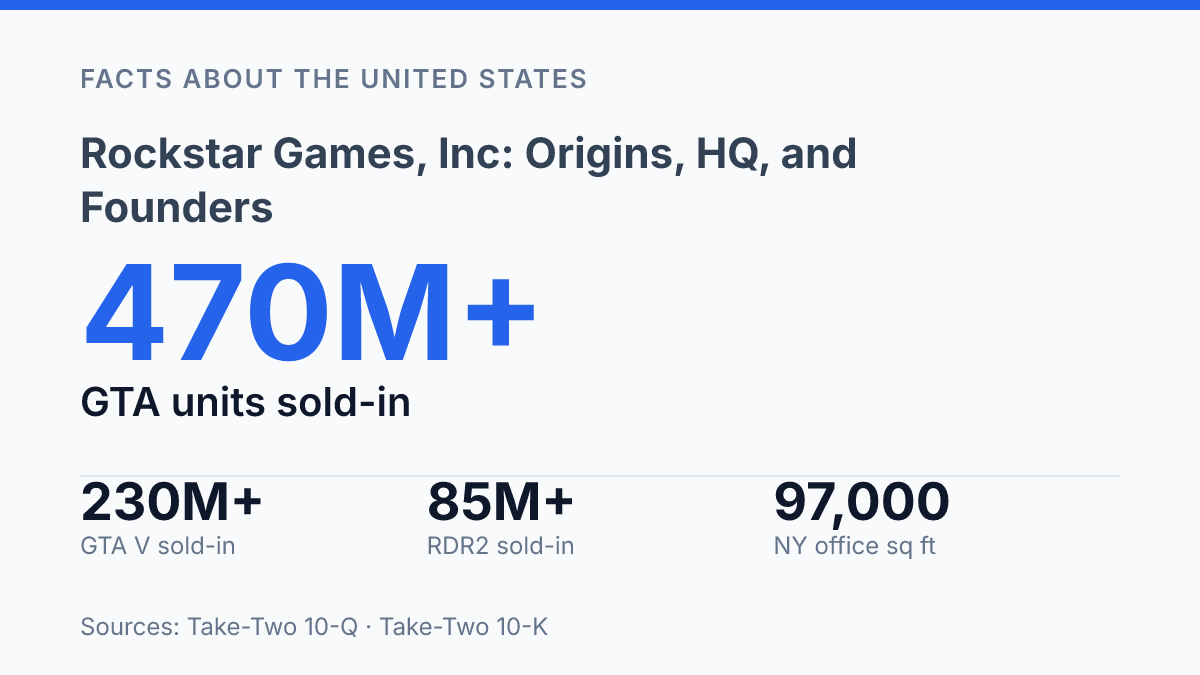
Take-Two’s 2026 annual filing places Rockstar’s corporate offices in about 97,000 square feet of leased space in New York, with leases running to March 2030. That filing gives the headquarters location more weight than a mailing address: it shows an ongoing corporate presence in the same city associated with the company’s origin, rather than a later relocation that separated the publisher’s official identity from its founding base.
The headquarters is commonly given as New York, New York, United States, which anchors the company’s profile within the American games industry. In that sense, the company is accurately described as an American video game publisher, even though its commercial audience and parent-company reporting extend far beyond one city. The location supplies the formal geographic reference point used in company descriptions, corporate directories, and business profiles.
That continuity matters because the headquarters aligns with the city where the publisher first took shape, creating a simple through-line in its official history. The point should not be overstated, however.
A New York headquarters identifies corporate base and national status, but it does not, on its own, explain the company’s creative methods, brand identity, or international sales reach. Take-Two’s June 2026 quarterly filing reported that the Grand Theft Auto series had sold-in more than 470 million units, a scale that reflects global demand rather than headquarters geography alone.
How the early ownership structure shaped its identity
The most revealing ownership detail is that BMG Interactive did not simply hand over a catalogue and disappear; according to Take-Two’s SEC Form 8-K, the consideration included preferred shares that left BMG with about 15.8% beneficial ownership. That stake helps explain why the company’s prehistory is not only a branding story, but also a corporate transaction with voting and economic consequences attached to it. The preferred stock carried one vote per share and a $6.875-per-share liquidation preference, giving the seller a defined position in the acquiring company rather than only a one-time sale price.
Rockstar Games, Inc. therefore belongs in reference profiles as a subsidiary of Take-Two Interactive, not as a stand-alone company created outside a larger corporate parent. The assets that fed into the publishing label came from BMG Interactive and included the worldwide publishing and distribution rights and copyright to Grand Theft Auto, according to the same Take-Two filing. That point matters because the later public identity of the label was built on intellectual property and publishing assets already brought into Take-Two’s corporate structure in 1998.
Corporate ownership and brand identity point to different kinds of facts. The subsidiary relationship describes legal and financial placement inside Take-Two, while the Rockstar name describes the operating and consumer-facing publishing identity that became visible to players, retailers, press, and business partners. Treating one as a substitute for the other can flatten the company profile: ownership explains control and reporting context, while the brand explains market recognition and how the publisher was presented to the games industry.
This distinction is especially useful because Rockstar’s identity has often been discussed through its creative output and public image. A reference account needs the less visible structural layer as well: the label’s early identity emerged from Take-Two’s ownership framework, BMG-derived assets, and a subsidiary model that placed the publisher inside a larger public company from the start.
Why the New York structure still matters
The most useful way to read Rockstar’s origin is as a reminder that creative brands can be built from legal control as much as from studio culture. The Grand Theft Auto rights, BMG’s voting stake, and the New York publishing label were not background details; they set the conditions under which a distinct identity could scale inside a public company. By 2026, that structure still had visible consequences, from Rockstar’s roughly 97,000 square feet of New York office space to franchise sales measured in hundreds of millions.
The practical implication is clear: Rockstar’s headquarters history is not trivia. It helps explain why the company remains both a cultural label and a strategic Take-Two asset.
Frequently Asked Questions
Q: When was Rockstar Games founded?
A: Rockstar Games was founded in December 1998. It began as a subsidiary of Take-Two Interactive after Take-Two acquired assets from BMG Interactive. That structure shaped the company’s early expansion and publishing role.
Q: Where is Rockstar Games headquartered?
A: The company is headquartered in New York, New York, in the United States. This location aligns with its status as an American video game publisher. Its base in New York has remained central to its corporate identity.
Q: Who founded Rockstar Games?
A: Rockstar Games is associated with five founders: Sam Houser, Dan Houser, Terry Donovan, Gary Foreman, and Jamie King. These names are commonly linked to the company’s formation in 1998. The founding team helped establish the label’s early direction under Take-Two Interactive.
Q: Is Rockstar Games part of Take-Two Interactive?
A: Yes. Rockstar Games was established as a subsidiary of Take-Two Interactive. The company was created using assets Take-Two had previously acquired from BMG Interactive, which provided the foundation for the new publishing label.
Q: What type of company is Rockstar Games?
A: Rockstar Games is an American video game publisher. Its role is to publish and support game releases rather than act solely as a retail brand. The company’s New York base and Take-Two ownership are key parts of its corporate profile.