
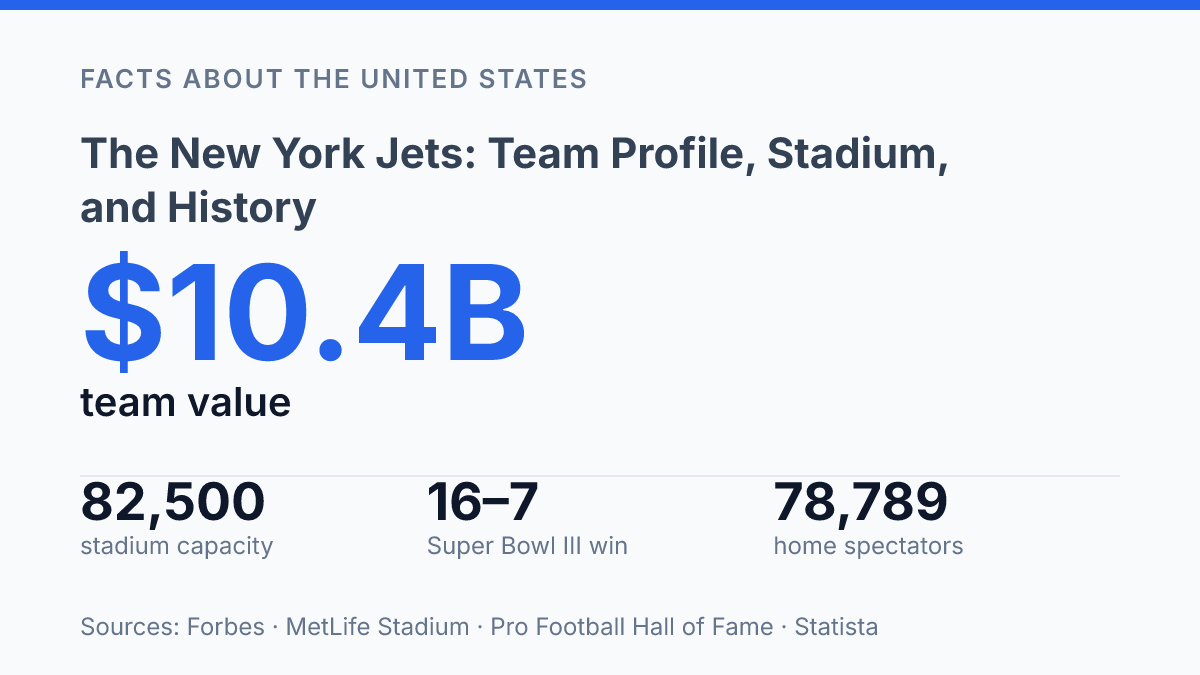
The New York Jets can be read through an unusual contrast: a 2–5 record and third-place AFC East standing in the 2026 snapshot, set against a Forbes valuation of $10.4 billion. That gap between competitive frustration and institutional strength is central to understanding the franchise. Founded in 1959 as an AFL-era team, renamed from the Titans to the Jets in 1963, and defined historically by the 16–7 Super Bowl III win over Baltimore on January 12, 1969, the organization carries more than its recent results.
Its current profile also includes a shared 82,500-seat home at MetLife Stadium, a leadership reset under head coach Aaron Glenn, and strong attendance despite criticism of ownership in the NFLPA’s 2025 club report card. The story is not only where the team sits in the standings, but why its identity still carries weight in New York and across the NFL.
Team identity and place in the NFL
A franchise identified with New York, New York is formally a metropolitan-area club, a distinction that explains why official descriptions often reach beyond one city boundary. The New York Jets are a professional American football team based in the New York metropolitan area, representing New York, New York, United States, while drawing their identity from a regional sports market that extends across city and state lines.
In league structure, the club competes in the National Football League as a member of the American Football Conference East division. That divisional placement puts the Jets in one of the NFL’s four-team AFC groupings, where standings are shaped first by divisional competition and then by broader conference results. NFL Pro listed the team at 2–5 and third in the AFC East in its 2026 snapshot, a current-status marker rather than a full measure of the franchise’s broader profile.
The organization’s present football leadership is centered on head coach Aaron Glenn, who was hired on January 22, 2025, according to the team’s own leadership listings. His role is central to the club’s on-field operation because the head coach sets staff structure, competitive priorities, and weekly preparation within the constraints of the roster and front office.
The franchise’s league identity also reflects its AFL lineage: it was awarded on August 14, 1959, played as the New York Titans from 1960–62, then as the New York Jets from 1963–69 in the AFL before joining the NFL in 1970, according to the Pro Football Hall of Fame. That sequence explains why the club is both a long-established New York football brand and a modern NFL member rooted in the league’s merger-era structure.
Ownership, leadership, and home venue
The Jets’ most visible home marker is MetLife Stadium in East Rutherford, New Jersey, not a venue inside New York City limits. That geography matters because the team’s public identity is tied to the New York metropolitan market rather than to a single municipal boundary. The stadium’s location in North Jersey places the franchise inside the same media, sponsorship, commuting, and fan economy that defines New York football, even as the mailing address complicates a simple city-based label.
Ownership is centered on Woody Johnson and Christopher Johnson, with the team’s official 2025–2026 front office listing Robert Wood Johnson as chairman and Christopher W. Johnson as vice chairman. The same directory lists Darren Mougey as general manager and Hymie Elhai as president, showing a structure in which family ownership sits above the football and business operations. That distinction is useful because public discussion of the club often blends ownership decisions, roster management, stadium economics, and fan expectations into one organizational profile.
According to MetLife Stadium, the venue is home to both the Jets and the Giants and has a capacity of 82,500. Sharing one of the NFL’s largest stadiums can simplify major-event operations and concentrate football infrastructure in a single metropolitan venue. It also means the Jets’ home presentation must compete for visual and cultural distinction within the same building used by another New York-market franchise.
The business scale remains large despite recurring scrutiny of ownership. Forbes valued the franchise at $10.4 billion in 2026, up from $8.1 billion in 2024, and reported $716 million in revenue.
Player sentiment has been less favorable: the NFLPA’s 2025 club report card gave Jets ownership an F, said Woody Johnson had the league’s lowest owner score for contributing to positive team culture, and ranked ownership’s commitment to building a competitive team 31st of 32. Together, the figures show a franchise with major market value and stadium reach, but also with leadership perceptions that remain a central part of its day-to-day identity.
1969 title and franchise history
A single 16–7 result from January 1969 still supplies the Jets’ clearest historical dividing line. According to the Pro Football Hall of Fame, the franchise’s first Super Bowl appearance ended with a win over the Baltimore Colts in Super Bowl III on January 12, 1969. That game produced the club’s only NFL championship, making 1969 the central competitive achievement in its history rather than one milestone among many comparable titles.
The importance of that championship comes from both scarcity and timing. Because the team has not added another league title since, the victory has remained the primary reference point for evaluating the franchise’s peak. It also gives the Jets a fixed place in New York football history: the club is not remembered only as a long-running metropolitan franchise, but as one whose defining moment came through a championship that still carries institutional weight decades later.
That emphasis can narrow public memory if treated as the whole story. A single title does not account for the team’s extended presence, generational fan base, or continuing role in the city’s football culture. Still, the 1969 championship remains the anchor because it is the one achievement that most clearly connects the franchise’s name, history, and competitive legacy in a way no later season has matched.
Why the Jets matter to New York sports
The Jets can share football attention and still remain unavoidable in regional sports because the New York market is large enough to make split allegiance a major public presence. Being one of two NFL teams associated with the city increases visibility through constant comparison, but it also means coverage, fan identity, and civic argument are often divided rather than centered on a single franchise. That tension is part of the club’s place in local sports culture, where relevance is measured not only by trophies but by sustained attention across generations of fans.
The franchise name functions as a metropolitan label rather than a narrow municipal address. New York signals the city’s media power and sporting identity, while the team’s audience extends across the wider region, including suburban and commuter communities that treat New York teams as shared civic property. This helps explain why the club’s identity remains tied to the city even when its practical footprint reaches beyond city boundaries.
Divisional competition gives that identity a recurring national frame. The AFC East places the Jets in regular conflict with the Buffalo Bills, Miami Dolphins, and New England Patriots, creating annual points of comparison that are familiar to both local supporters and national audiences. These rivalries matter because they turn the schedule into a repeated test of regional status, not just a sequence of isolated games.
Public interest is also visible in attendance. Statista reported that the Jets averaged 78,789 home spectators in 2024, a figure that indicates durable demand in a crowded sports market. For New York sports, the franchise matters because it combines a city-branded identity, a broad metropolitan fan base, and a divisional setting that keeps the team in regular conversation even when attention is shared.
Where brand strength stops being enough
A franchise with this profile is best assessed through competing measures rather than a single verdict. Standings show the limits of the current football operation, while attendance, valuation, and historical memory show why the club remains commercially and culturally durable. The unresolved question is whether new leadership can turn that durability into credibility on the field.
For a team sharing the country’s largest media market and an 82,500-seat stadium, patience is not the same as indifference. The practical consequence is clear: future evaluations of the Jets will depend less on the force of their brand than on whether organizational stability produces results that match the scale of the platform.
Frequently Asked Questions
Q: What division do the New York Jets play in?
A: The team competes in the NFL’s AFC East, where it plays against three other division rivals. This placement shapes the regular-season schedule and creates a consistent set of divisional matchups each year.
Q: Who owns the New York Jets?
A: The franchise is owned by Woody Johnson and Christopher Johnson. Ownership has been central to the club’s modern administration and long-term football operations.
Q: Who is the current head coach of the New York Jets?
A: The current head coach is Aaron Glenn. The head coach directs on-field strategy, practice preparation, and game management across the season.
Q: Where do the New York Jets play home games?
A: The Jets play home games at MetLife Stadium. The venue is located in the New York metropolitan area and is shared with another NFL franchise, which makes it one of the league’s most recognizable shared stadiums.
Q: How many NFL championships have the New York Jets won?
A: The Jets have won 1 NFL championship, which came in 1969. That title remains the franchise’s defining championship achievement and is still a major part of its history.