
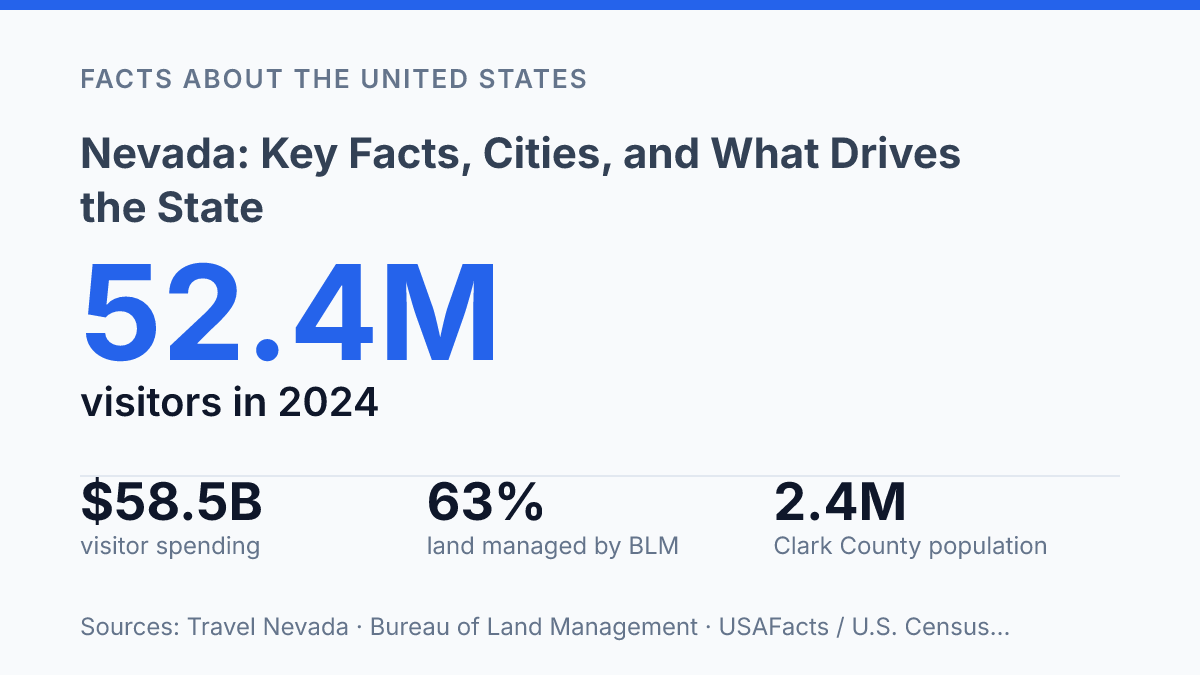
Nevada pairs a 2025 population of 3,282,188 with 109,860.46 square miles of land, creating a state where growth is concentrated in a few urban areas while vast stretches remain sparsely settled and federally managed. Nearly 48 million acres, about 63% of the state’s land base, are managed by the Bureau of Land Management, a fact that shapes development, mining, recreation, conservation, and access.
The state is often reduced to Las Vegas, but the numbers point to a broader structure: Clark County holds most residents, tourism supports a large share of employment, gaming remains a major fiscal and commercial force, and mineral extraction continues to define the “Silver State” in economic rather than purely historical terms. Understanding the state requires connecting its geography, population patterns, city hierarchy, public lands, and symbols to the industries that continue to drive daily life.
State profile and geographic setting
More than three-fifths of the state’s land is federally managed, a fact that helps explain why settlement, infrastructure, grazing, mining, conservation, and military uses are so closely tied to public-land policy. The Bureau of Land Management says it manages nearly 48 million acres there, about 63% of the land base, making federal ownership a structural feature rather than a marginal land-use category.
As of July 1, 2025, Nevada had 3,282,188 residents across 109,860.46 square miles of land, according to U.S. Census Bureau, 2025 QuickFacts. That combination produces a state that is large in area but relatively sparse overall, with population concentrated in a limited number of valleys and metropolitan corridors rather than evenly distributed across the interior.
The state lies in the western United States, bordered by California to the west and southwest, Oregon and Idaho to the north, Utah to the east, and Arizona to the southeast across the Colorado River region. New Mexico is part of the broader American Southwest, but it does not share a border with the state. The capital is Carson City, near the Sierra Nevada and Lake Tahoe region, while Las Vegas is the largest city and the dominant urban center in the south.
Physical geography strongly shapes where people live and how land is used. Much of the state sits within the Basin and Range Province, where north-south mountain ranges alternate with broad valleys and closed basins.
The climate is among the driest in the country, so water availability, transport routes, and energy systems carry unusual weight in settlement patterns. This creates a clear geographic contrast: a vast arid interior with extensive public lands, and a population pattern concentrated in a few urbanized areas that depend on carefully managed regional infrastructure.
How the state economy is structured
Visitors spent $58.5 billion in 2024, a scale that makes travel demand one of the clearest measures of the state’s economic structure, according to the state tourism office and Tourism Economics. The same report estimated that the visitor economy generated $39.0 billion in GDP, equal to 15.0% of statewide output, and sustained 459,081 jobs, or 21.3% of all jobs. That concentration explains why Las Vegas and Reno are not only entertainment centers but also employment, convention, retail, and restaurant hubs tied to national and international travel cycles.
Gaming remains the signature revenue engine within that broader tourism economy. State gaming regulators reported $15.64 billion in statewide gaming win for July 2024 through June 2025, with Clark County accounting for $13.58 billion, or 86.8%, and 149,367 licensed slot machines statewide.
Major operators such as MGM Resorts International and Caesars Entertainment anchor large resort portfolios on the Las Vegas Strip, while Reno’s casinos serve a smaller but still significant regional market. This model creates large employment and tax benefits, but it also leaves the economy exposed when air travel, conventions, or discretionary leisure spending weaken.
Mining provides a different economic base, less visible to many visitors but central to the state’s industrial profile. The state Bureau of Mines and Geology and Division of Minerals reported $10.099 billion in mineral, petroleum, and geothermal extraction in 2024.
Gold production reached 3,479,748 troy ounces, equal to 68% of U.S. output, confirming the state’s role as the country’s dominant gold producer. The same report noted that it remained the only U.S. state producing lithium compounds from primary extraction, linking traditional mining expertise to battery supply chains and energy storage demand.
Growth in logistics, warehousing, and energy projects has broadened the economy beyond resorts and mines. The Las Vegas area benefits from proximity to Southern California consumer markets, while the Reno-Sparks area has attracted distribution and advanced manufacturing activity along major western freight corridors. Renewable energy and geothermal development also fit the state’s resource profile, although these industries depend on transmission capacity, permitting, commodity prices, and long-term infrastructure investment rather than visitor volumes.
Major cities and population patterns
Nearly three out of four residents live in Clark County, making the state’s settlement pattern far more concentrated than its large map suggests. USAFacts, using U.S. Census Bureau 2024 data, estimated the county at about 2.4 million people, or 73.7% of the statewide total. That concentration places Las Vegas at the center of the population system, with Henderson forming the second major city in the same metropolitan area and North Las Vegas adding another large urban population nearby.
City-level figures show how much of the urban hierarchy is anchored in the south. The 2024 estimates put Las Vegas at 678,922 residents, Henderson at 350,039, and North Las Vegas at 294,034, while Reno had 281,714 residents.
Reno remains the main population center in the northwest and, together with Sparks and nearby communities, forms the state’s second major metropolitan cluster. The result is not a balanced spread of mid-sized cities across the state, but two dominant urban regions separated by extensive rural territory.
Growth since the late 20th century has been especially strong in the Las Vegas metropolitan area, driven by domestic migration, job creation, comparatively available land for suburban expansion, and the area’s role as the state’s primary service and employment hub. Henderson illustrates this shift particularly clearly because it expanded from a smaller industrial community into one of the state’s largest municipalities through master-planned housing, annexations, and regional population inflows. Population gains have also continued around Reno, though on a smaller scale than in the south.
The state demographer’s 2024 projections indicate that this pattern is expected to persist rather than reverse. The statewide population is projected to rise from 3,302,982 in 2024 to 3,944,225 in 2043, with Clark County projected to reach 2,960,319 and Washoe County 578,070. For public agencies, that means transportation, water, housing, schools, and health services are most pressured in the two metropolitan regions, while rural counties face a different challenge: maintaining long-distance roads, emergency response, utilities, and basic services across large areas with relatively few residents.
Places and symbols that define Nevada
A single state identity can stretch from the neon corridor of the Las Vegas Strip to the alpine shoreline of Lake Tahoe without leaving the most familiar public image of the state. The Strip functions as a national symbol of spectacle, signage, resort architecture, and live entertainment, while Lake Tahoe represents a cooler mountain setting shared with California and associated with forests, skiing, boating, and clear-water recreation.
Red Rock Canyon National Conservation Area adds a third visual marker: sandstone cliffs and Mojave Desert terrain close to the state’s largest urban area, with 195,819 acres set aside for conservation and outdoor use. Together, these places explain why general guides often describe the state through both built spectacle and open terrain, rather than through a single desert image.
The nickname “Silver State” anchors that identity in mining rather than entertainment. It refers to 19th-century silver discoveries, especially the Comstock Lode near Virginia City, which drew prospectors, investment, and settlement before statehood. The label has endured because it connects official identity with the mineral rushes that shaped territorial politics, place names, and early infrastructure, even when modern public attention often centers on other associations.
Official symbols broaden the reference picture. The state flower is sagebrush, an apt emblem for dry basins and rangelands; the state animal is the desert bighorn sheep, associated with rugged mountain habitat; and the motto is “All for Our Country.” The flag’s phrase “Battle Born” points to admission to the Union during the Civil War in 1864, a concise historical marker that often appears in classrooms and civic materials.
Taken together, the symbols and landmarks resist a single shorthand. Entertainment districts and desert scenery are highly visible, but mountain water, canyon country, mining memory, and public-land recreation all belong to the same state identity.
What the next population wave will require
Growth will make Nevada’s defining contrasts harder to treat as background facts. State demographer projections point to nearly 3.94 million residents by 2043, with Clark and Washoe counties absorbing much of that increase. That shift will raise practical questions about housing, water, transportation, recreation access, and the balance between private development and public land management.
The state’s next chapter is unlikely to be shaped by a single sector, even one as visible as tourism or gaming. It will depend on how population growth, mineral demand, conservation priorities, and city planning interact across a state where most people live in a small share of the land.
Frequently Asked Questions
Q: What is Nevada best known for?
A: Nevada is best known for its casino tourism, entertainment, and desert cities such as Las Vegas and Reno. The state also has a major role in mining, especially gold production, which remains one of its most important industries.
Q: Which are the largest cities in Nevada?
A: Las Vegas is the largest city, followed by Henderson and Reno. Most of the state’s population is concentrated in the Las Vegas Valley, which shapes housing demand, transportation, and public services.
Q: What drives Nevada’s economy?
A: Tourism is a central driver, supported by hospitality, conventions, and entertainment in the southern part of the state. Mining, logistics, construction, and professional services also contribute, giving Nevada a more diversified economy than its resort image suggests.
Q: Why is Nevada considered one of the driest states in the U.S.?
A: Most of Nevada has an arid climate because it lies in the Great Basin and is blocked by mountain ranges that limit moisture. Low rainfall affects water supply, agriculture, and long-term growth planning, especially in urban areas.
Q: Does Nevada have state income tax?
A: Nevada does not levy a state personal income tax, which is one reason it is often viewed as tax-friendly for residents and businesses. State revenue relies more heavily on sales taxes, gaming taxes, and business-related taxes than on income taxation.