
The New Orleans Saints drew 80,879 fans to Tulane Stadium for their first regular-season game in 1967, only months after selling 20,000 season tickets on the first day of their inaugural drive. That early demand helps explain why the franchise is best understood as both a football team and a New Orleans civic institution. Its history runs from a fast NFL launch in 1966-67 to a modern stadium era shaped by the Caesars Superdome, a $560 million renovation, and a lease that now extends through the 2035 season.
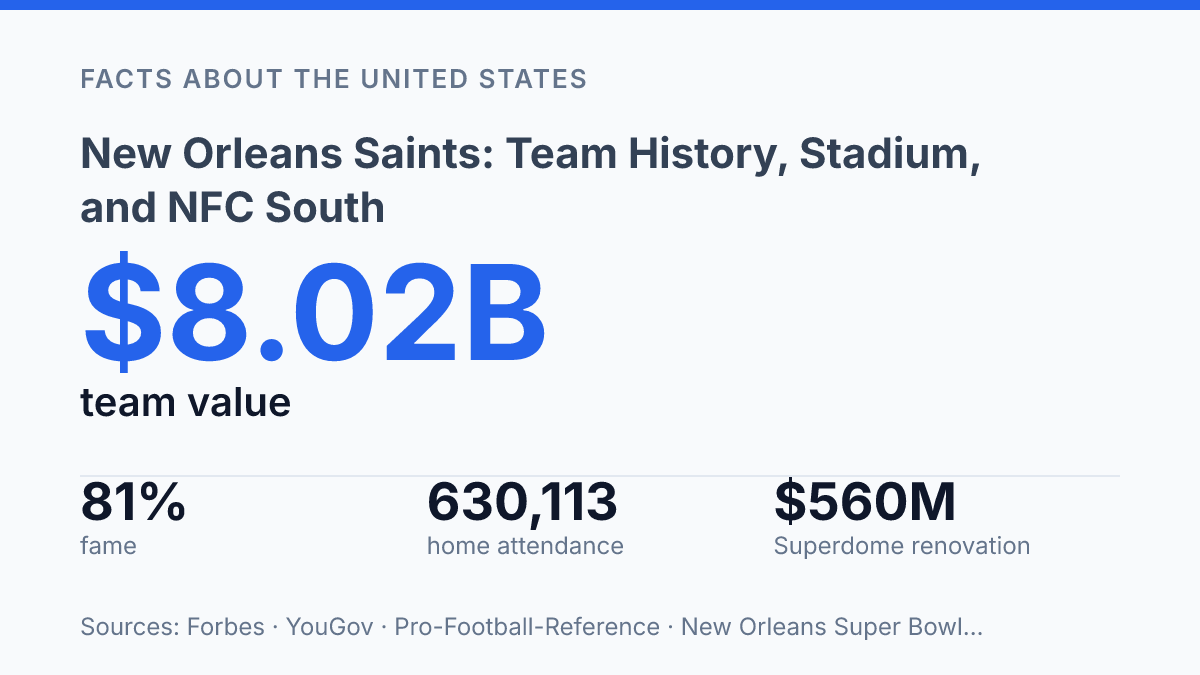
The team’s place in the NFC South adds the competitive frame, while attendance, valuation, and public-opinion data show how its identity can remain strong even when results fluctuate. A 2–5 start in the 2026 snapshot tells only part of the story; the larger record includes fan loyalty, infrastructure, divisional pressure, and a brand valued by Forbes at $8.02 billion.
How the franchise began in New Orleans
New Orleans received its NFL franchise on All Saints’ Day, a coincidence that helped turn a league expansion decision into a name rooted in the city’s own cultural language. The NFL awarded the city its 16th franchise on November 1, 1966, and the New Orleans Saints began play in 1967, according to the Pro Football Hall of Fame. The timing mattered because the expansion bid followed sustained local lobbying to bring major professional football to Louisiana, linking civic ambition with the NFL’s post-merger growth plans.
David Dixon, a New Orleans sports promoter, was central to the effort to secure a franchise, while John W. Mecom Jr. became the team’s first majority owner. Their roles reflected two sides of the club’s creation: Dixon helped build the case that New Orleans could support the NFL, and Mecom supplied the ownership structure needed for league approval. Political support also strengthened the bid, as Louisiana officials pushed for the city during a period when the NFL was expanding its national footprint.
The nickname “Saints” was announced on January 9, 1967, and it carried unusually strong local associations from the start. It referred not only to the All Saints’ Day franchise award but also to “When the Saints Go Marching In,” a song closely associated with New Orleans jazz, and to the city’s Catholic and carnival traditions. That made the name less like a generic sports brand and more like a civic marker, giving the new club an identity that residents could recognize immediately.
Early enthusiasm did not remove the instability typical of an expansion team. The first season-ticket drive sold 20,000 tickets on its first day and 33,400 before the 1967 season, according to the Pro Football Hall of Fame, showing that public demand preceded competitive success. The franchise’s early years were uneven on the field, but the club quickly became a Louisiana institution because its name, founding story, and fan response were tied closely to the city that had fought to land it.
Home field and game-day setting
The same indoor building that amplifies Saints home games has also staged eight Super Bowls, giving the club’s stadium a national profile well beyond its regular-season schedule. That dual role is central to how the venue functions: it is both a home-field setting for NFL games and a recurring host site for major events associated with New Orleans.
Since opening in 1975, Caesars Superdome has been the team’s defining home venue and one of the NFL’s best-known indoor stadiums. Its enclosed format helps concentrate crowd noise and removes weather as a major game-day variable, which supports a consistent home-field environment. The building’s visibility also attaches the team to a recognizable civic venue, especially when national broadcasts and postseason events place the stadium in front of audiences that extend beyond local supporters.
The stadium has changed most clearly through reinvestment and naming. Opened as the Louisiana Superdome, it later operated under corporate naming agreements before becoming Caesars Superdome in 2021.
A $560 million, five-phase renovation ran across five Saints offseasons from January 14, 2020, to August 21, 2024, according to New Orleans Super Bowl Host Committee and Caesars Superdome renovation materials. That project modernized the building for both NFL operations and large-scale events while preserving its role as the club’s long-term home.
Game-day demand gives the venue’s importance a measurable base. In 2024, Saints regular-season home attendance totaled 630,113 at Caesars Superdome, according to Pro-Football-Reference, showing that the stadium remained a major draw even without a playoff season. The team’s stadium future also became more settled when the Saints and the Louisiana Stadium and Exposition District signed a 10-year lease extension in 2025 keeping the club in the building through the 2035 season, according to the team’s official site.
The broader significance of the Superdome comes from events beyond Saints games. Among the Super Bowl games hosted in New Orleans, the Superdome has repeatedly served as the main stage, including Super Bowl LIX in 2025. That pattern makes the building part of the franchise’s public identity as well as a major event venue for the city.
Where the Saints fit in the NFC South
Six of the Saints’ 17 regular-season games are locked into the same three opponents before the rest of the NFL schedule formula matters. The New Orleans Saints compete in the National Football Conference South division, most commonly identified as the NFC South, alongside the Atlanta Falcons, Carolina Panthers, and Tampa Bay Buccaneers. That alignment places the club in a four-team grouping within the NFC, which is one of the NFL’s two conferences.
Divisional structure gives the regular season a predictable core. Each team plays its three division rivals twice, once at home and once away, creating six annual division games that carry extra weight in the standings. The remaining games rotate through other NFC and AFC opponents under the league’s scheduling formula, but the repeated home-and-away matchups inside the division are the part of the schedule most directly tied to a team’s place in its immediate competitive group.
Playoff qualification also runs through the division format. The NFL sends seven teams from each conference to the postseason: four division winners and three wild-card teams. Winning the NFC South therefore provides the clearest route to the playoffs, because the division champion receives an automatic postseason berth regardless of whether multiple wild-card contenders elsewhere in the conference have similar records.
This structure simplifies the competitive target while raising the importance of familiar opponents. A strong record against Atlanta, Carolina, and Tampa Bay can separate a team in a tight divisional race, while poor results in those same games can leave it dependent on wild-card calculations and conference tiebreakers. Divisional record is also one of the NFL’s tiebreaking criteria, so these games can affect both the standings and the mechanics used to settle them.
Notable achievements and public identity
The franchise’s defining national moment is still an onside kick, a late interception, and a championship won less than five years after Hurricane Katrina displaced its home season. The Saints earned their first and only NFL title in the 2009 season, defeating the Indianapolis Colts 31–17 in Super Bowl XLIV. Quarterback Drew Brees, named the game’s Most Valuable Player, gave the team a central figure for its modern identity: precise, prolific, and closely associated with the city’s post-Katrina era.
That championship changed the club’s standing beyond Louisiana because it converted decades of uneven results into a nationally recognized success story. The Saints are not a franchise with a large stack of Lombardi Trophies; their profile rests on one Super Bowl title, which makes the 2009 run especially concentrated in memory. The win also arrived during a period when the team’s offense, led by Brees and head coach Sean Payton, became one of the league’s most identifiable units.
Local meaning is harder to separate from the events surrounding Katrina. The team spent the 2005 season away from its damaged home facility, then returned to the Superdome in 2006 for a nationally televised game against Atlanta that became a civic marker as much as a sporting event. Steve Gleason’s blocked punt in that game remains one of the franchise’s most replayed moments because it symbolized the return of major communal gatherings to a city still recovering.
The depth of that civic attachment was visible from the beginning: the Pro Football Hall of Fame records that the NFL awarded New Orleans its 16th franchise on November 1, 1966, the club was named the Saints on January 9, 1967, and the first season-ticket drive sold 20,000 tickets on its first day and 33,400 before the 1967 season began. Seen against that history, the team’s public identity is not only a record of wins and losses. It reflects a long relationship between a city, a football institution, and shared moments that carried meaning well beyond the standings.
Why the Superdome agreement changes the frame
The Saints’ next phase is anchored less by uncertainty over place than by the harder question of competitive direction. A renovated Superdome and a lease through 2035 give the franchise unusual stability at a time when NFL team values are rising quickly and local stadium arrangements often shape long-term strategy. That stability does not solve roster performance, divisional standing, or year-to-year public mood, but it changes the terms of evaluation.
The franchise can be judged against a fixed home-field future rather than relocation speculation or facility doubt. If attendance remains resilient while on-field results lag, the clearest measure to watch will be whether financial strength and civic attachment translate into a stronger NFC South position.
Frequently Asked Questions
Q: What league do the New Orleans Saints play in?
A: The New Orleans Saints are part of the National Football League. They compete in the league’s National Football Conference South division, which places them among the NFL’s four NFC South teams.
Q: Where are the New Orleans Saints based?
A: The team is based in New Orleans, Louisiana. That location ties the franchise closely to the city’s regional identity and gives it a clear home market within the NFL.
Q: Which division are the New Orleans Saints in?
A: The Saints play in the NFC South. Division membership determines most of the team’s regular-season matchups against familiar opponents and shapes its path to the playoffs.
Q: Are the New Orleans Saints an NFL team?
A: Yes. The Saints are a professional American football team in the National Football League. Their status as an NFL franchise places them in the top tier of U.S. professional football.
Q: Why are the New Orleans Saints associated with the NFC South?
A: They are one of the four teams assigned to the NFC South division. That alignment affects scheduling, standings, and divisional competition, which are central to how NFL teams are evaluated over a season.