
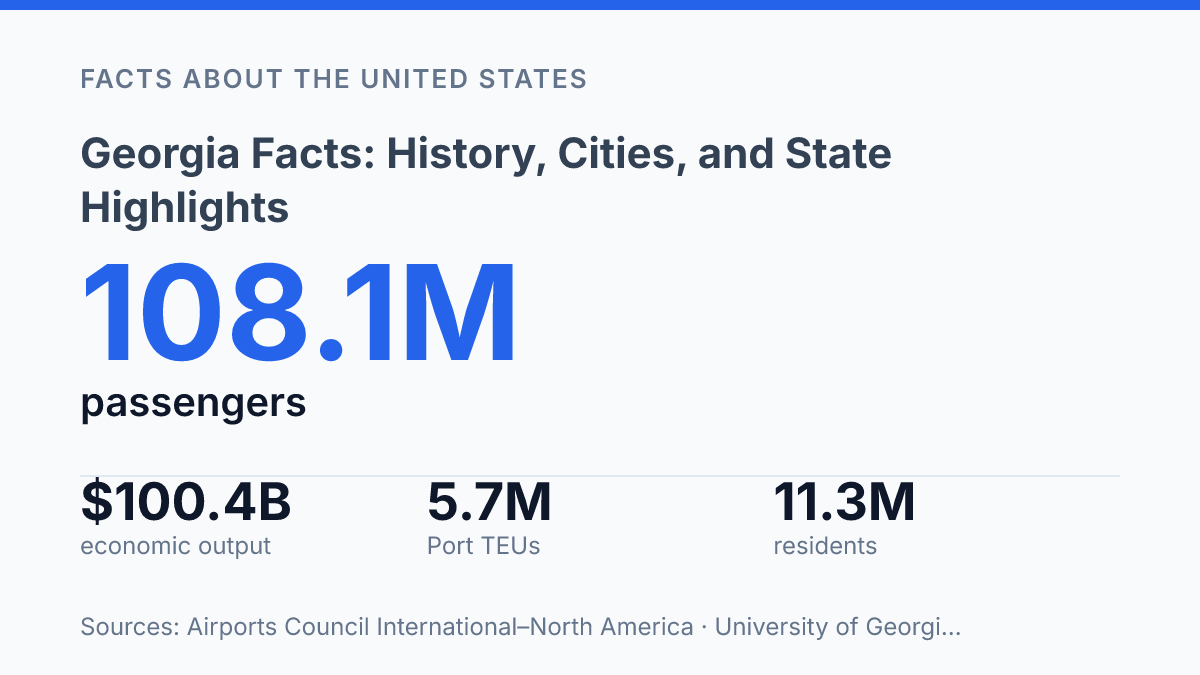
Georgia holds 11,302,748 people across 57,716.96 square miles, but its real scale shows up in the way Atlanta, Savannah, Augusta, farms, ports, and 159 counties all pull in different directions. Atlanta’s airport handled 108.1 million passengers in 2024, while the Port of Savannah moved more than 5.7 million TEUs in fiscal year 2025, so this isn’t just a state with a famous skyline and a peach nickname.
It’s a place where colonial history, poultry farms, cybersecurity investment, college towns, coastal trade, and small county seats all sit inside the same story. The useful facts are the ones that explain those contrasts: where the state sits, why certain cities matter, how older industries still shape the economy, and which details tend to stick after the map is folded away.
Where Georgia sits and what it covers
At 11,302,748 residents in 2025, up 5.5% from the April 2020 estimates base, Georgia covers 57,716.96 square miles of land, according to U.S. Census Bureau QuickFacts. That gives the state a useful scale to keep in mind: it’s populous, still growing, and large enough that its regions don’t all feel alike.
You’ll find it in the southeastern United States, with Atlanta serving as the state capital and best-known urban center. The state borders five other U.S. states: Florida to the south, Alabama to the west, Tennessee and North Carolina to the north, and South Carolina to the east. It also has direct access to the Atlantic Ocean, which matters because the coast gives the state a maritime identity as well as an inland Southern one.
The basic civic timeline starts early in U.S. history: Georgia became the 4th state to ratify the U.S. Constitution on January 2, 1788. Today, it is divided into 159 counties, a number that helps explain why the state can’t be reduced to Atlanta alone. Smaller cities, rural counties, and the long Atlantic coastline all shape how the state works, looks, and thinks about itself.
Major cities and what they’re known for
Atlanta’s airport handled 108.1 million passengers in 2024, a city-scale clue to why the state’s largest city carries so much economic weight. Hartsfield-Jackson Atlanta International Airport isn’t just a place people pass through; according to Airports Council International–North America, it remained the busiest airport in North America and globally in 2024. That gives Atlanta a reach that goes well beyond its skyline, helping support business travel, logistics, conventions, and the region’s role as a corporate hub.
Savannah tells a different story, but one that matters just as much. Its historic district is one of the city’s best-known draws, with squares, preserved architecture, and riverfront streets that make tourism a major part of its identity.
At the same time, the Port of Savannah is a serious trade engine: the Georgia Ports Authority reported that it moved 5,703,287 TEUs in fiscal year 2025, an 8.6% increase from the prior fiscal year. So Savannah isn’t only a postcard city; it’s also a major cargo gateway.
Augusta is best known nationally for The Masters, the annual golf tournament held at Augusta National Golf Club. That event gives the city a global sports profile every spring, but Augusta also has a growing technology angle. The Georgia Cyber Center opened there in July 2018 as a $100 million facility, giving the city a clearer place in cybersecurity, workforce training, and public-sector tech development.
Macon adds another layer to the state’s city story through music. Its legacy is tied to artists and acts such as Little Richard, Otis Redding, and the Allman Brothers Band, which gives the city a cultural identity that’s distinct from Atlanta’s business reach or Savannah’s port-and-history mix. Taken together, these cities show how the state is shaped by aviation, trade, tourism, sports, technology, and music rather than by one metro area alone.
History, agriculture, and industry
The Peach State’s biggest farm surprise is that chickens, not peaches, bring in the largest share of farm value. Broilers were the state’s top farm-gate commodity in 2024, worth $6.1 billion and accounting for 36.1% of total farm-gate value, according to UGA’s College of Agricultural & Environmental Sciences.
Peanuts are just as central to the story, with the state producing about half of the nation’s crop in 2024. Pecans and peaches still matter, too, and that peach nickname has stuck because it’s easy to remember, even if poultry and peanuts carry more economic weight.
History here reaches into the country’s founding conflicts, not just textbook dates. During the American Revolution, fighting between Patriot and Loyalist forces included the Battle of Kettle Creek, a Patriot win that helped weaken British-aligned support in the backcountry.
The state’s later national significance also runs through the Civil Rights Movement. Atlanta was the birthplace of Martin Luther King Jr. in 1929, and his childhood home in the Sweet Auburn area remains one of the clearest links between local history and the wider push for civil rights.
Farming is still part of daily life and employment well beyond the fields. The 2026 Ag Impact Report, based on 2024 data, says food and fiber production and related industries supported 370,400 jobs and contributed $100.4 billion to the state’s economic output. That figure includes the broader chain around agriculture: processing, transportation, supplies, equipment, and the businesses that connect farm products to stores and restaurants.
At the same time, the modern economy isn’t only rural or agricultural. Atlanta is home to major corporate names such as Coca-Cola and Delta Air Lines, and the film and television production sector around the metro area has become a visible source of jobs and spending. That mix is the real takeaway: older strengths like poultry, peanuts, pecans, and peaches still shape the state, while large companies and media production help drive newer growth.
Fun facts people usually remember
The Peach State nickname is more famous than the peach crop itself. The state is known as the Peach State because peaches became a strong symbol of Southern hospitality, summer roadside stands, and state branding. Commercial peach farming still exists, but it’s smaller than many people assume; the nickname works better as a cultural shortcut than as a measure of the crop’s economic rank.
Stone Mountain is another fact that tends to stick because it’s easy to picture and not just another pretty lookout. The granite dome rises above a major tourism park known for hiking, views, family attractions, and a very large mountain carving. Its popularity matters because it shows how one landmark can be both a recreational draw and a public symbol with complicated meaning.
For a natural fact with a completely different feel, the Okefenokee Swamp covers about 438,000 acres of peat-filled wetlands, according to the U.S. Fish and Wildlife Service. Its dark, tea-colored water comes from tannins released by decaying plants, and the area is strongly associated with alligators, cypress trees, wading birds, and quiet paddling trails. That makes it memorable for a simple reason: the state isn’t only cities, farms, and historic sites; it also has one of the South’s most distinctive wild places.
What the numbers change about the Peach State
The Peach State makes more sense when you treat it as a set of connected systems rather than a checklist of trivia. Population growth changes roads and housing, ports change warehouse corridors, airports change business reach, and farm output keeps rural counties tied to national supply chains. If you’re using these facts for travel, school, relocation, or general context, check the date behind the number before you repeat it.
A 2025 population estimate, a 2024 airport count, and a 2026 agriculture report each capture a slightly different moment. That timing matters because the state people describe today may already be shifting by the next data release.
Frequently Asked Questions
Q: What is Georgia best known for?
A: Georgia is known for its role in American history, its mix of coastal and mountain scenery, and major cities like Atlanta. It also stands out for agriculture, especially peaches, peanuts, and pecans. If you’re looking at the state as a whole, its economy and transportation links make it one of the South’s most influential states.
Q: Why is Atlanta such an important city in Georgia?
A: Atlanta matters because it’s the state capital and the largest city, so a lot of Georgia’s government, business, and transportation activity flows through it. It’s also a major hub for airlines, conventions, and cultural institutions. That makes it one of the most recognizable cities in the Southeast.
Q: What are some historic places to visit in Georgia?
A: You can find historic sites tied to colonial America, the Civil War, and the civil rights movement across the state. Savannah, Augusta, and Atlanta each offer different pieces of that story, from preserved old districts to museums and memorials. If history is your focus, Georgia gives you a lot of different eras in one trip.
Q: What part of Georgia has the best scenery?
A: That depends on what you want to see. North Georgia is known for mountain views and hiking, while the coast offers beaches, marshes, and island scenery. The state also has plenty of farmland and pine forests in between, so the scenery changes a lot as you travel.
Q: When is the best time to visit Georgia?
A: Spring and fall are usually the most comfortable times, with milder temperatures and less humidity than summer. Winter is generally mild in much of the state, though north Georgia can get cooler and even see snow. If you’re planning outdoor activities, spring and fall are often the easiest seasons to enjoy.