
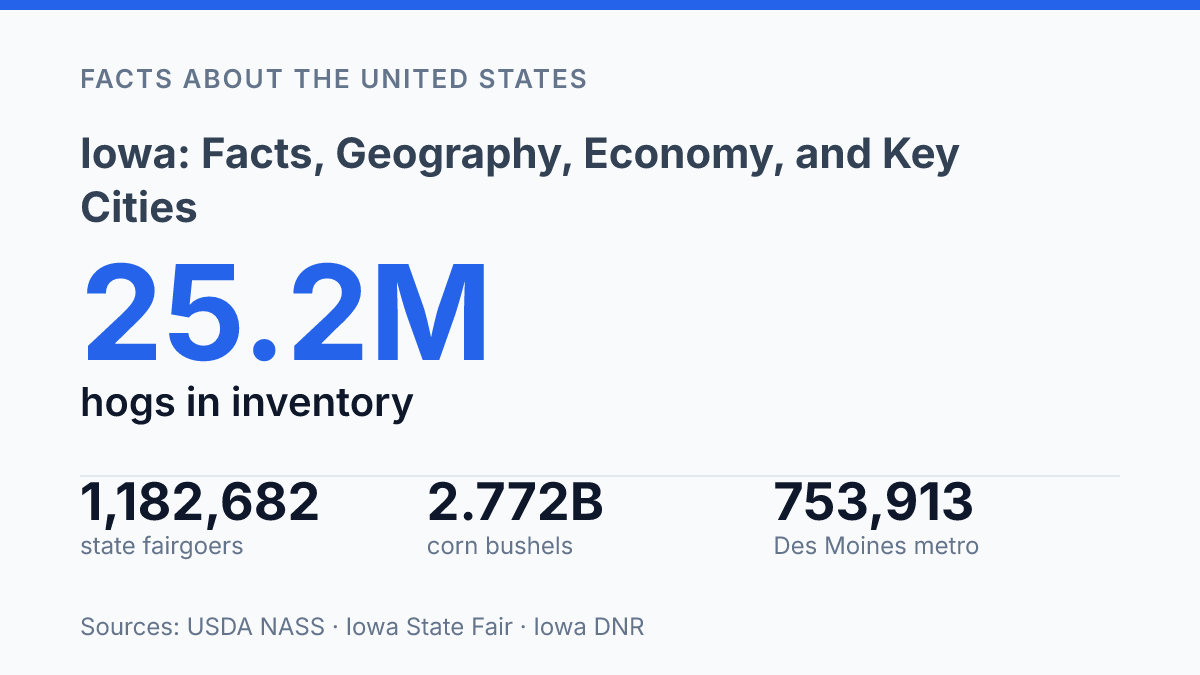
Iowa covers 55,853.7 square miles and has 3,241,488 residents, giving it about 58 people per square mile, yet its farm, factory, university, and campaign networks reach far beyond its borders. The state’s agricultural scale is easy to measure: 86,200 farm operations work 29.9 million acres, and corn production reached 2.772 billion bushels for grain in 2025. Its economy, however, is not defined by farming alone, because manufacturing accounts for 17% of state GDP and supports more than 222,000 jobs.
Population patterns add another layer, with the Des Moines metro holding about 22% of residents while Cedar Rapids and Iowa City anchor other major centers. The sections ahead connect those numbers to geography, industry, education, politics, and culture, showing why a lightly populated Midwestern state receives national attention disproportionate to its size.
Where Iowa is and what the state is known for
Two great rivers define much of the state’s outline: the Mississippi River marks its eastern edge with Wisconsin and Illinois, while the Missouri River forms a major western boundary with Nebraska. That river-framed position helps explain why the state is understood not only as farmland, but also as a place organized around corridors of settlement, transport, and regional exchange.
The state sits in the central Midwest and borders six states: Minnesota to the north, Wisconsin and Illinois to the east, Missouri to the south, and Nebraska and South Dakota to the west. According to the U.S. Census Bureau, Iowa has 55,853.7 square miles of land area, 3,241,488 residents, and about 58 people per square mile, a combination that points to a relatively spacious settlement pattern compared with more densely urban states.
Physical geography has also shaped the state’s public image. Much of its land is associated with glacial plains and deep, productive soils, which support the agricultural identity often attached to the region.
Yet that shorthand can be too narrow. The Mississippi and Missouri edges, rolling interior landscapes, and central position between the Great Plains and the Great Lakes all contribute to how the state functions and how it is perceived.
Its historical identity is condensed in the nickname “The Hawkeye State”, a label widely used in civic, athletic, and cultural settings. Statehood came in 1846, placing it among the nineteenth-century states admitted as U.S. settlement and political organization expanded westward. Together, the nickname, river boundaries, glaciated terrain, and Midwest location form the basic frame for understanding the state before turning to its economy, cities, or political role.
How agriculture and manufacturing shape the economy
Manufacturing accounts for 17% of state GDP, according to the Iowa Economic Development Authority, placing the state fifth nationally for manufacturing’s share of output. That figure complicates any view of the economy as crop production alone: factories, processors, and value-added exporters are central to income as well as farm-linked supply chains. In 2025, the authority reported $23.8 billion in manufactured and value-added exports, showing that industrial activity reaches well beyond local markets.
Crop farming still anchors this wider system. The USDA National Agricultural Statistics Service reported 86,200 farm operations working 29.9 million acres, with corn for grain production reaching 2.772 billion bushels valued at about $11.37 billion in 2025. Corn and soybeans remain the core crops because they support both direct commodity sales and downstream industries, including animal feed, grain handling, processing, and corn-based ethanol production.
Livestock and related processing convert crop output into another layer of economic activity. USDA/NASS counted 25.2 million hogs in inventory on December 1, 2025, and the state held 32% of the nation’s 2024 hog inventory; red meat production reached 9.16 billion pounds in 2024. Pork production creates demand for feed, slaughter, packaging, cold storage, and transport, while egg production and ethanol add other major links between farms, processors, and regional logistics networks.
Employment data show how much of this value is industrial rather than purely agricultural. The state workforce agency’s 2024 manufacturing profile counted 222,328 manufacturing jobs across 4,246 locations, equal to 14.2% of covered public and private employment. The average annual manufacturing wage was $74,637, or 21.7% above the statewide average, which helps explain why industrial employers are a major source of household income as well as business output.
The result is an economy in which agriculture supplies raw materials, but manufacturing, food processing, biofuels, and bioscience-related activity capture a larger share of value. Ethanol plants depend on corn, livestock operations depend on feed, and processors depend on steady farm output, yet the highest economic impact often comes from turning those inputs into fuel, meat, eggs, ingredients, machinery, and exported goods.
Major cities, population patterns, and education hubs
The Des Moines metropolitan area contains 753,913 people, or 22% of the state total, according to the state Department of Natural Resources in 2025. That concentration reflects the capital city’s role as the largest urban center, with state government, finance, insurance, health care, and business services reinforcing its pull well beyond the city limits. Its scale also makes central commuting patterns different from those in less urban counties, where workers often travel longer distances between small towns, county seats, and regional employers.
Cedar Rapids is another major population and employment center, and its metro area had 278,677 residents, or 9% of the state total, in the same 2025 data. Davenport anchors an important eastern urban area tied to the Quad Cities, while Sioux City serves as a major center in the northwest. Together, these cities show that the state is not simply a collection of small towns, although many communities remain small enough that access to hospitals, higher education, public agencies, and specialized services often depends on the nearest regional hub.
Higher education adds a second layer to the population map because major campuses draw students, staff, research activity, and medical or technical services into specific cities. The University of Iowa in Iowa City is especially significant for health care, law, writing, and research, while Iowa State University in Ames is closely associated with engineering, science, agriculture-related research, and technology transfer.
The Board of Regents reported that public university enrollment rose by 1,378 students, or 2%, in Fall 2025 compared with the previous fall; state residents made up 58% of students, and all 99 counties were represented. That statewide reach helps explain why university towns influence labor markets and civic life beyond their own metro boundaries.
Why Iowa matters in national politics and culture
Few mid-sized states receive as much presidential scrutiny as the Iowa caucuses generate in a single winter week. Their influence comes less from the state’s size than from timing: candidates, journalists, donors, and party organizers have long treated the caucus results as an early signal of campaign strength, message discipline, and voter enthusiasm. In the 2024 cycle, Republicans held the First-in-the-Nation Caucus on January 15, 2024, with 110,272 total votes in final reporting by the state party, a figure that mattered because it shaped national coverage at the opening stage of the contest rather than because it represented a large share of the American electorate.
That political visibility is narrower than it can appear from national news coverage. The state attracts intense attention during nomination season, then often recedes from the political spotlight between presidential cycles. This pattern helps explain why its national influence can seem larger than its population would suggest: the attention is concentrated, repeated, and tied to a process that rewards early momentum.
The Iowa State Fair gives the state a second, less formal route into national politics and culture. Fair organizers reported 1,182,682 fairgoers in 2024, the largest attendance in the event’s 170-year history, making it not only a major annual gathering but also a public stage for political appearances, agricultural display, food traditions, and civic ritual. Presidential hopefuls often use the fair to perform accessibility in front of local and national media, while residents encounter national politics in a setting built around livestock shows, concerts, competitions, and fair food.
Popular culture has reinforced this visibility through a smaller set of recognizable references. The film Field of Dreams, tied to the baseball field near Dyersville, turned a rural site into a national symbol of memory, family, and American sport.
That reference does not represent the full complexity of the state, but it shows how one cultural image can travel farther than everyday coverage. Together, caucus politics, the state fair, and Field of Dreams help explain why the state remains familiar to many Americans even when it is not a constant focus of national media.
Why scale matters more than stereotypes
State profiles often flatten places into one or two familiar labels, but the evidence here points to a more useful reading: scale matters differently depending on what is being measured. An acreage statistic reflects commodity markets and land use, while a metro population count reveals where services, employers, and graduates concentrate.
A caucus turnout figure or State Fair attendance total captures a different kind of influence, one built through ritual, media attention, and repeated national exposure. For comparisons with neighboring states, those layers need to remain separate before drawing conclusions about growth, political influence, or economic risk.
Frequently Asked Questions
Q: What is Iowa known for?
A: Iowa is widely known for its agricultural production, especially corn and soybeans. It also has a strong role in U.S. politics because the state hosts the first-in-the-nation presidential caucuses. That combination of farming and political influence makes the state notable beyond its population size.
Q: What are the largest cities in Iowa?
A: Des Moines is the state capital and largest city, followed by Cedar Rapids, Davenport, Sioux City, and Iowa City. These cities anchor the state’s main population and economic centers. They also serve different functions, with Des Moines as the government and insurance hub and Iowa City as a major education center.
Q: What is the geography of Iowa like?
A: Iowa is dominated by flat to gently rolling terrain that was shaped by glaciers and prairie ecosystems. The state lies between the Mississippi River on the east and the Missouri River on the west, which gives it a strongly river-defined border. Much of its land is among the most productive farmland in the United States.
Q: How important is agriculture to Iowa’s economy?
A: Agriculture remains one of Iowa’s core economic sectors, with crop production and livestock contributing heavily to state output. Corn, soybeans, pork, and ethanol are especially significant. This agricultural base also supports related industries such as food processing, equipment manufacturing, and transportation.
Q: Is Iowa a good place to live?
A: Iowa is often considered attractive for its relatively low cost of living, strong public universities, and access to mid-sized cities. Job opportunities are concentrated in sectors such as manufacturing, healthcare, insurance, and agriculture. The main tradeoff is that population growth and urban amenities are more limited than in larger metro-heavy states.