
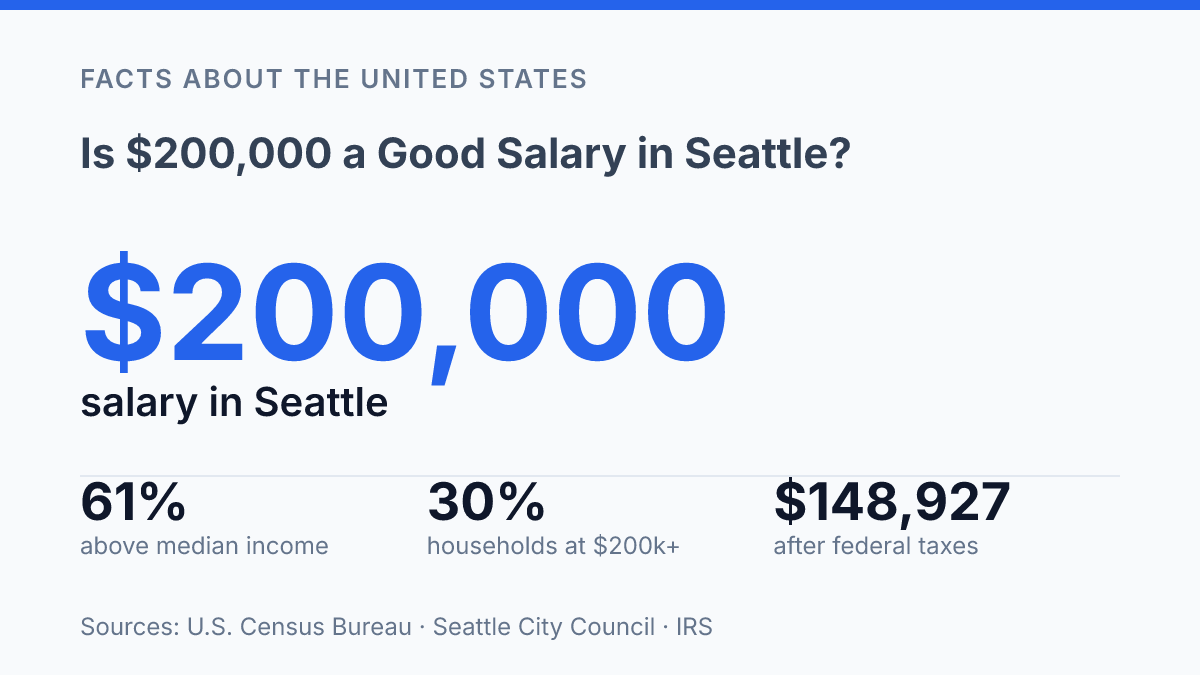
A $200,000 salary in Seattle is about 61% above the city’s $123,860 median household income, but it still falls inside a bracket reached by roughly 30% of local households. That is why the question “Is $200,000 a good salary in Seattle?” has a more nuanced answer than the headline number suggests. Federal income and payroll taxes can reduce a single filer’s pay to about $148,927 before benefits, retirement contributions, and sales taxes, while Seattle’s 10.55% sales tax affects everyday spending.
The same income can make typical rent manageable, with Zillow’s $2,185 metro rent equal to about 13.1% of gross monthly income, yet it can feel far less flexible when childcare, a high purchase price, or a larger household enters the budget. The useful answer comes from comparing income rank with after-tax cash flow and fixed costs.
How $200,000 compares with Seattle pay levels
A $200,000 salary is not merely above Seattle’s midpoint; it clears the city’s median household income by about $76,000. According to U.S. Census Bureau QuickFacts, Seattle’s median household income is $123,860 and per-capita income is $86,095 in 2020–2024 dollars, which means $200,000 is about 61% above the median household figure and roughly 2.3 times per-capita income. On pay comparisons alone, the answer to “Is $200,000 a good salary in Seattle?” is yes: it sits well above ordinary household and individual earnings in the city.
Labor-market averages point in the same direction. The Bureau of Labor Statistics reported an average Seattle-Tacoma-Bellevue wage of $44.13 per hour in May 2025, or about $91,790 a year, so $200,000 is roughly 2.18 times the average local wage. Even within computer and mathematical occupations, one of the region’s strongest pay categories, the average annualized wage was about $151,757, meaning $200,000 still exceeds a major high-earning professional benchmark rather than simply matching it.
Large local employers help explain why the number can feel recognizable in Seattle even while remaining high. Public self-reported compensation databases such as Levels.fyi commonly show many mid-level software roles at Amazon and Microsoft in the high-$100,000s to above-$200,000 range when salary, bonus, and equity are counted together.
Boeing pay data from public salary aggregators more often places many engineering roles in the low-to-mid-$100,000s, with higher figures concentrated in senior, specialist, or management positions. These employer comparisons suggest that $200,000 is plausible in Seattle’s upper professional labor market, especially in technology, but it is not representative of the typical worker.
That distinction matters because pay rank and purchasing power are separate questions. A salary can be far above local norms and still feel less expansive in a costly metro area, particularly once household size, taxes, childcare, and ownership costs enter the analysis. As a wage comparison, however, $200,000 is clearly high income in Seattle rather than merely average professional pay.
What $200,000 buys after taxes and living costs
A single Seattle earner at $200,000 can keep roughly $148,927 after federal income and payroll taxes before health premiums, retirement contributions, credits, and local consumption taxes are considered. Using a single-filer example for 2026, IRS and Social Security Administration rules imply about $36,734 in federal income tax before credits, with combined federal income and payroll taxes of about $51,073. The final paycheck can vary meaningfully if the worker contributes to a pre-tax 401(k), pays for employer health coverage, has stock compensation, or qualifies for deductions beyond the standard deduction.
Washington changes the calculation because it does not impose a normal state wage income tax, so Seattle workers avoid a tax layer that would reduce take-home pay in many other high-cost states. That advantage is real, especially at higher incomes, but it does not make the city tax-free. Seattle’s combined sales tax is 10.55%, according to the Washington Department of Revenue in 2026, so after-tax spending power is still affected by taxable purchases.
Housing is the largest reason the take-home number can feel either spacious or merely adequate. Zillow Research reported a typical Seattle metro rent of $2,185 in December 2025, equal to about 13.1% of gross monthly income on a $200,000 salary and roughly 17.6% of the estimated after-federal-tax monthly amount above. That makes ordinary renting manageable by common affordability standards, though premium apartments, parking, utilities, and neighborhood choice can raise the effective cost.
Homeownership creates a much sharper affordability test than renting. Redfin reported a Seattle median sale price of $879,474 in May 2026, and Seattle City Council materials estimated annual property tax of $8,254 on a median assessed-value home of $833,000. Before mortgage interest, insurance, maintenance, or a down payment are considered, that tax bill alone adds nearly $688 per month, which helps explain why a high salary can still encounter limits in the purchase market.
The same pattern appears in family-related costs, particularly childcare. Child Care Aware of Washington’s 2024 King County report, published in June 2025, listed median monthly center care at $2,530 for an infant, or $30,360 per year. No state income tax leaves more pay available than in many peer cities, but Seattle’s housing and care costs can absorb a large share of that advantage quickly.
Single earner vs family: how the answer changes
The same $200,000 can sit more than three times above a single adult’s basic-needs benchmark and only modestly above a two-parent, two-child benchmark in the Seattle metro. MIT’s Living Wage Calculator, updated February 15, 2026, estimates that a single adult in the Seattle-Tacoma-Bellevue area needs $60,758 before tax for basic expenses, while two working adults with two children need $155,092. That gap explains why household size changes the answer more than the headline salary does.
For one adult, the salary typically leaves room for market-rate housing, retirement savings, travel, dining out, and unexpected expenses, assuming debt is not unusually high. The budget has fewer fixed claims on each paycheck: one health-insurance profile, one food budget, no child-related care schedule, and usually more flexibility to choose a smaller apartment or delay buying a home. Student loans, auto payments, or credit-card balances can still reduce comfort, but they compete against a much larger surplus than they would in a lower-income household.
A family of four faces a different equation because Seattle-area childcare can function like a second housing-sized expense. Child Care Aware of Washington reported in its 2024 King County data that median monthly center care was $2,167 for a toddler and $1,820 for a preschool-age child. A household paying for both at once would be looking at $3,987 per month before after-school programs, summer coverage, activity fees, school supplies, or transportation adjustments.
Spouse income is often the dividing line between comfortable and constrained. If a second adult earns income, the household may absorb childcare more easily, though some of that extra pay is offset by care costs and commuting expenses.
If one adult stays home, childcare expenses may fall, but the same $200,000 must support four people and cover larger food, medical, insurance, and housing needs. Debt obligations narrow the margin further because family budgets have less discretionary room once fixed payments are stacked on top of Seattle-area housing and child-related costs.
When $200,000 is comfortable, and when it still feels tight
The same $200,000 income can feel abundant in a leased apartment near a light-rail station and strained after purchasing a house that adds mortgage, property tax, insurance, maintenance, and longer-distance commuting to the budget. Renting in central neighborhoods such as Capitol Hill, Ballard, or West Seattle can preserve flexibility because the housing commitment is usually easier to adjust if work location, household size, or market conditions change. Buying in Seattle or in nearby suburbs such as Shoreline, Renton, Bothell, or Lynnwood can still be feasible for some households, but the monthly obligation becomes less forgiving once ownership costs and commuting patterns are fixed.
Where $200,000 creates room, and where it does not
The most useful test is not whether $200,000 sounds high, but how much of the after-tax income is precommitted before discretionary spending begins. In Seattle, that test separates renters with moderate fixed costs from households trying to buy near a median sale price close to $879,474 while paying for care, transportation, insurance, and savings. A practical next step is to model the salary as monthly net pay, then subtract housing, childcare if relevant, retirement contributions, debt payments, and a cash reserve before judging lifestyle capacity.
The same gross income can produce financial slack or a thin margin depending on those commitments. At this level, Seattle affordability is less about meeting basic needs and more about whether the largest recurring costs have already claimed the raise.
Frequently Asked Questions
Q: Is $200,000 a good salary in Seattle for one person?
A: Yes. A $200,000 salary is well above average in Seattle and generally supports a comfortable standard of living for a single person. The main constraint is housing, since rent and home prices can absorb a large share of income even at that level.
Q: Is $200,000 enough to live comfortably in Seattle with a family?
A: It can be, but the margin depends on family size, childcare costs, and housing. For a household with children, Seattle’s high living costs reduce discretionary income faster than they do for a single earner. That makes budgeting and housing choice more important than the salary figure alone.
Q: How far does a $200,000 salary go in Seattle after taxes?
A: Take-home pay is materially lower after federal and Washington-state payroll taxes, so gross salary overstates spending power. The exact amount depends on filing status, benefits, retirement contributions, and whether there is other household income. In practice, the post-tax budget still remains strong by local standards.
Q: What is considered a high salary in Seattle?
A: A salary that is well above the area’s median household income is usually considered high, and $200,000 clearly falls in that range. High income in Seattle does not eliminate cost pressure, but it does provide more flexibility than most local households have. Housing, childcare, and commuting costs are the main factors that determine how far that income stretches.
Q: Is $200,000 enough to buy a home in Seattle?
A: It may be, depending on down payment, debt, interest rates, and whether the household has a second income. Seattle home prices are high enough that mortgage qualification does not always translate into an easy purchase. The salary can support homeownership, but affordability still varies sharply by neighborhood and property type.