
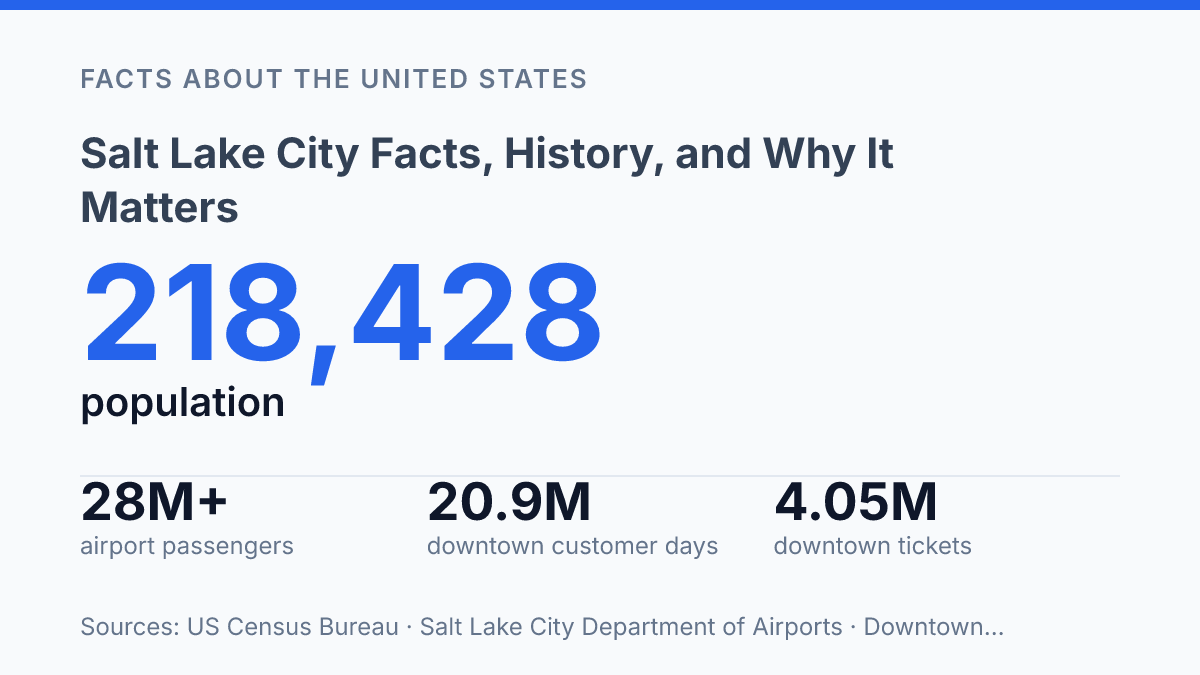
Salt Lake City added nearly 19,000 residents between 2020 and 2025, yet its daily rhythm still turns on a 19.5-minute commute and an airport moving 28 million passengers a year.
That contrast explains the city better than any postcard view of mountains or temple spires. It’s compact. It acts bigger than its size.
It’s tied to pioneer migration, but 23.5% of residents now speak a language other than English at home. It has high wages by national standards. A typical owner-occupied home sits above $539,000.
The useful facts sit in the pressure points: who lives here, how money moves, why downtown pulls workers and visitors, and which landmarks reveal the city’s real role in the West. In my honest opinion, the airport is the fact people underestimate most.
Salt Lake City at a glance
A city of 218,428 people can still carry the political weight of an entire state. Salt Lake City was estimated at that population as of July 1, 2025, according to the U.S. Census Bureau.
It remains Utah’s capital and its most populous city. That mix gives it a status no other Utah city has: it is both the formal seat of state government and the largest municipal population center.
The shorthand matters here. When locals say Salt Lake or SLC, they’re usually talking about the same city, not the lake, the valley, or the broader metro area. That can confuse visitors fast.
The name gets stretched in casual speech. The city itself has clear legal boundaries and a defined role in government.
Its county role adds another layer. The city is the county seat of Salt Lake County, which is also the most populous county in Utah. That means county courts, administration, and civic business tie back to the same place that anchors state politics. In my view, that overlap is one reason the city matters more than its population alone suggests.
But the two roles don’t line up neatly. State capitals are about authority.
County hubs are about services, records, courts, and daily administration. Population influence works differently again, since the wider county and metro area can shape politics, housing, and commuting patterns beyond the city line.
Look only at the city proper and you miss part of the story. Look only at the region and you blur the core identity. SLC stands out because it sits at the center of both maps, even when those maps measure power in different ways.
How the city grew into Utah’s center
A settlement planned after a 1,300-mile migration ended up shaping where Utah’s roads, offices, markets, and political power would cluster for generations.
The turning point came in 1847, when Brigham Young led Mormon pioneers into the Salt Lake Valley after the long westward movement along the Mormon Trail. They weren’t casual settlers looking for a loose frontier camp. They arrived with a plan to build a durable community far from the pressure they had faced farther east.
That origin matters, but not because every later chapter can be reduced to religion. The early settlement set down a tight civic pattern: surveyed blocks, irrigation systems, gathering places, and routes that tied farms and smaller settlements back to the valley hub. Once those lines were in place, commerce and government followed them.
The city grew as a command point because the pioneers built it that way from the start. Supplies moved through it.
Decisions moved through it. People moving into the wider territory had reason to pass through, trade there, or look there for direction.
The tension is clear. Its founding story is inseparable from one religious migration, yet its later identity became broader than that single heritage. In my honest opinion, that’s what makes the growth story more useful than a simple origin tale: the first settlers created a framework, but later residents kept expanding what the place could mean.
You can still read that early logic in the city’s role within Utah. A planned settlement became a territorial hub, then a state-level anchor, not by accident but through location, organization. The habit of drawing surrounding communities toward one central place.
What drives the economy and daily life
The legal city is only a fraction of the place most people use every day. The city proper counted 218,428 residents as of July 1, 2025, up 9.4% from the April 2020 estimate base of 199,726, according to the U.S. Census Bureau, 2025 estimate. But the daily economy spills across Salt Lake County, where well over 1 million people form the larger population center that shops, works, travels, and commutes through the same urban core.
Finance has an outsized footprint here. Regional banking, credit services, insurance, and back-office operations benefit from a workforce with unusually high educational attainment. Tech firms add another layer, especially along the I-15 corridor, where software, health tech, and data operations connect the city to the broader Wasatch Front economy.
Transportation pulls the region together in a more visible way. The international airport handled more than 28 million passengers in fiscal 2024. That traffic supports hotels, rental car firms, logistics, restaurants, and travel-related jobs.
That’s why the economy doesn’t feel like a stand-alone city economy. It feels like a regional operating system.
Government still shapes the workweek, even when it doesn’t dominate the conversation. State agencies, courts, public schools, the university system, and local services create stable jobs that soften the swings of private industry.
The tradeoff is familiar: public institutions bring steady employment. They also deepen the demand for housing close to central offices and transit.
Geography keeps forcing hard choices. The Wasatch Front gives residents quick access to mountain canyons and nearby communities. The same north-south corridor concentrates growth along limited routes.
That helps explain why a mean commute of about 19.5 minutes can coexist with rising housing pressure. Short trips aren’t the same as easy affordability.
In my humble opinion, the key to understanding daily life here is this: the city looks compact on a map. It behaves like the control room for a much larger metro area. You may live outside its borders and still depend on its airport, jobs, hospitals, courts, entertainment venues, and downtown offices every week.
Landmarks and facts people usually miss
At about 4,200 feet above sea level, the city sits higher than many visitors expect, and your lungs may notice before your eyes do. The altitude helps sharpen winter cold, deepen the blue of clear days, and make summer sun feel stronger than the thermometer suggests.
It also changes the air story: mountain walls frame the views. They can trap pollution during inversions.
Temple Square is the downtown landmark people picture first, even if they don’t know its street-grid role. Its 10-acre core places religious architecture, gardens, meeting halls, and family history resources within a few blocks of civic and commercial buildings.
The Salt Lake Temple, completed in 1893, gives the area its visual anchor. The square works just as much as a wayfinding point as a sacred site.
West of the city, the Great Salt Lake gives the region its name and its strangest horizon line. It’s shallow, salty, and changeable, with shorelines that move enough to remind you this isn’t a fixed postcard. In my view, that volatility matters more than the easy lake-name trivia, because it ties the city’s identity to water, drought, ecology, and dust in a very real way.
The mountain access gets most of the attention, and for good reason. You can look east and see a wall of peaks that makes the metro feel unusually close to wild terrain. But that same basin setting shapes the less photogenic parts of daily life, from winter haze to summer smoke blown in from regional fires.
Quick facts can make the place easier to place on a mental map. It sits near a terminal lake instead of an ocean, at high elevation instead of desert-low altitude, with a landmark square at the center rather than a single corporate skyline. The city feels compact from downtown, but its setting does a lot of heavy lifting.
The next test is what the city does with its reach
The numbers point to a city with reach, but reach is not the same as ease. A place can have short commutes, high education levels, and packed venues, then still make ordinary life harder through housing costs and uneven access.
Watch the choices made after FY2025–26. The City Council approved a $2.2 billion budget without raising property taxes.
That only starts the harder argument. Growth now has to pay for itself in streets, transit, parks, safety, and trust.
If you visit, invest, or move here, don’t just ask whether the city is growing. Ask who the growth is serving. In my humble opinion, that answer will tell you more than the skyline.
Frequently Asked Questions
Q: Why is Salt Lake City important in Utah?
A: It matters because it’s both the state capital and the most populous city in Utah. That gives it political weight and real population influence, not just name recognition. It also sits at the center of Salt Lake County. A lot of the state’s activity runs through it.
Q: Is Salt Lake City the biggest city in Utah?
A: Yes, Salt Lake City is the most populous city in the state. That makes it different from a capital city that’s mostly administrative. Here, the political center and the population center overlap. That changes how the city works.
Q: What county is Salt Lake City in?
A: Salt Lake City is the county seat of Salt Lake County. That’s a pretty strong setup for a city that already holds the state capital too… it concentrates a lot of local government in one place. In my view, that dual role is the part people miss when they treat it like just another Western city.
Q: Why do people call it SLC?
A: SLC is just the common abbreviation for Salt Lake City. People use it in travel, sports, and everyday conversation because it’s fast and familiar. Salt Lake is another shortened version you’ll hear, but SLC is the cleanest shorthand.
Q: What makes Salt Lake City stand out from other U.S. state capitals?
A: It stands out because it’s not only a capital. It’s also the biggest city in its state. That gives it more day-to-day influence than capitals that sit outside the main population center. The city’s role in Salt Lake County adds another layer. The stakes are higher than they first look.