
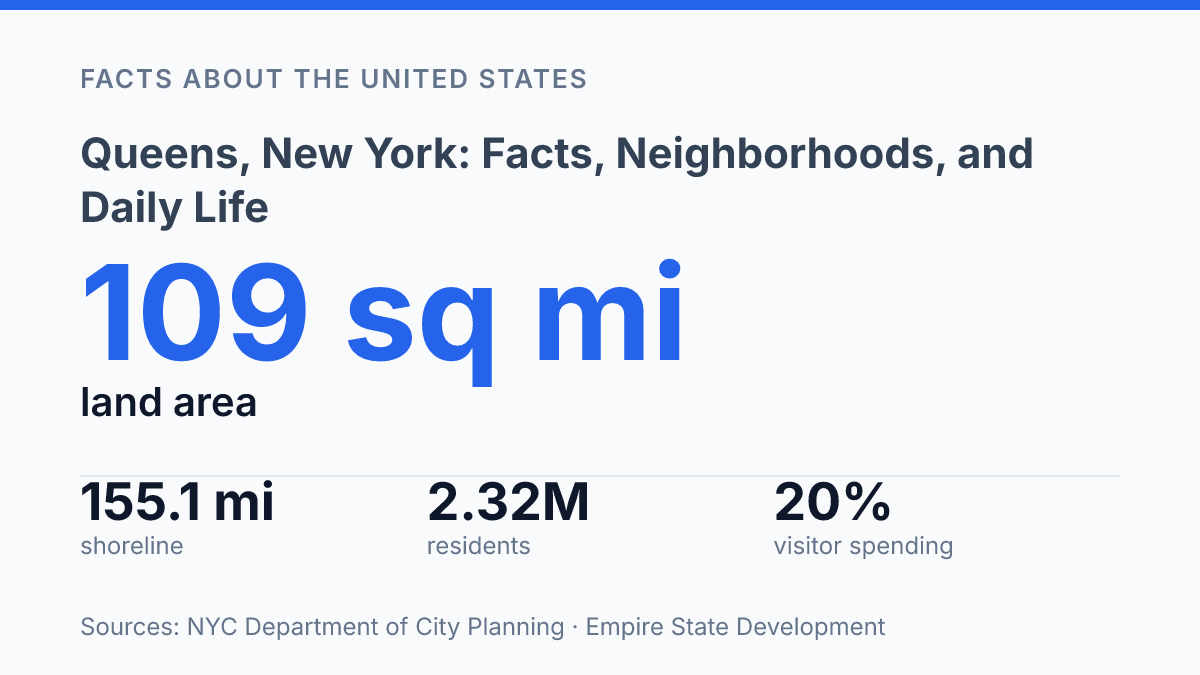
Queens covers 109 square miles and 155.1 miles of shoreline, giving New York City its broadest mix of dense transit corridors, airport districts, low-rise blocks, and coastal edges. Its scale is matched by demographic weight: NYC Planning estimated 2,316,841 residents on July 1, 2024, after a one-year gain driven by international migration even as more residents moved to other parts of the United States than arrived from them. That contrast helps explain why the borough can feel both settled and constantly remade.
Nearly half of residents are foreign-born, and more than half of those age 5 and older speak a language other than English at home. The sections below examine how geography, migration, housing, neighborhood patterns, and visitor activity shape daily life across a borough that is too large and varied to fit a single New York stereotype.
Where Queens sits in New York City
The borough’s eastern border is also New York City’s edge: beyond it, Long Island continues into Nassau County. Queens is one of New York City’s five boroughs, but its geography can be misleading because it is physically part of western Long Island while politically administered as part of New York City. The borough is also coterminous with Queens County, a distinction that matters for courts and records even though most everyday services are organized through city government.
Scale gives the borough a different physical profile from the denser core of Manhattan. According to the NYC Department of City Planning, in 2025 Queens was the city’s largest borough by land area at 109 square miles and had its most extensive shoreline, at 155.1 miles. That footprint helps explain why the borough contains major waterfronts, airport zones, rail corridors, dense apartment districts, and lower-rise residential areas within the same municipal boundary.
Transport links reinforce its role as both a city borough and a regional gateway. LaGuardia Airport sits on the north side of the borough, while John F. Kennedy International Airport occupies a large area near Jamaica Bay in the southeast.
The Long Island Rail Road also runs through multiple stations in the borough, connecting riders with Manhattan, Brooklyn, Nassau County, and points farther east on Long Island. This combination of airports, rail service, and road connections makes the borough central to movement between New York City, Long Island, and the wider metropolitan region.
Population, diversity, and languages spoken
The evidence behind Queens’ diversity claim is unusually measurable: the 2020 Census counted 2,405,464 residents in the borough, while the 2024 ACS profile from the U.S. Census Bureau found that 47.5% of residents were foreign-born. That combination makes immigration central to the borough’s identity rather than a secondary feature of its population. The same ACS profile reported that 56.1% of residents age 5 and older spoke a language other than English at home, which helps explain why public services, schools, small businesses, and civic organizations often operate in multilingual settings.
The borough’s immigrant communities are broad rather than anchored to a single migration pattern. Latin American, Chinese, Korean, South Asian, Caribbean, Middle Eastern, and Eastern European communities have all shaped local institutions, commercial streets, foodways, religious life, and neighborhood networks. NYC Department of City Planning’s Newest New Yorkers 2026 report shows how concentrated this can be at the local level: in 2019–2023, Flushing–Murray Hill was 67% foreign-born, Elmhurst was 66% foreign-born, and Corona was 61% foreign-born.
Language data show the practical side of that diversity. Spanish is widely heard across many neighborhoods, while Chinese languages such as Mandarin and Cantonese, Korean, Hindi, and many other languages are part of ordinary daily exchange. NYC Planning reported 618,974 limited-English-proficient residents age 5 and older, equal to 28.2% of that age group, which makes interpretation and translation more than a courtesy; they are basic infrastructure for health care, education, legal assistance, and local government access.
This diversity is a defining strength, but it is not evenly experienced from place to place. A short walk can pass between blocks where different languages dominate storefront signs, school communications, religious institutions, and community services. That variation gives the borough much of its cultural depth, while also requiring local institutions to respond to sharply different needs within a relatively small area.
Neighborhoods, housing, and local character
A six-story apartment house in Astoria and a Tudor-style row in Forest Hills describe the borough as accurately as any single skyline. Neighborhood identity is unusually granular here: Astoria is often associated with apartment living, Greek and Middle Eastern dining, and active retail strips such as Steinway Street and 30th Avenue, while Forest Hills is known for a more garden-suburb feel around Forest Hills Gardens and the shops and restaurants of Austin Street.
Housing forms shift block by block rather than by a single borough-wide pattern. The NYU Furman Center reported that Queens added 68,746 housing units from 2010 to 2025, including 17,843 income-restricted units, yet the 2024 median gross rent was $1,980 and the rental vacancy rate was 2.8%. Those figures help explain why new construction has not eliminated pressure in popular areas, especially where older apartments, two-family houses, and small homes compete with demand for larger household space.
Flushing shows how a neighborhood can operate as both a residential center and a regional commercial destination. Main Street, Roosevelt Avenue, and nearby blocks contain dense apartment buildings, supermarkets, banks, medical offices, houses of worship, and restaurants serving customers from well beyond the immediate area. Community institutions such as Flushing Town Hall and Queens Botanical Garden add civic and cultural anchors, giving the neighborhood an identity that is not only commercial but also institutional.
Jackson Heights presents a different version of density, with prewar apartment buildings, internal garden courtyards, co-op complexes, and compact retail corridors around 37th Avenue and 74th Street. Its local character is visible at street level through food businesses, sari shops, jewelry stores, civic groups, and religious institutions, many of which serve specific communities while also drawing visitors from elsewhere in the city.
The same variety that gives the borough its local texture also produces uneven daily conditions. Denser districts tend to offer more shops within walking distance but less private outdoor space and tighter parking, while quieter residential areas may have more houses and yards but fewer nearby services and higher barriers to entry for buyers or renters. As a result, neighborhood choice often reflects a balance among space, price, local commerce, and attachment to particular community institutions.
What draws people to the borough today
Visitor spending tied to the borough reached roughly $11.8 billion in 2024, based on Empire State Development and Tourism Economics reporting that the borough accounted for 20% of regional visitor spending. That figure helps explain why its appeal extends beyond residential life: restaurants, sports venues, parks, hotels, transit stops, and airport-adjacent jobs all support a daily economy shaped by both local residents and short-term visitors.
Food remains one of the clearest reasons people cross borough lines. Flushing’s dining scene is closely associated with Chinese, Korean, and other Asian cuisines, with food courts, bakeries, noodle shops, and banquet restaurants serving both local communities and destination diners.
Astoria’s restaurant corridor draws on a different mix, including Greek, Middle Eastern, North African, Mediterranean, and newer casual dining formats. These areas are not attractions in the same way as a museum or stadium; their draw comes from ordinary commercial streets where grocery shopping, takeout, family meals, and nightlife overlap.
Large destinations give the borough a more visible public profile. Citi Field brings baseball crowds to Willets Point, while the USTA Billie Jean King National Tennis Center anchors one of the city’s major annual sporting events. Flushing Meadows-Corona Park adds a broader civic and recreational layer, combining open space, cultural institutions, athletic fields, paths, and remnants of World’s Fair-era infrastructure. Together, these sites make the borough relevant to visitors who may spend only part of a day there, not only to people with neighborhood ties.
The borough’s practical appeal is also tied to work patterns. Many residents choose it because commuting options connect employment centers without requiring residence in Manhattan, while airport workers, logistics employees, hospitality staff, and service providers form a large part of the daily workforce around travel-related activity.
Small business owners also benefit from dense commercial corridors and multilingual customer bases, although conditions vary widely by location, lease costs, transit access, and customer demand. The result is a place often valued for accessibility and variety, but not as a single uniform experience; its relevance depends on whether food, work access, open space, family networks, or visitor destinations matter most in a given daily life.
Where growth will test the borough next
Growth in the borough is not a single trend to celebrate or solve; it is a planning condition with uneven local effects. A 2.8% rental vacancy rate leaves little slack for households moving within the borough, while continued international migration keeps schools, health systems, and public agencies dependent on language access at a scale few U.S. counties face.
The practical test is whether new housing, transit capacity, coastal resilience work, and multilingual public services can be matched to the places where population change is most concentrated. If that alignment improves, the borough’s variety becomes easier to live with, not just easier to describe.
Frequently Asked Questions
Q: What is Queens known for besides being one of New York City’s boroughs?
A: Queens is known for its ethnic diversity, large residential areas, and strong transit links to Manhattan and the rest of New York City. It also has a major role in air travel through its two airports, which makes it both a residential and a transportation hub.
Q: Which neighborhoods in Queens are most commonly mentioned by visitors and new residents?
A: Frequently cited neighborhoods include Astoria, Flushing, Long Island City, Jackson Heights, and Forest Hills. These areas differ sharply in housing type, commercial activity, and cultural mix, which is why neighborhood choice often depends on commute needs and lifestyle preferences.
Q: Is Queens a good place to live for people who commute into Manhattan?
A: Queens can be a practical base for Manhattan commuters because several subway and commuter rail lines connect the borough with the city’s core. Travel times vary widely by neighborhood and line access, so proximity to transit usually matters more than distance on a map.
Q: How does the cost of living in Queens compare with other parts of New York City?
A: Queens is often less expensive than parts of Manhattan, but prices vary significantly by neighborhood and housing type. Areas close to transit or with strong rental demand can be costly, while farther-out neighborhoods may offer more space for the same budget.
Q: What is daily life like in Queens for families and working adults?
A: Daily life in Queens is often shaped by commuting, neighborhood-based shopping, and access to local schools, parks, and restaurants. The borough’s size means routines can feel very different from one area to another, with some neighborhoods offering a quieter residential pace and others functioning like busy commercial centers.