
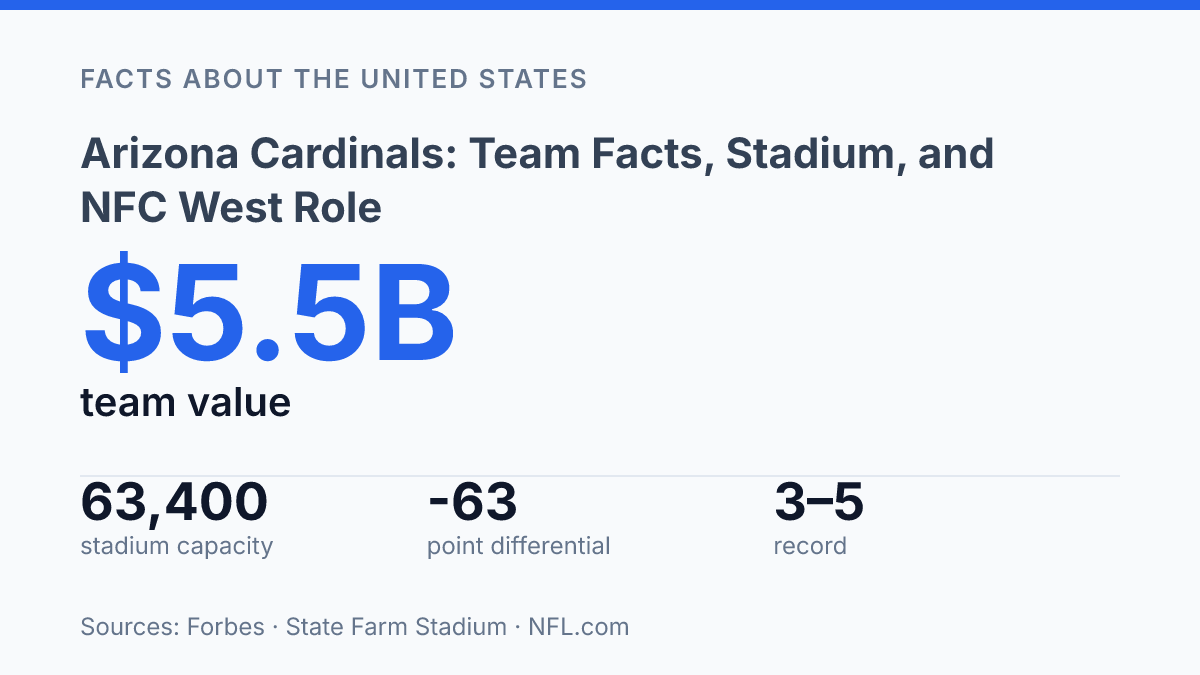
As of November 2, 2026, the Arizona Cardinals sit 3–5–0 with the NFC West’s worst point differential at -63, a snapshot that makes the team profile more than a list of names and colors. The current picture combines a new coaching tenure, a high-capacity Glendale venue, and a division in which the 49ers, Seahawks, and Rams all stand ahead of them. Mike LaFleur’s arrival on February 2, 2026, after three seasons as the Rams’ offensive coordinator, gives the franchise a fresh reference point for judging direction.
State Farm Stadium adds another layer: its 63,400 fixed seats, retractable roof, and natural grass surface shape both game operations and public perception. The sections ahead connect current standings, stadium facts, visual identity, and NFC West context into a clearer picture of how the franchise is positioned.
Team profile and league placement
A 3–5–0 record and fourth-place position in the NFC West make the Cardinals’ current league placement more than a label; it defines the competitive frame around the team. As of November 2, 2026, NFL.com lists the club at 3–5–0, fourth in the division, with Mike LaFleur as head coach, Michael Bidwill as owner, and the franchise established in 1920.
The Arizona Cardinals are a professional American football team based in the Phoenix metropolitan area in Arizona, United States. They compete in the National Football League, the top professional football league in the country, and sit within the National Football Conference as part of the NFC West. That placement matters because the club’s season is measured not only by its overall record but also by how it performs against divisional opponents that shape playoff access and standings position.
Ownership and coaching provide the clearest current leadership reference points. Michael Bidwill is the owner, while LaFleur’s role as head coach makes him the central football decision-maker for weekly preparation, roster usage, and on-field direction. The team’s Arizona branding is geographic and statewide in character, but its national relevance is tied to results inside one of the NFL’s more demanding divisional groupings.
State Farm Stadium and home-field setup
A postseason NFL game was moved to State Farm Stadium in early 2025 because of a natural disaster, making the venue the site of the first relocated playoff game in league history, according to the club’s 2025 Media Guide. The Rams–Vikings Wild Card matchup drew a sellout crowd of 64,515, a detail that illustrates the stadium’s ability to stage high-profile football on short notice rather than only its usual home schedule.
The Cardinals play their home games at State Farm Stadium in Glendale, a West Valley city within the Phoenix metropolitan area. That location gives the team a defined home-field setting separate from downtown Phoenix while still keeping it inside the region’s main population and entertainment market. The venue’s official fixed capacity is 63,400 and can expand to more than 73,000, according to the stadium’s official site, which helps explain why it is suited to both regular-season NFL games and larger event configurations.
As a modern football facility, the stadium is built around controlled presentation and flexible use. Its retractable roof and natural grass playing surface allow games to be staged in an indoor-style environment when conditions require it, while preserving a field type traditionally associated with outdoor football. Around the building, Sportsman’s Park covers 160 acres, includes parking for 14,000 cars, and features the Great Lawn, which stretches more than 1,000 feet and covers 4.61 acres, according to the 2025 Media Guide.
The venue strengthens the club’s public identity by linking game days with a recognizable suburban stadium district and large pregame gathering areas. Still, stadium design does not create home-field advantage by itself. The building can support scale, comfort, and presentation, but the competitive effect depends on the quality of play, crowd turnout, and the intensity generated inside the venue on a given game day.
Mascot, colors, and public identity
A 6-foot-4 cardinal with a 7-foot wingspan gives the franchise one of its most direct links between name, imagery, and fan-facing identity. The team’s mascot is Big Red, whose official “hatched” date is October 4, 1998, according to the Cardinals’ official essentials page and 2025 media guide. That presentation matters because it turns the club’s bird identity into a visible character used at games, community appearances, and promotional settings rather than leaving the cardinal only as a logo or nickname.
The team name and bird imagery are the clearest through-line in the club’s public branding. A stylized cardinal head is the most widely recognized visual marker, especially because it translates cleanly across helmets, merchandise, digital graphics, and broadcast identifiers. This kind of symbol works well for a football franchise because it remains legible at different scales: it can be read quickly on a helmet during play, enlarged on stadium graphics, or simplified for apparel without losing its basic identity.
Color also reinforces that recognition. The Cardinals list three official team colors: Red 194 C, Process Black, and Grey 3 C, according to official team materials.
Red carries the strongest association because it matches both the bird reference and the club name, while black and grey provide contrast for uniforms, trim, and secondary design uses. The result is a compact identity system built around a name, a bird mark, a mascot, and a limited color palette.
Branding creates continuity across seasons, especially for casual fans who may recognize symbols before they follow roster changes or standings. Its practical value is strongest when reinforced by sustained competitiveness, since winning seasons attach memorable moments to the same colors, mascot, and logo. Without that on-field reinforcement, the symbols still identify the franchise clearly, but they carry less cultural weight beyond the existing fan base.
What the NFC West context means
Six of the Cardinals’ 17 regular-season games are reserved for divisional opponents, which gives the NFC West a larger practical effect than any other scheduling category. Under the NFL’s divisional format, Arizona faces the Los Angeles Rams, San Francisco 49ers, and Seattle Seahawks twice each season, once at home and once away. That repetition turns the division into both a standings race and a direct comparison test, because every result changes not only one team’s record but also a rival’s position in the same table.
Divisional games carry particular playoff weight because they feed into the league’s tiebreaking structure. Head-to-head results and division record are key measures when clubs finish with similar records, so a win over a division opponent can matter more than a non-conference result with the same final score. The division winner also earns an automatic playoff berth, making the six-game divisional slate central to season expectations even before broader conference positioning is considered.
The regional shape of the group adds another layer to the Cardinals’ identity within the conference. Matchups with Los Angeles, San Francisco, and Seattle connect Arizona to major West Coast and Pacific Northwest markets, creating regular games with travel, fan-interest, and media significance beyond a single week’s result. The competitive meaning is just as direct: each opponent is familiar with Arizona’s personnel tendencies, coaching habits, and roster strengths because the teams meet so often.
Division structure creates recurring high-stakes matchups, but it does not determine success by itself. A strong record inside the NFC West can improve playoff access and reinforce a team’s standing, yet the full season still tests roster depth, coaching adaptability, injury management, and consistency against non-division opponents. The division supplies the most concentrated pressure points; performance across the complete schedule determines whether those moments become part of a playoff path or simply missed opportunities.
Why the division context changes the profile
A team profile carries more weight when it is read against the conditions surrounding the club. For this franchise, the next meaningful questions are not limited to branding, venue scale, or ownership value; they concern whether a new coaching staff can turn stable institutional assets into measurable progress in a division where small gaps can compound quickly.
State Farm Stadium gives the organization a modern home platform, and the franchise’s multibillion-dollar valuation shows commercial strength, but standings and point differential remain the public scoreboard for competitive health. If the division race tightens, the same facts will read differently; if the gap widens, they will frame the scale of the rebuild.
Frequently Asked Questions
Q: Where do the Arizona Cardinals play their home games?
A: The Arizona Cardinals play at State Farm Stadium in the Phoenix metropolitan area. The venue is the team’s home field and a central part of its identity in Arizona.
Q: What division are the Arizona Cardinals in?
A: They compete in the NFC West as part of the National Football League. That division alignment places them against other West Coast and western-market teams each season.
Q: Who owns the Arizona Cardinals?
A: The team is owned by Michael Bidwill. Ownership matters because it shapes long-term football operations, staffing decisions, and broader organizational direction.
Q: Who is the head coach of the Arizona Cardinals?
A: The current head coach is Mike LaFleur. The head coach directs game planning, staff coordination, and the team’s on-field approach across the season.
Q: What is the mascot of the Arizona Cardinals?
A: The team mascot is Big Red. Mascots are part of a franchise’s public identity and are commonly used in stadium events, community appearances, and fan engagement.