
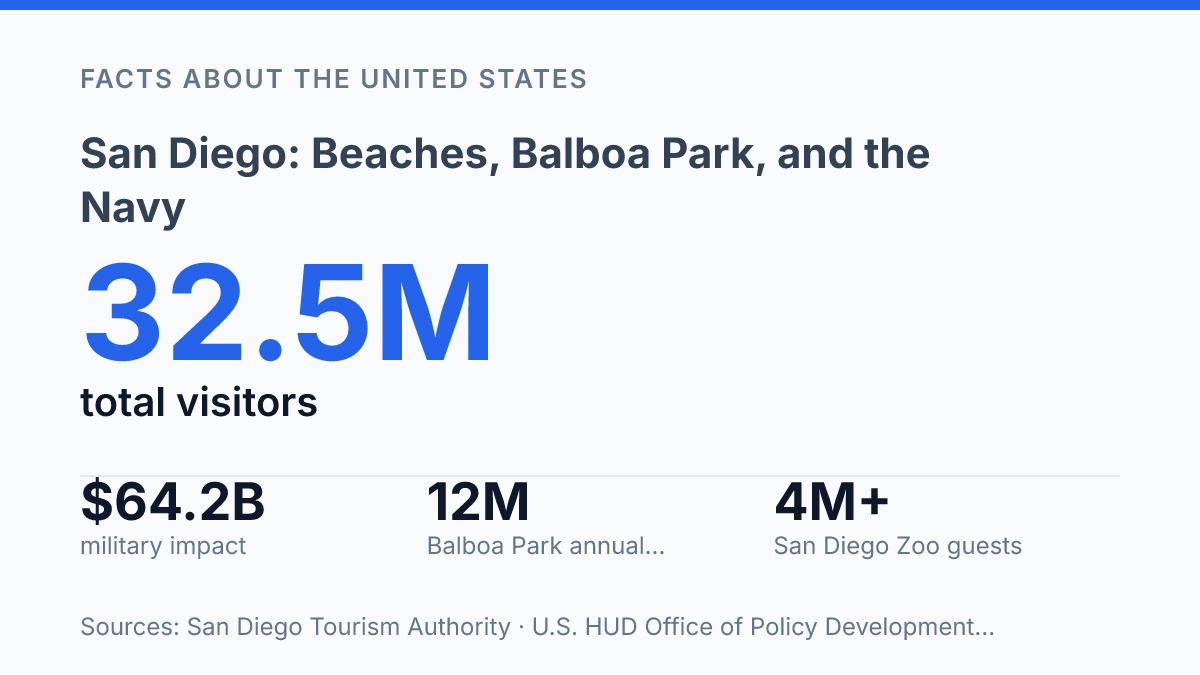
San Diego records an annual normal high of 70.9°F and just 9.79 inches of rain, a climate profile that helps explain why its coast functions as both civic space and economic infrastructure. The city’s beaches are not separate from its wider identity; they sit beside a deep harbor, a major naval complex, and one of the country’s most concentrated urban cultural districts. Balboa Park alone contains a 400-acre cultural district within a 1,200-acre park, while the zoo on its grounds draws more than 4 million guests each year.
The harbor adds another scale entirely: the main naval base homeports 60 ships, and the port supports trade, cruise activity, and thousands of jobs. The result is a city whose appeal cannot be reduced to weather or scenery. Its growth, visitor demand, and public image are tied to the way climate, culture, defense, and the waterfront reinforce one another.
Coastal setting and year-round weather
Few large U.S. cities pair an international border with surf beaches and seventy-degree average afternoons as directly as San Diego. The city sits on the Pacific coast of Southern California, close to the U.S.-Mexico border, which gives its shoreline both a regional and cross-border identity rather than the feel of an isolated resort coast. Ocean access is not peripheral to the city’s image; it shapes daily recreation, visitor itineraries, and the way many neighborhoods meet the water.
Measured climate data helps explain why outdoor activity remains practical through much of the year. San Diego Lindbergh Field’s 1991–2020 climate normals show an annual normal daily maximum of 70.9°F, an annual normal daily minimum of 58.5°F, and average annual precipitation of 9.79 inches across 40.3 precipitation days, according to NOAA National Centers for Environmental Information, generated. Those figures point to a mild, relatively dry coastal climate, supporting beachgoing, walking, cycling, boating, and waterfront dining well beyond a short summer season.
The shoreline draw is visible in places such as Mission Beach, known for its broad sandy strand and boardwalk activity, and La Jolla Shores, where a gentler beach setting supports swimming, kayaking, and coastal sightseeing. The climate, however, is better described as generally temperate than uniformly warm.
Marine layers, ocean breezes, and seasonal shifts can make beach neighborhoods cooler or cloudier than inland areas, especially at certain times of day or year. That variation does not weaken the city’s outdoor appeal; it explains why its coastal identity depends as much on moderation as on warmth.
What makes Balboa Park a major cultural center?
Within a single public park, a 400 acres cultural district can draw nearly a quarter-million people in an ordinary week. The Balboa Park Experience Plan describes the district as part of a larger 1,200-acre park, with museums, art galleries, artist studios, gardens, theaters, and civic spaces concentrated close enough to function as a shared cultural campus. That density matters because it turns the park into more than open space: it is a place where exhibitions, public programs, classes, performances, and informal recreation overlap throughout the week.
Balboa Park also has an institutional scale unusual for a municipal park. According to the Balboa Park Cultural Partnership, its 24 institutions involve 500 trustees, 7,000 volunteers, and 3,500 staff, serving more than 6.2 million visitors annually. Those figures point to an ecosystem rather than a loose collection of attractions, with nonprofit governance, volunteer labor, curatorial work, and education programs supporting the park’s daily cultural role.
The Museum of Us illustrates the park’s educational function by using anthropology and social-history exhibitions to examine human experience across cultures. Nearby, working studios and gallery spaces give the district a production side as well as a display side, allowing artists to make, teach, and sell work within the same public setting. Gardens add a slower-paced counterweight, giving the park quiet areas that serve residents as much as visitors.
The San Diego Zoo is the park’s signature attraction and one of its clearest links between public entertainment, science, and conservation. The San Diego Zoo Wildlife Alliance’s 2024 annual report says the zoo welcomes more than 4 million guests each year across 100 acres in the park and cares for more than 12,000 animals representing over 680 species. Its scale brings heavy foot traffic, but it also reinforces the park’s broader educational profile through wildlife interpretation and conservation messaging.
Because the park is so large, its cultural life is not experienced in a single way. A visit may center on a major museum corridor, a studio courtyard, a performance venue, a garden path, or the zoo, and each produces a different rhythm of use. That range helps explain why the park remains one of the city’s defining public spaces without being only a sightseeing stop.
How the harbor shapes the city’s naval role
The harbor’s depth and shelter help explain why the city is not only a coastal destination but one of the Navy’s principal operating centers in the Pacific. Large surface ships require reliable channels, berthing space, repair capacity, fuel access, and proximity to training areas, and the bay provides the physical setting for those functions. That practical geography gives the waterfront a working character: warships, piers, logistics facilities, and restricted areas sit near civic and visitor-facing spaces rather than apart from them.
The clearest measure of that role is Naval Base San Diego, which the Navy describes as the largest Navy installation on the West Coast and its second largest overall, according to U.S. Navy/CNIC information accessed in 2026. The base homeports 60 ships and supports 250 tenant commands, with 26,000 sailors, 6,000 reservists, and 30,000 civilian personnel connected to its operations. Those figures show that the harbor is not incidental infrastructure; it is a core platform for fleet readiness, employment, contracting, and daily movement across the waterfront.
Military activity also extends well beyond the gates of a single installation. HUD’s 2024 housing market analysis, citing SDMAC, reported more than 111,000 active-duty service members in the region and estimated a total military economic impact of $64.2 billion in FY2024. The scale of that presence helps explain why naval identity remains visible in housing demand, transportation patterns, ship repair work, and the local labor market, not just in ceremonial or symbolic terms.
Public access to this naval identity is most visible at the USS Midway Museum, a retired aircraft carrier preserved as a waterfront museum. Its location gives visitors a direct view of how naval history and current maritime operations share the same bay.
The contrast is instructive: parts of the waterfront serve recreation, dining, and sightseeing, while other parts remain active defense infrastructure. That mix distinguishes the harbor from a purely leisure-oriented port and makes the Navy a defining part of the city’s economy, skyline, and civic identity.
Why San Diego draws visitors and new residents
Visitor demand shows the city’s combined appeal at scale: the regional tourism authority’s 2026 fast-facts page reported 32.5 million total visitors in 2024. That figure was paired with $14.8 billion in direct visitor spending and 17.5 million hotel nights sold, which indicates that the draw is not limited to short beach stops or single-purpose travel.
The core appeal rests on three unlike but mutually reinforcing assets: beaches for outdoor recreation, Balboa Park for arts- and institution-focused spaces, and the harbor for a working maritime identity shaped in part by military heritage. This combination gives the city a broader profile than a destination built around one signature landmark. Coastal access supports casual recreation and visual identity, the park concentrates cultural activity in a walkable civic setting, and the waterfront keeps defense, trade, and public-facing maritime history close to the visitor economy.
That range also helps explain the city’s appeal as a place for long-term settlement rather than tourism alone. The same features that attract visitors can become daily amenities for residents: accessible shorelines, established cultural institutions, and a waterfront economy with connections to shipping, hospitality, and defense. The port district’s FY2023 economic impact report reinforces the employment side of that equation, reporting $13.8 billion in countywide economic contribution, support for 71,360 jobs, and more than 2.4 million tons of cargo handled.
The appeal is therefore broad without being vague. Outdoor recreation, arts-focused civic space, and military-maritime activity serve different audiences, but together they create a distinctive urban identity in which leisure, culture, and economic function remain visibly connected.
The pressure behind the coastal appeal
The same assets that make the city attractive also raise the stakes for planning decisions. Mild weather supports outdoor life and tourism, but it also increases pressure on beaches, roads, hotels, and housing markets that already absorb military, port, university, and visitor demand. A $64.2 billion military economic impact and 32.5 million annual visitors point to a place where local identity is inseparable from large institutions and mobile populations.
Future choices about transit, shoreline resilience, park stewardship, and housing supply will shape whether that appeal remains broadly accessible or becomes increasingly selective. The practical consequence is clear: the coast, Balboa Park, and the harbor are not amenities on the edge of the city; they are operating systems that require continual investment.
Frequently Asked Questions
Q: What is San Diego best known for?
A: San Diego is best known for its Pacific coastline, mild weather, and major public attractions. The city combines beach access with large urban green spaces and a strong naval presence, which gives it a mixed coastal and military identity.
Q: Is Balboa Park worth visiting in San Diego?
A: Balboa Park is one of the city’s main cultural destinations. It contains the San Diego Zoo, art galleries, artist studios, museums, and gardens, so it serves both recreational and educational interests in one place.
Q: Why is the Navy so important to San Diego?
A: San Diego has a deep harbor that supports a large active naval fleet. This makes the city a major U.S. military center on the Pacific coast and shapes both its economy and its waterfront identity.
Q: Can the USS Midway be visited in San Diego?
A: Yes. The USS Midway is open to the public as a museum ship. As an aircraft-carrier-turned-museum, it provides a direct look at naval history and life at sea.
Q: What kind of climate does San Diego have?
A: San Diego is known for its warm climate, which supports year-round outdoor activity. That weather helps explain the city’s strong beach culture and the popularity of its parks and coastal attractions.