
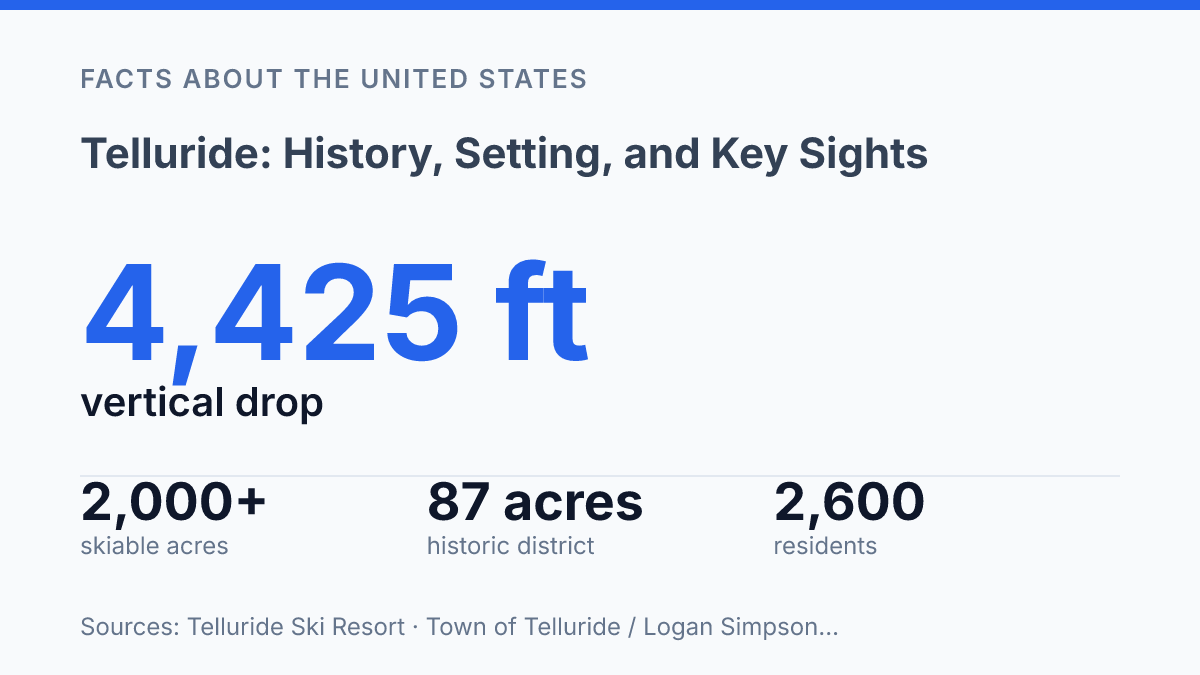
Telluride compresses an unusual amount of Colorado history and mountain tourism into a town of about 2,600 residents at 8,750 feet. Platted in January 1878 as an 80-acre town site, it sits at the floor of a long box canyon along the San Miguel River, with the San Juan Mountains rising tightly around it. That setting helps explain both the town’s physical character and the way its historic core has remained legible despite modern visitor pressure.
The story is not only one of scenery or ski travel. It includes a mining-boom district designated a National Historic Landmark in 1961, restored Victorian-era buildings, and a resort economy large enough to draw seasonal crowds far beyond the resident population. The following sections examine how geography, preservation, and destination infrastructure overlap in one of Colorado’s most closely bounded mountain towns.
How the town sits in a box canyon
A resident population of about 2,600 occupies a town floor at 8,750 feet, yet seasonal visitors can make the community function like a far larger mountain hub. According to a 2026 profile from the Town of Telluride, the town sits in remote southwest Colorado and swells during ski season and festival periods, a pattern that reflects both its isolation and its draw.
Telluride lies in Colorado’s Rocky Mountains within the San Juan range, where its built area is pressed into the bottom of a long box canyon. Forested slopes rise steeply on multiple sides, and the surrounding peaks give the town its enclosed, high-alpine character. This setting is not just scenic context; it affects how the place is experienced, because views tend to terminate in cliffs, ridgelines, waterfalls, and narrow canyon walls rather than spreading outward across open valley country.
The same geography that creates the town’s visual identity also limits how it can expand and how people arrive. A box canyon narrows practical routes, concentrates development on the canyon floor, and makes the compact street grid feel more physically bounded than many other mountain towns. That constraint helps explain why access, parking, lodging patterns, and pedestrian movement are central parts of the visitor experience rather than background logistics.
At the base of the canyon, the town is closely tied to the nearby ski-and-golf resort economy. The resort connection gives the small historic community a year-round destination role, with winter skiing, summer recreation, and event travel all feeding into the same confined mountain setting. The result is a place where geography, tourism, and daily circulation are unusually interdependent: the canyon supplies the dramatic backdrop, while also shaping the practical limits of movement and growth.
From mining camp to Victorian-era town
A town site platted in January 1878 became significant enough within a few decades to anchor one of Colorado’s best-preserved mining-era historic districts. The early settlement grew as prospectors, merchants, boarding-house operators, and civic institutions followed the late 19th-century silver-mining boom into the San Juan region. That growth pattern explains why the town reads less like a resort subdivision than a former Victorian mining community, with a compact commercial core, narrow lots, and streets lined by buildings scaled to a 19th-century economy.
Mining wealth did not produce a single uniform architectural style, but it did leave a recognizable townscape. Wood-frame houses, brick commercial blocks, false-front storefronts, and public buildings from the boom period survived in enough concentration to preserve the visual rhythm of the old town center. According to the Town of Telluride Historic Preservation Department, the community became a National Historic Landmark District in 1961 because of its mining-boom significance from 1878 to 1913, a designation that places its built environment among nationally important historic places rather than merely local heritage sites.
The protected district now covers 87 acres, according to the Town of Telluride and Logan Simpson Comprehensive Plan, giving preservation a practical as well as symbolic role. Historic status helps retain the scale, materials, and street character that distinguish the town center from newer mountain development.
It also constrains how much the district can change: alterations, additions, and redevelopment must account for the historic fabric that gives the place much of its identity. In that sense, preservation is not only a record of the mining era but a continuing planning framework that shapes what the town can become.
Landmarks in the historic district
A century-old opera house and a former hospital now do much of the civic work inside the historic district, showing how preservation here is not limited to static architecture. The Sheridan Opera House, originally built in 1913 as the Segerberg Opera House, remains one of the district’s most recognizable cultural anchors. Its importance lies partly in continuity: the building links an early-20th-century entertainment venue to a modern performing-arts role without requiring the structure to be treated only as a period exhibit.
Restoration has been central to that continuity. According to the Sheridan Arts Foundation, construction of the original opera house was completed in July 1913, and $2,414,818 has been spent restoring the historic building to date. That figure gives preservation a practical dimension, because landmark status alone does not keep a public venue usable; masonry, interiors, stage systems, access, and safety all require ongoing investment if a historic building is to remain open rather than merely admired from the street.
The Telluride Historical Museum provides a different kind of civic anchor within the same historic district. Its building was constructed in 1896 as Hall’s Hospital, served as the local hospital until 1964, and reopened as a museum in 1966, according to the museum’s own history. The conversion gives the site layered significance: the structure preserves a public-service building while housing collections and interpretation that help explain the community’s development without turning the district into a single-purpose heritage display.
These landmarks matter because they keep institutional memory tied to places that still receive the public. The opera house functions as a cultural venue, while the museum functions as an interpretive and educational space. Together, they show how the historic district operates as both a preserved setting and an active town center, where older civic buildings continue to shape public life rather than standing apart from it.
Why Telluride remains a notable mountain destination
A 4,425-foot vertical drop gives the modern resort economy a scale that the compact historic town center does not visually announce. According to the resort’s 2024/25 mountain-facts sheet, the ski area includes more than 2,000 skiable acres, 149 trails, 19 lifts, and 280 inches of average annual snowfall. Those figures explain why winter access remains central to the town’s destination profile, even though the visitor experience is still framed by preserved streets, older buildings, and the enclosing mountain setting rather than by a fully resort-built core.
Warmer months extend that appeal through golf access, which broadens the recreation base without changing the town’s essential scale. The result is a place where seasonal activity is significant, but the public face of the community remains tied to historic streetscapes and canyon scenery. This combination matters because preservation and recreation are not separate identities here; the historic district provides the visual and cultural context in which the mountain amenities are encountered.
Compared with larger resort communities, the town’s distinction lies in compression rather than expansion. Lodging, dining, cultural venues, preserved architecture, and outdoor access sit close together, so the community reads less like a purpose-built resort center and more like a historic mountain town with a substantial recreation economy attached.
Demand is still measurable: according to the local tourism board’s 2024 Annual Report, the guest-services team welcomed 15,906 people at the Visitors Center, handled 12,347 calls and 1,310 chats, and recorded a 2.7% year-over-year rise in trips to the destination. Those numbers indicate sustained visitor interest, but the town’s small physical footprint helps keep heritage, scenery, and recreation visibly linked rather than absorbed into a generic resort format.
Why the small scale still shapes the future
A small mountain town can absorb only so much change before its defining features become harder to protect, and that tension is central to Telluride’s next chapter. Visitor demand is not abstract: the tourism board recorded 15,906 people welcomed at the Visitors Center in 2024, along with a 2.7% year-over-year rise in trips to the destination. Those numbers help explain why preservation is not simply a historical exercise.
It affects transportation, building reuse, public space, and the balance between a working community and a high-demand resort economy. The town’s future will be shaped less by whether people keep coming than by how carefully growth is fitted into an 87-acre historic district and a narrow canyon floor.
Frequently Asked Questions
Q: What is Telluride known for historically?
A: Telluride is known as a former Victorian mining town in Colorado’s Rocky Mountains. Its historic district preserves that legacy through preserved buildings and cultural landmarks that reflect the town’s mining-era growth.
Q: Where is Telluride located?
A: Telluride is set in a box canyon amid forested peaks in southwestern Colorado. Its setting at the base of a popular ski-and-golf resort gives the town a compact mountain layout and a strongly defined natural backdrop.
Q: What are the main historic sights in Telluride?
A: Two of the most notable landmarks are the Sheridan Opera House and the Telluride Historical Museum. The opera house is a performing-arts venue originally built in 1913, while the museum is housed in a converted hospital built in 1896.
Q: Is Telluride a good place to learn about local history?
A: Yes. The Telluride Historical Museum presents local history in a building that dates to 1896, which adds historical context to the exhibits. The town’s preserved district also helps show how the community developed from its mining origins.
Q: Why does Telluride’s setting stand out?
A: Its box-canyon location creates a distinctive sense of enclosure, with forested peaks surrounding the town. That geography shapes both the visual character of the town and its reputation as a mountain destination.