
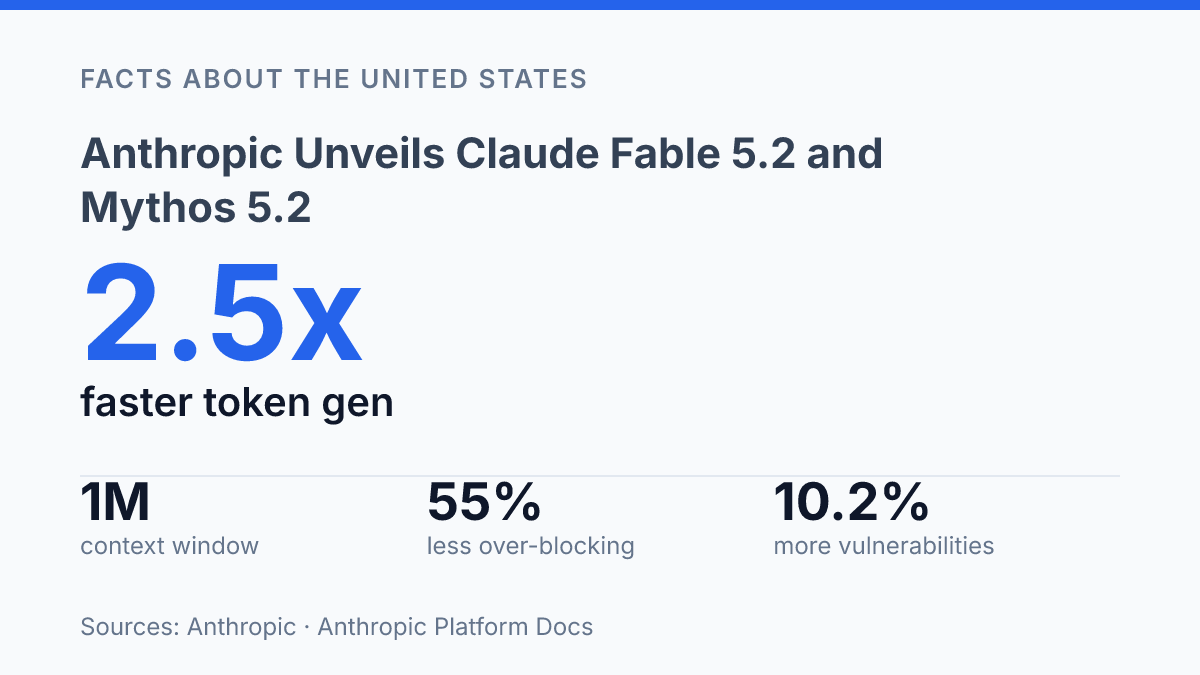
Anthropic unveils Claude Fable 5.2 and Mythos 5.2 AI models with output generation up to 30% faster than version 5.1 and a 20% cut in standard token prices, putting performance and cost in the same launch headline. Announced on November 9, 2026, the release pairs larger deployment parameters, including a 1 million-token context window for Fable 5.2, with sharper benchmark results in coding, science, and cybersecurity evaluations. The timing also gives the launch a corporate dimension.
One week earlier, Anthropic amended its IPO filing for a planned Nasdaq listing under the ticker ANT, while Reuters reported investor discussions around a possible $1.5 trillion valuation. The details matter because the 5.2 models are not just product updates; they are evidence Anthropic can point to when arguing for enterprise growth, pricing discipline, and technical momentum.
What Anthropic announced on November 9, 2026
Anthropic paired a major model release with one of the most closely watched corporate milestones in artificial intelligence: a possible public offering that could arrive as soon as next week. On November 9, 2026, the company released Claude Fable 5.2 and Claude Mythos 5.2, identifying them as its most advanced AI models to date. The announcement positions the 5.2 generation as the new high end of Anthropic’s product line, rather than a narrow maintenance update to the Claude family.
The two-model structure also preserves a familiar split in Anthropic’s roadmap. Claude Fable 5.2 serves as the broader flagship model for advanced general-purpose work, while Claude Mythos 5.2 extends the company’s emphasis on specialized high-capability systems. Anthropic’s release materials frame both models as forward steps in capability and production readiness, according to Anthropic, 2026, giving enterprise and developer customers a clearer signal about where the company is concentrating its next phase of model development.
Timing gives the launch significance beyond product sequencing, but the IPO context remains prospective rather than confirmed. Anthropic’s amended IPO filing, submitted on November 2, 2026, said the company had applied to list Class A shares on the Nasdaq Global Select Market under the ticker ANT, according to its SEC S-1/A filing.
Reuters also reported in October that Anthropic was expected to market shares during the week of November 9, placing the model announcement directly alongside the company’s preparations for a possible listing. The result is both a technical release and a strategic signal: Anthropic is presenting its newest AI systems at the same moment it may be asking public-market investors to assess the durability of its product roadmap.
How the 5.2 models differ from 5.1
The headline comparison is unusually straightforward: the 5.2 generation is presented as faster at producing responses while costing 20% less than the 5.1 generation. That framing matters because Anthropic is emphasizing operational efficiency rather than only model capability, making the upgrade easier to evaluate for teams already running the earlier Fable or Mythos versions.
Claude Fable 5.2 and Claude Mythos 5.2 are positioned as direct successors to Claude Fable 5.1 and Claude Mythos 5.1, not as separate product lines with a different usage model. According to Anthropic, the two 5.2 models generate outputs up to 30% faster than Claude Fable 5.1 and Claude Mythos 5.1, with standard pricing set at $8 per million input tokens and $40 per million output tokens; an optional fast mode can reach up to 2.5 times faster token generation at $16 per million input tokens and $80 per million output tokens.
The comparison suggests that Anthropic is trying to reduce two common constraints in production use: response latency and inference cost. A faster output rate can improve interactive applications, coding assistants, and agent-style workflows where waiting time affects usability. Lower per-token costs can also make high-volume deployments more feasible, especially where prompts and generated responses are repeated across many users or tasks.
Those claims should still be read as product-level comparisons rather than proof that every workload will improve by the same margin. Output speed depends on factors such as request type, deployment mode, and system load, while cost reductions affect total spending differently depending on the balance between input and output tokens. The clearest supported conclusion is that Fable 5.2 and Mythos 5.2 are designed to outperform their 5.1 predecessors on speed and unit economics, with the strongest stated gains tied to generation speed and token pricing rather than a disclosed architectural overhaul.
Pricing and token costs for enterprise users
Output-heavy deployments will feel the 5.2 tariff more sharply than prompt-heavy ones because generated tokens cost five times as much as input tokens. At standard rates, Anthropic lists both models at $8 per million input tokens and $40 per million output tokens, according to Anthropic pricing documentation. That spread matters for enterprise forecasting: a workload that sends 100 million input tokens and receives 100 million output tokens would cost $800 for inputs and $4,000 for outputs before any caching, batching, or product-level discounts are applied.
For developers, the practical budgeting variable is often not the number of calls but the ratio between prompt size and generated response length. Retrieval-augmented systems, coding assistants, research agents, and document-generation tools can produce long completions, so modest per-token rates can still translate into material monthly spend at scale. Short-answer classification or routing workloads, by contrast, may be more sensitive to input volume than output volume, especially when large documents or conversation histories are passed into the model.
Anthropic’s platform documentation also gives enterprise buyers several cost-control mechanisms to model rather than treating the headline rates as the full bill. Fable 5.2 is listed with a 1 million-token context window, 128K maximum output, $0.20 per million cache-read tokens, and a 50% Batch API discount, according to Anthropic Platform Docs. Those details are operationally significant because repeated context can become cheaper when cached, while asynchronous bulk processing can reduce costs for non-real-time workloads.
Lower per-token pricing can widen adoption by making more use cases economically viable, but it does not make high-volume generation inexpensive by itself. The largest cost swings will come from output length, repeated context handling, cache hit rates, and whether workloads can be shifted to batch processing without affecting service requirements.
What the release signals about Anthropic’s IPO plans
A model launch days before a possible share sale can function as evidence that Anthropic’s growth story is still being refreshed, not merely documented in regulatory paperwork. Reports around the planned listing give the timing its significance: according to Reuters via Investing.com, Anthropic is preparing for a potentially historic initial public offering, and the offering could happen as soon as next week. That wording remains conditional, but it places the release inside a period when public-company investors are likely to scrutinize product cadence, revenue durability, customer adoption, and governance structure at the same time.
The connection is not that a new model determines whether an IPO succeeds, but that a high-profile product release can strengthen the investor-facing momentum around the company. For an AI developer seeking public-market backing, fresh model announcements help show that technical progress is ongoing rather than retrospective. They also give the company a concrete way to discuss demand drivers, enterprise use cases, and competitive positioning without relying only on long-range claims about artificial intelligence adoption.
Financial context makes that product signal more meaningful. Anthropic’s filing data show quarterly revenue rising from $11.555 billion in Q2 2026 to $16.956 billion in Q3 2026, while customers generating at least $100,000 in trailing-12-month revenue grew to 11,900-plus as of September 30, 2026, from 950-plus a year earlier, according to the SEC S-1/A and Reuters via Investing.com. Those figures suggest that the company would enter any offering with a growth narrative tied to large customers, not only consumer awareness or research reputation.
Governance will also be part of how investors assess the deal. The filing describes a founder-controlled Class F share structure carrying 50.1% of total voting power, which means public investors would be evaluating both commercial momentum and control rights. The model release can support the company’s case, but IPO execution still depends on financial performance, risk disclosures, investor demand, and market conditions that are not settled by the announcement itself.
Why the release timing matters beyond model specs
The next test is whether the 5.2 release turns benchmark gains into durable enterprise spending. Lower token prices can widen adoption, but they also raise the bar for volume growth, infrastructure efficiency, and customer retention.
The IPO context makes that tradeoff more visible: public-market investors will not assess Fable 5.2 and Mythos 5.2 only as technical products, but as signals of how quickly Anthropic can convert model improvements into recurring revenue. The most practical consequence is that enterprise buyers now have clearer data for comparing speed, context size, security performance, and cost against prior deployments before the company enters its next phase as a public-market candidate.
Frequently Asked Questions
Q: What did Anthropic announce on November 9, 2026?
A: Anthropic released two new AI models, Claude Fable 5.2 and Claude Mythos 5.2, on November 9, 2026. The launch came as the company prepared for a possible IPO as soon as next week.
Q: How do Claude Fable 5.2 and Mythos 5.2 compare with the previous generation?
A: Anthropic said the new models produce outputs 30% faster than their predecessors. The company also described them as its most advanced offerings to date, which suggests a focus on both speed and capability.
Q: How much do the new Anthropic models cost to use?
A: The company said the models will be priced at $8 per million input tokens and $40 per million output tokens. That places the input cost below the previous generation, while output generation remains the more expensive part of usage.
Q: Are Claude Fable 5.2 and Mythos 5.2 cheaper than version 5.1?
A: Yes. Anthropic said the new models cost 20% less than the 5.1 generation. Lower pricing can matter for teams that run large volumes of prompts or long generations, where small per-token differences scale quickly.
Q: Why is this model release getting attention beyond the product update?
A: The timing is significant because it arrived as Anthropic prepared for a potentially historic IPO. A new flagship model release can help signal product momentum to the market, especially when paired with faster performance and lower pricing.