
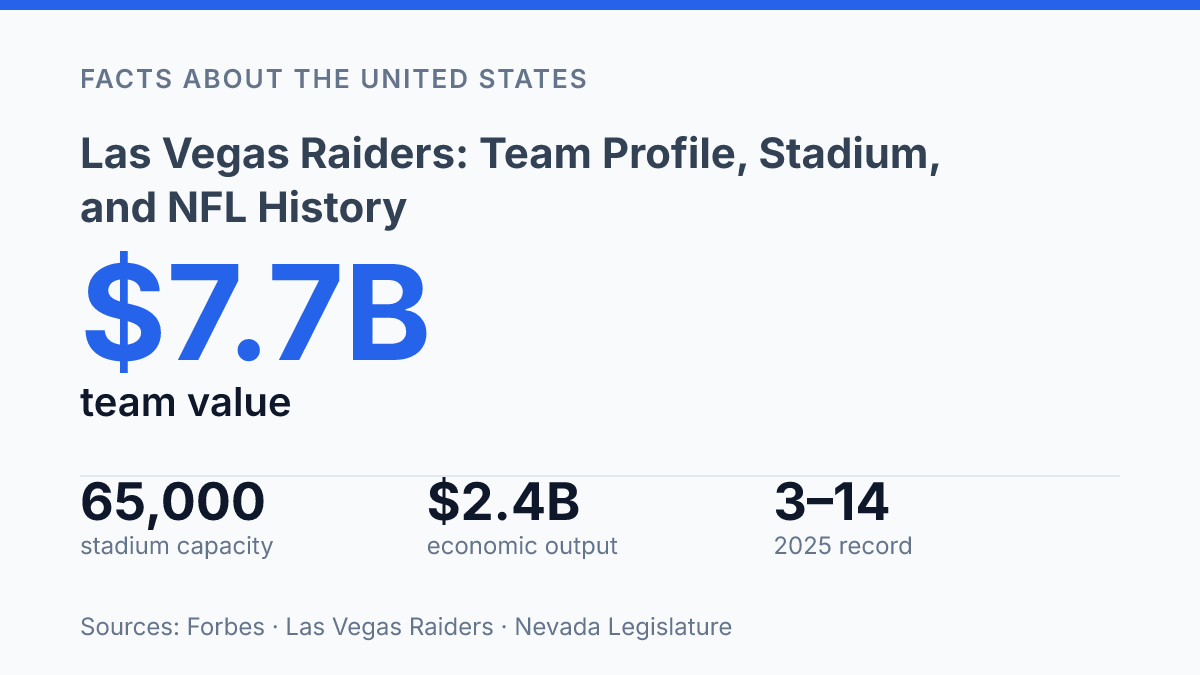
The Las Vegas Raiders entered 2026 with one of the NFL’s sharpest contrasts: a 3–14 record and a minus-191 point differential in 2025, paired with a Forbes valuation of $7.7 billion, ninth among league franchises. That gap is the key to understanding the club’s current position. Competitive results have lagged in the AFC West, but the move to Nevada tied the franchise to a 65,000-seat, fully enclosed stadium beside the Strip and to an event economy that outperformed early public projections.
Allegiant Stadium drew 1.6 million total attendees in the 2025 trailing-year data, while the organization added a high-profile minority owner in Tom Brady and began a new coaching phase under Klint Kubiak. The team’s modern identity is therefore not only a question of wins and losses, but also of market power, venue economics, leadership structure, and a legacy built on three Super Bowl titles.
Team identity and place in the NFL
A club can be rooted in Las Vegas while still carrying one of the NFL’s most geographically portable identities. The Raiders are based in the Las Vegas metropolitan area in Las Vegas, Nevada, United States, but the team’s public profile is not limited to its current home market. Its national following and long-established branding mean the franchise is often discussed both as a Nevada team and as a broader NFL brand with recognition well beyond the state.
Within the league structure, the Raiders compete in the National Football League as a member of the American Football Conference West division. That placement is more than a label: division alignment determines a fixed portion of the regular-season schedule and creates repeated matchups that shape competitive context from year to year. The AFC West groups the Raiders with the Denver Broncos, Kansas City Chiefs, and Los Angeles Chargers, making those three clubs the team’s primary divisional opponents.
Recent results show the competitive difficulty of that setting. The club’s official 2025 standings page lists the Las Vegas Raiders at 3–14, fourth in the AFC West, with 241 points scored, 432 allowed, and a -191 point differential. Those figures place the team’s current identity in a practical football context: the Raiders remain a high-recognition franchise, but their divisional position is also measured by recurring games against established conference rivals and by year-to-year performance within one of the NFL’s four AFC divisions.
Allegiant Stadium and the Las Vegas home-field setup
A 65,000-seat, climate-controlled stadium just off the Strip gives the Raiders one of the NFL’s clearest links between a home venue and a destination market. Allegiant Stadium is the team’s home field in Paradise, Nevada, near the Las Vegas Strip, and the franchise describes it as fully enclosed and built for year-round event use, according to the Raiders’ 2026 venue information. That setting matters because the stadium is not only a football site; it is positioned inside the city’s tourism corridor, where visibility from visitors, broadcast partners, and event traffic reinforces the club’s Las Vegas identity.
Attendance data shows how strongly the venue functions beyond game days. Nevada’s 2025 trailing-12-month stadium-impact summary through the third quarter reported 1.6 million total attendance, including 1.0 million visitors and 950,000 incremental visitors tied to Allegiant Stadium. The same report said that incremental-visitor figure was 111% above the original 2016 projection, which indicates that the building has outperformed early expectations as a tourism draw.
For the franchise, the practical effect is a larger platform for home games and public visibility. A modern enclosed stadium reduces weather variability, supports a polished television product, and gives the team a consistent stage for premium seating, sponsorship, and high-demand matchups. Nevada’s report estimated the venue’s broader economic footprint at $2.4 billion in total output, compared with an original $620 million projection, with $587 million in wages and salaries and 10,600 jobs connected to the stadium’s activity.
Home-field advantage, however, is not created by the building alone. A destination venue can attract large crowds, but tourism markets can also produce a mixed crowd when visiting fans travel well. The stadium strengthens the Raiders’ profile in Las Vegas, yet the week-to-week competitive effect still depends on performance, crowd composition, and whether the team gives its home audience enough on-field momentum to turn the building into a sustained advantage.
Ownership and coaching leadership
Forbes valued the Raiders at $7.7 billion in 2025, a figure that places the franchise’s business position well above its recent competitive results. Forbes also listed Mark Davis as owner, underscoring his role as the controlling figure for the organization’s largest strategic decisions. That level of authority normally includes decisions such as executive hiring, major spending direction, stadium-related business priorities, and approval of the broader football structure rather than every tactical choice made during a season.
The ownership picture gained another high-profile element when NFL owners unanimously approved Tom Brady’s minority stake in 2024, according to the Associated Press. Brady received 5% control after a 17-month approval process that required support from at least 24 of 32 owners. Minority ownership does not displace Davis’s controlling role, but it adds a notable voice and public profile to the franchise’s leadership group.
Coaching leadership sits closer to the weekly football product. The team announced Klint Kubiak as head coach on February 9, 2026, saying he entered his 13th NFL season after coordinating a Seattle offense that averaged 28.4 points per game and ranked third in the league in scoring. That background points to an offensive direction shaped by play design, quarterback development, and efficiency, although the effect of a coaching change depends on roster fit and execution as much as scheme.
The practical distinction is that ownership sets the conditions under which football decisions are made, while coaches and personnel staff translate those conditions into roster plans, systems, practice priorities, and game-day choices. Stable ownership can preserve institutional continuity, but a new head coach can quickly alter what types of players are emphasized and how existing players are deployed. For the Raiders, that makes the Davis-led structure and Kubiak’s football approach separate but connected parts of the same competitive reset.
Championship years and historical legacy
A 30-season run from 1963 through 1992 gave the franchise one of pro football’s clearest historical identities: according to the Pro Football Hall of Fame, the Raiders went 285-146-11 for a .661 winning percentage during that span. That record was supported by 12 division championships, the 1967 AFL title, and three Super Bowl victories, creating a standard that still shapes how the franchise is discussed across the league.
The championship years most closely associated with that legacy are 1977, 1981, and 1984, when the organization claimed NFL titles through Super Bowls XI, XV, and XVIII. Those wins place the Raiders among the league’s historically recognized franchises, not merely as a team with isolated peaks but as one that sustained a winning identity across multiple eras of competition. The titles also gave the brand a durable connection to physical defense, pressure football, and a reputation for defiance that remained part of its public image long after the championship rosters changed.
Historical credibility, however, is different from present-day competitiveness. The franchise’s older championship era supplies a powerful reference point for supporters, media, and the league, but it does not by itself create the week-to-week consistency required in the current NFL. Modern success depends on roster depth, quarterback stability, coaching continuity, health, and performance against divisional rivals, none of which can be inherited from past title teams.
That contrast explains why expectations around the Las Vegas Raiders often carry extra weight. The trophy history makes the organization difficult to treat as an ordinary rebuilding team, yet the standard attached to those titles also sharpens scrutiny when sustained success proves elusive. The franchise’s legacy remains a real asset, but its contemporary meaning depends on whether future teams can turn historical prestige into repeatable results.
The gap that will define the next Raiders era
The Raiders’ next phase will test whether institutional value can be converted into football stability. Allegiant Stadium has already changed the scale of the franchise’s business case, and the Brady stake keeps the ownership group under national attention. Those factors can support investment, recruiting appeal, and patience, but they do not replace roster construction or weekly performance.
The useful measure over the next several seasons will be whether the franchise can narrow the distance between its off-field strength and its place in the AFC West standings. If that gap closes, the Nevada move will read less like a market relocation story and more like the start of a durable competitive reset.
Frequently Asked Questions
Q: Who owns the Las Vegas Raiders?
A: The team is owned by Mark Davis. Ownership has been central to the franchise’s modern era, including its relocation to Las Vegas and the move into Allegiant Stadium. That structure places control of football and business decisions within the Davis family line.
Q: Who is the current head coach of the Raiders?
A: The current head coach is Klint Kubiak. The head coach directs the team’s on-field strategy, staff responsibilities, and weekly preparation. In the NFL, coaching changes can shape roster use, scheme fit, and overall team direction.
Q: What division do the Raiders play in?
A: The Raiders compete in the AFC West. That division places them alongside other teams in one of the NFL’s most closely followed regional rivalries. Division placement matters because it determines a large share of a team’s regular-season opponents each year.
Q: Where do the Raiders play their home games?
A: The team plays at Allegiant Stadium in Las Vegas, Nevada. The stadium is the franchise’s home venue and a key part of its identity in the Las Vegas metropolitan area. A modern indoor facility also affects game-day conditions, travel logistics, and event scheduling.
Q: How many NFL championships have the Raiders won?
A: The Raiders have won 3 NFL championships, with titles in 1977, 1981, and 1984. Those seasons remain the high-water mark of the franchise’s history. The title count is often used as a shorthand for the team’s legacy within the league.