
The United States Congress is operating in 2026 with a House effectively at 433 seats, not the full 435, and a Senate divided 53 Republicans, 45 Democrats and 2 Independents. That arithmetic is more than a party scorecard; it shapes control of floor votes, committee agendas and the practical limits of lawmaking. The institution’s formal design is simple enough to describe as two chambers, yet its real work runs through more than 200 committees and subcommittees, where most proposals are screened before they ever reach a recorded vote.
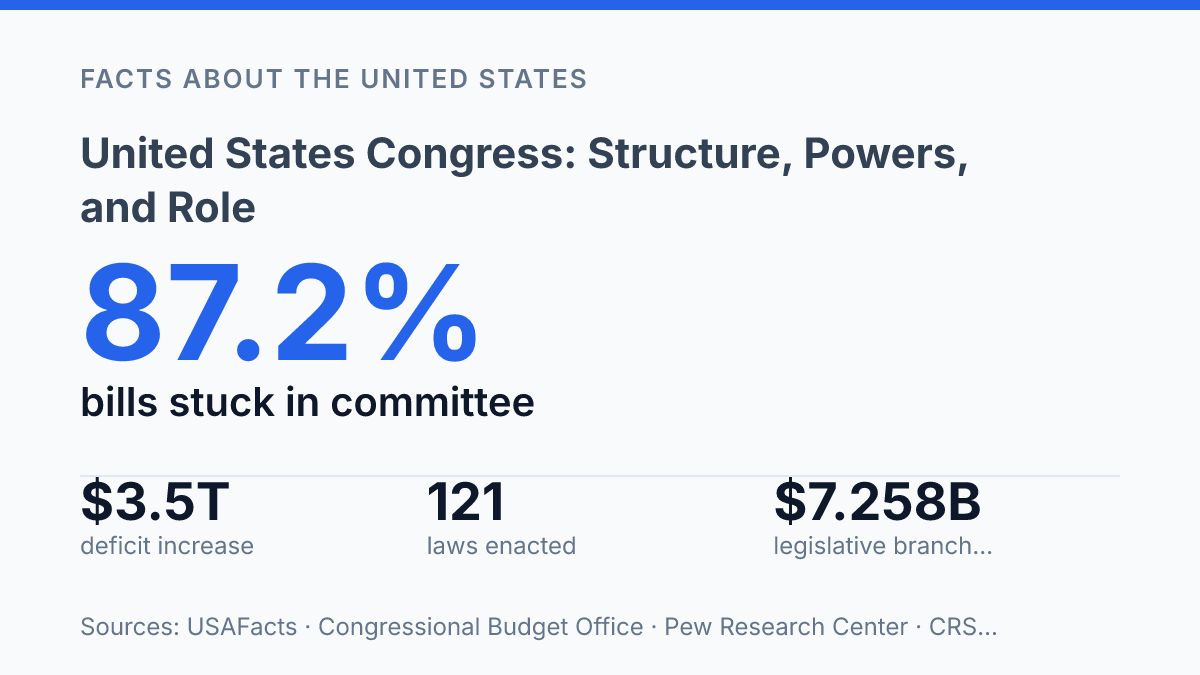
In the 119th Congress, 87.2% of introduced bills had not left committee as of October 2026, while health alone accounted for about 1,900 bills. Understanding Congress means looking past the Capitol’s two floors to the rules, chamber differences and institutional pressures that decide which national questions become federal law.
How the two chambers are arranged
Every federal bill faces two institutional votes, not one, because the legislative branch is split into separate chambers that must agree on the same text. The United States Congress is arranged as a bicameral legislature: the lower chamber is the U.S. House of Representatives, and the upper chamber is the U.S. Senate. This structure places federal lawmaking authority in two separate bodies rather than in a single assembly, so neither chamber can enact ordinary legislation on its own.
Both chambers meet in the United States Capitol in Washington, D.C., but they operate as distinct institutions with separate memberships, officers, calendars, and voting procedures. The arrangement dates to March 4, 1789, when the federal legislature established under the constitutional system first convened. Physical proximity therefore does not mean institutional unity: the House and Senate share a legislative workplace while retaining independent authority over whether a measure advances.
The two-chamber design can slow legislation because a proposal must survive consideration in both the House and the Senate, and any differences between the chambers must be resolved before a final bill can move forward. That delay is not incidental to the design. It creates an internal check by requiring broader agreement across differently organized bodies, reducing the likelihood that temporary pressure in one chamber alone becomes federal law.
The House’s current operating size also shows why chamber arrangement matters in practical terms. The House party breakdown lists 218 Republicans, 214 Democrats, 1 Independent, and 2 vacancies, with the whole number of the House at 433, according to the House Radio-TV Gallery. In a closely divided lower chamber, vacant seats and narrow margins can affect how difficult it is to assemble a majority, even before a measure reaches the Senate for separate approval.
What federal lawmaking actually covers
A bill about taxes, military funding, food safety, banking rules, or interstate shipping can become binding national law because Congress legislates for the federal system rather than for a single locality. Its core lawmaking authority comes from the Constitution, especially the Article I powers to tax, spend, borrow, regulate commerce, establish federal rules in specified areas, and make laws needed to carry those powers into effect. This authority is broad, but it is not open-ended: federal statutes must rest on a constitutional source of power and remain subject to presidential vetoes and judicial review.
Taxing and spending are among the clearest ways Congress shapes national policy. Revenue laws determine how the federal government raises money, while appropriations and budget measures decide how funds are distributed across defense, health programs, infrastructure, administration, and other federal functions. The fiscal stakes can be large; the Congressional Budget Office estimated that laws enacted in the first session of the 119th Congress would increase cumulative deficits by $3.5 trillion over 2025–2034, reflecting how legislative choices can affect national finances long after a vote is taken.
War powers and commerce authority give Congress influence over both security and the national economy. The Constitution assigns Congress the power to declare war, raise and support armed forces, and fund military activity, while the president commands the armed forces once authorized and funded. In commerce, congressional power reaches trade among states, with foreign nations, and with tribal nations, which is why federal law can set nationwide rules for areas such as transportation, financial markets, consumer protection, and workplace standards when they connect to interstate economic activity.
Oversight is the other major part of federal lawmaking authority because Congress must be able to examine how laws are carried out. Committees can hold hearings, request records, question officials, and investigate whether agencies are following statutory instructions. This does not make Congress the manager of executive agencies, but it gives lawmakers tools to expose administrative failures, revise statutes, condition future funding, or create reporting requirements that narrow how delegated power is used.
How the House and Senate differ
A resident of a small state has the same two senators as a resident of the largest state, while House seats rise or fall with population. That contrast is the central design difference between the chambers: the House reflects people through population-based apportionment, and the Senate reflects states through equal representation. The arrangement gives smaller states a guaranteed voice in national decisions, but it can also produce outcomes that differ from the population-weighted balance visible in the House.
Term length reinforces those different representative roles. Members of the House serve two-year terms, which keeps the chamber closely tied to short election cycles and changing public opinion.
Senators serve six-year terms, giving the chamber a longer time horizon and making it less immediately responsive to every electoral shift. This does not make one chamber more democratic than the other; rather, it means each measures representation through a different institutional lens.
Formal responsibilities also divide the work. The House has the lead role in revenue bills, since legislation for raising federal revenue must begin there, and it has the power to bring impeachment charges. Those powers give the chamber a first-mover role in taxation and in the accusation stage of constitutional accountability.
The Senate has distinct duties tied to advice and consent. It considers presidential nominations for major executive and judicial offices, and it approves treaties before they can take effect as binding international agreements.
In impeachment, its role differs from the House’s: after charges are brought, the Senate conducts the trial and decides whether removal or disqualification should follow. The result is a bicameral system in which both chambers participate in national governance, but neither is simply a duplicate of the other.
Why Congress matters in Washington, D.C.
A proposal can define a national debate in Washington and still never receive a chamber-wide vote: according to USAFacts, 87.2% of bills introduced in the 119th Congress had not left committee as of October 2026. That filtering power helps explain why Congress matters beyond the visible moments of floor debate. Legislative priorities are often shaped through agenda control, committee review, negotiation, and the decision to advance or withhold measures from final consideration.
Congress is one of the three branches of the federal government, alongside the presidency and the judiciary. Its position in that system gives it a central role in translating political commitments into national rules, appropriations, and oversight demands. The presidency may propose priorities and federal agencies may administer programs, but congressional decisions determine much of the legal and budgetary framework within which those actors operate.
The work done in Washington, D.C. affects national policy most directly in areas such as spending, defense, and regulation. Recent legislative activity shows both the scale and the limits of that influence: Pew Research Center reported that, on October 15, 2026, the 119th Congress had enacted 121 laws since convening in January 2025, the second fewest at that point in any Congress in the past 40 years. A low count of enacted laws does not mean Congress is irrelevant; it indicates that major policy change often requires sustained bargaining, especially when party control is close or when the two chambers must reconcile different priorities.
The Capitol serves as the physical center of legislative activity, not merely as a symbol of national government. It anchors the committee work, leadership negotiations, floor scheduling, and member coordination through which federal choices are assembled. Congress can shape national priorities, but durable action usually depends on agreement across institutional and partisan lines, making its influence both powerful and conditional.
Where congressional power shows up most clearly
The real measure of congressional power is not the number of bills introduced or the volume of speeches delivered on the floor. A Congress that had enacted only 121 laws by October 15, 2026 still carried major fiscal weight: CBO estimated that first-session laws would raise cumulative deficits by $3.5 trillion over 2025–2034. That contrast explains why institutional design matters.
Slow throughput does not necessarily mean weak power; it can mean that influence is concentrated in agenda control, committee gatekeeping, budget decisions and the few measures that survive the process. Future assessments of Washington should track not only who holds the gavels, but which proposals are allowed to become unavoidable.
Frequently Asked Questions
Q: What is the role of Congress in the U.S. federal government?
A: Congress is the legislative branch of the federal government, so its main role is to make federal laws. It also has powers over taxation, spending, declarations of war, and oversight of the executive branch. These powers make it central to how national policy is created and enforced.
Q: Why does Congress have two chambers?
A: The U.S. Congress is bicameral, meaning it has two chambers: the House of Representatives and the Senate. This structure was designed to balance representation by population in the House with equal representation for each state in the Senate. The arrangement slows lawmaking enough to require broader agreement across both chambers.
Q: Where does Congress meet?
A: Both chambers meet in the United States Capitol in Washington, D.C. The Capitol is the formal meeting place for the House and Senate and is the central physical site of federal lawmaking. Its location in the capital also reflects Congress’s national role.
Q: When was Congress established?
A: Congress was established on March 4, 1789, following the ratification of the U.S. Constitution. That date marks the start of the modern federal legislative branch. Its creation gave the new national government a permanent lawmaking body with defined constitutional powers.
Q: What is the difference between the House of Representatives and the Senate?
A: The House of Representatives and the Senate are both parts of Congress, but they are organized differently. The House is the lower chamber and is based more directly on population, while the Senate is the upper chamber and gives each state equal representation. Because a bill must pass both chambers, their different rules and compositions shape how legislation moves forward.