
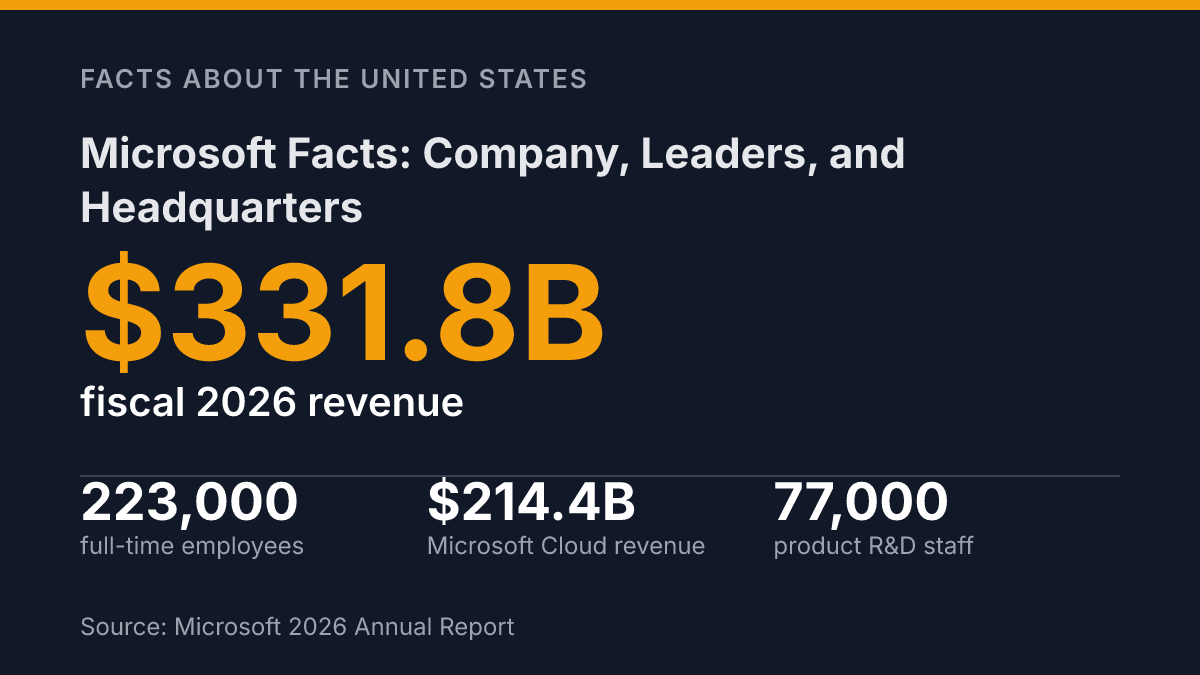
Microsoft entered fiscal 2026 with $331.839 billion in revenue, 223,000 full-time employees, and a cloud business alone worth $214.4 billion, which makes its 1975 origin story unusually compressed by comparison. The company began when Bill Gates and Paul Allen saw the Altair 8800 on the January 1975 cover of Popular Electronics and recognized that personal computing would need software before most of the market had a name for it. That contrast between a two-founder software bet and a global engineering organization is the useful frame for the facts that follow.
The details are not only biographical. Current executive roles, technology leadership, and the Redmond headquarters all show how the company organizes decision-making at scale, from Satya Nadella’s dual CEO and chairman role to a campus whose move in February 1986 came just weeks before the IPO.
Company snapshot and founding story
A company that began after a hobbyist-computing magazine cover reported $331.839 billion in fiscal 2026 revenue, illustrating the distance between its origin story and its present scale. Microsoft Corporation is an American multinational technology conglomerate headquartered in Redmond, Washington, United States, with a business profile that remains strongly associated with software but now extends across cloud services, devices, and enterprise tools.
The founding story is unusually direct: the company was founded in 1975 by Bill Gates and Paul Allen after the January 1975 Popular Electronics cover featuring the Altair 8800 inspired their early work, according to Microsoft Stories, 2026/accessed. That timing placed the firm near the beginning of the personal-computing market, when software was becoming a distinct commercial category rather than merely an accessory to hardware.
Redmond became central to the company’s corporate identity as it matured from a founder-led software business into one of the largest American technology firms. The headquarters location in Washington state is not just a mailing address; it anchors a global organization that, as of June 30, 2026, reported about 223,000 full-time employees, split between 121,000 in the United States and 102,000 internationally in its 2026 annual report. The same filing reported fiscal 2026 revenue rising from $281.724 billion the prior year, while cloud-related revenue reached $214.4 billion, showing how far the company’s scale now extends beyond its early software roots.
Who leads the company now?
The chief executive role has been unusually stable for a company of this size: Satya Nadella has led the company as CEO since February 4, 2014. According to the 2026 SEC Form 10-K, he also became chairman in June 2021, giving him both management leadership and board-level authority over long-term strategy.
Responsibility is divided across a small group of senior officers rather than concentrated in one office. The same 2026 SEC filing lists six executive officers as of July 29, 2026: Nadella, Judson Althoff, Amy Coleman, Amy Hood, Takeshi Numoto, and Bradford L. Smith. That structure reflects the company’s operating scale, where product direction, commercial execution, people operations, finance, marketing, legal policy, and governance all require dedicated executive oversight.
Amy Hood serves as chief financial officer, a role she has held since May 2013, according to the SEC filing. Her position places capital allocation, reporting, investor communication, and financial discipline under a dedicated finance leader rather than the CEO alone.
Bradford L. Smith serves as president and vice chair, after becoming vice chair and president in September 2021. His remit is commonly associated with legal affairs, corporate governance, public policy, and broader institutional responsibilities, which are central for a global technology company subject to regulatory scrutiny across many markets.
This leadership model creates a clear distinction between strategic command and functional control. Nadella sets the overall direction, but executives such as Hood and Smith manage the financial and institutional systems that allow that strategy to operate at scale. The result is a governance structure built around specialization: one chief executive establishes priorities, while senior leaders translate those priorities into finance, compliance, workforce, commercial, and market-facing decisions.
Key technology leadership roles
The company’s technical hierarchy is easier to understand through staffing than titles: its 2026 Annual Report reported 77,000 employees in product research and development, compared with 43,000 in sales and marketing. That distribution helps explain why senior technology roles sit close to product strategy, infrastructure decisions, and long-range research rather than operating as advisory posts alone.
On the commercial side of that structure, Takeshi Numoto serves as chief marketing officer, a role he assumed in October 2023, according to the 2026 SEC filing. In a company built around cloud services, AI systems, business software, devices, and developer platforms, the CMO role is not only about advertising. It also helps translate technical capabilities into market positioning, customer adoption priorities, and product narratives that sales teams and enterprise customers can understand.
Technology leadership is divided across more than one CTO title, which should be read as part of this company’s own executive setup rather than as a standard model used uniformly across the industry. Kevin Scott is identified in company executive materials as chief technology officer, with a career that includes helping build LinkedIn’s engineering organization through its IPO and a period of rapid growth, according to his company Source profile. Victor Bahl is also identified as a CTO within the technical leadership structure, and his Research profile credits him with more than 165 U.S. patents, nearly five dozen keynote talks, and four lifetime achievement awards.
Together, these roles support the chain that connects research, engineering execution, platform architecture, and customer-facing strategy. For cloud and AI development in particular, senior technical leaders help set direction on computing infrastructure, model and software architecture, developer ecosystems, and the standards that allow large product groups to build on shared foundations. That coordination is especially important in a global technology company because platform decisions made in one engineering group can shape security, scalability, and product integration across many others.
Why the headquarters matters
The Redmond campus became the company’s control center just weeks before it entered public markets, linking the headquarters to one of the firm’s most consequential corporate milestones. According to the company’s Facts About page, the move to the corporate campus took place on Feb. 26, 1986, shortly before the March 1986 initial public offering. That timing matters because Redmond was not only an operating base; it became associated with the transition from a fast-growing software business into a publicly accountable corporation.
The headquarters remains in Redmond, Washington, which gives the company a defined center for executive administration, board oversight, investor reporting, and policy coordination. For a public company, headquarters location is tied to governance because it identifies where top corporate functions are organized and where leadership accountability is institutionally anchored. This does not mean every important decision is made in one building, but it does mean the headquarters serves as the formal hub for corporate control.
As a U.S.-based multinational company, its Redmond base also connects global operations to American securities, regulatory, and business norms. Strategic decisions made through headquarters-level governance can affect software licensing, cloud infrastructure, AI policy, cybersecurity practices, and enterprise customers in many countries. The contrast is central to understanding the company’s identity: its legal and executive center is rooted in the United States, while its commercial and technological consequences extend far beyond Washington state.
The physical campus reinforces that role without defining the whole enterprise. The City of Redmond describes a campus refresh replacing 12 older office buildings with about 3 million square feet of office space in 17 new buildings, organized into five villages with a 2-acre open plaza. That scale reflects a headquarters built for coordination among leadership, engineering, operations, and corporate functions, even as the company’s workforce, customers, and regulators remain globally distributed.
Why the dated facts carry the most weight
Company facts are most useful when treated as dated evidence rather than static trivia. Revenue, officer lists, workforce counts, and headquarters projects all carry reporting dates because they describe an institution that keeps changing while retaining a few fixed reference points.
The 1975 founding, the 1986 Redmond move, and the Nadella-era leadership structure anchor the record, but the higher signal may be the allocation of people and capital: 77,000 employees in product research and development and a campus rebuilt around 3 million square feet of new office space. Those figures point to a practical consequence for anyone comparing the company over time: the most revealing facts are the ones that connect scale to where decisions, engineers, and long-term infrastructure are placed.
Frequently Asked Questions
Q: Where is Microsoft headquartered?
A: Microsoft Corporation is headquartered in Redmond, Washington, in the United States. The location has been the company’s primary base of operations for years and remains central to its corporate identity.
Q: Who is the CEO of Microsoft?
A: Satya Nadella has served as CEO since February 4, 2014. His tenure has shaped the company’s focus on cloud services, enterprise software, and artificial intelligence.
Q: Who founded Microsoft?
A: Microsoft was founded by Bill Gates and Paul Allen. Their partnership established the company as a major software maker and laid the foundation for its later expansion into a broader technology conglomerate.
Q: Who are the top executives at Microsoft?
A: Microsoft’s leadership includes CFO Amy Hood, CMO Takeshi Numoto, CTOs Kevin Scott and Victor Bahl, and President Bradford L. Smith. These roles reflect a leadership structure that spans finance, marketing, technology, and corporate governance.
Q: Is Microsoft an American company?
A: Yes. Microsoft Corporation is an American multinational technology conglomerate based in Redmond, Washington. Its U.S. headquarters and global reach are both central to how the company operates.