
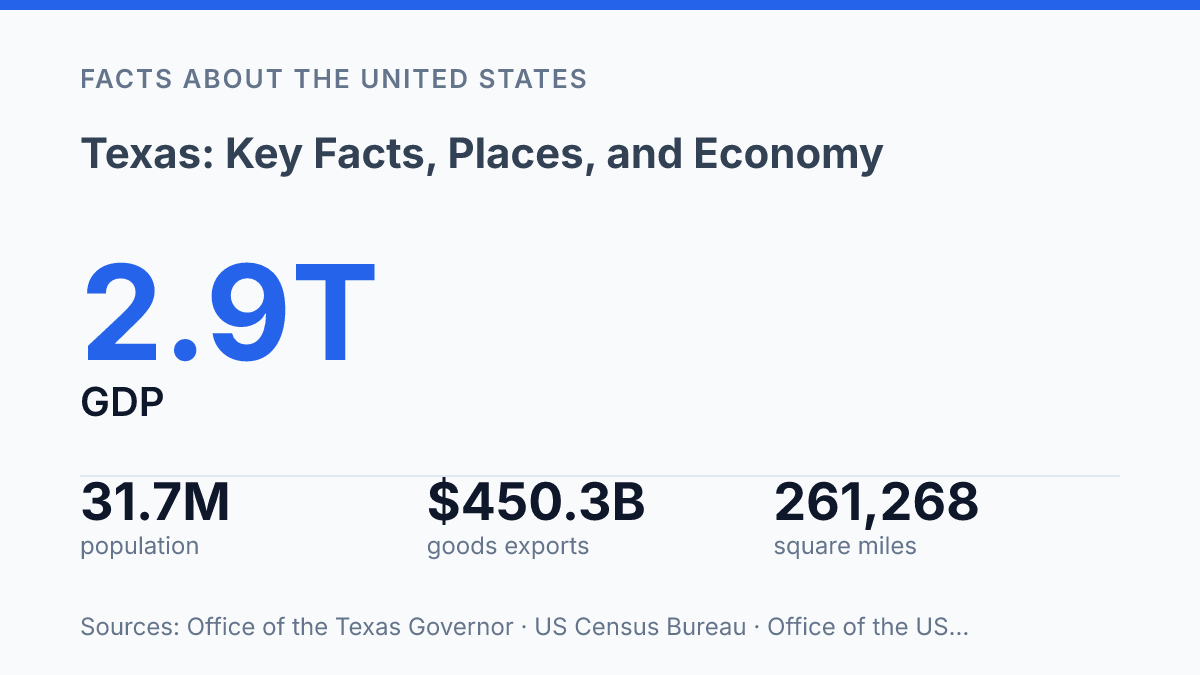
Texas had 31,709,821 residents on July 1, 2025, and 261,267.85 square miles of land, making it the only state that ranks second nationally in both population and land area. That scale is not just geographic; it is visible in the way growth spreads across major metros, border trade, state finance, and fast-expanding suburbs. The more revealing detail is that the five fastest-growing U.S. cities above 20,000 people from July 2024 to July 2025 were all in the state, led by Celina at 24.6%.
At the same time, Houston, San Antonio, Dallas, Fort Worth, and Austin all ranked among the nation’s 15 largest cities. The state’s history, constitution, tax structure, and $2.9 trillion economy help explain why its influence extends well beyond its borders.
What Makes Texas the Second-Largest State?
At 268,596 square miles, Texas is the only U.S. state besides Alaska above 250,000 square miles, placing it second nationally in total area behind Alaska. That total-area figure is slightly broader than land-area measurements, which exclude bodies of water and help explain why different official references may show different totals for the state’s physical size.
Population scale now matches the geographic scale. According to U.S. Census Bureau QuickFacts, Texas had 31,709,821 residents as of July 1, 2025, up 8.8% from the 2020 estimates base, with 261,267.85 square miles of land area.
That puts the state well above 30 million residents, but the population is not spread evenly across its full territory. Large metropolitan areas and expanding suburbs account for much of the concentration, while wide areas in the west and parts of the plains remain comparatively sparse.
Location is another part of the state’s scale. The southern border follows Mexico for a long stretch, while the southeast faces the Gulf of Mexico, giving the state both an international land frontier and a major coastal edge.
Its U.S. neighbors frame it on several sides: New Mexico lies to the west, Oklahoma to the north, Arkansas to the northeast, and Louisiana to the east. This position helps explain why distance within the state often feels regional rather than simply local, with places such as Houston and Dallas-Fort Worth serving as broad orientation points rather than a full picture of how settlement is distributed.
How Texas Government and History Shaped the State
For nearly a decade, the state had its own president, foreign relations, and national institutions before entering the United States. The break from Mexico produced independence in 1836, and annexation followed in 1845, creating a political memory that has remained unusually visible in state culture. The former Republic of Texas is still reflected in the lone star on state symbols, school curricula, public monuments, and the common use of “Lone Star” as shorthand for state identity.
That history can make the republic era seem larger than its actual duration. Modern state government is not organized as a continuation of independent nationhood; it operates within the U.S. federal system, under a state constitution and federal constitutional limits. The distinction matters because the symbols emphasize sovereignty and self-rule, while the institutions function as those of a U.S. state.
Austin is the capital, and the Texas Legislature works within a state government that includes a strong executive structure, though executive authority is distributed among several elected statewide offices rather than held only by the governor. The Legislature is bicameral, with a Senate and House of Representatives, and regular sessions are limited to 140 days in odd-numbered years. That schedule gives regular legislative sessions a compressed role, while special sessions can be called by the governor for specific subjects.
The state constitution has also shaped political development by requiring frequent voter approval for changes that other states might handle through ordinary law. Since the current constitution took effect in 1876, lawmakers have proposed 731 constitutional amendments; voters have approved 547, defeated 181, and 3 never reached the ballot, according to the state Legislative Reference Library. This pattern shows how the state’s political identity combines historic independence with a highly specific constitutional framework.
Which Cities Drive the State’s Population and Growth?
Five of the nation’s 15 most populous cities are in the state, a distribution that shows how growth is spread across several urban anchors rather than concentrated in one dominant city. According to Census Bureau city estimates for 2025, Houston remained the largest city with 2,397,315 residents, followed by San Antonio at 1,548,422, Dallas at 1,329,491, Fort Worth at 1,028,117, and Austin at 1,002,632. That lineup matters because each city sits inside a wider labor and housing market that extends well beyond municipal boundaries.
Dallas-Fort Worth is the clearest example of metropolitan scale shaping daily life. Dallas remains a major business center, while Fort Worth has become one of the country’s largest cities in its own right; the Census Bureau reported that Fort Worth added 19,512 residents from 2024 to 2025, the second-largest numeric city gain nationally. Growth in the region is also tied to suburban and exurban communities north of Dallas, where places such as Celina, Princeton, Melissa, and Anna have expanded rapidly as households seek newer housing and access to jobs across the broader metro area.
Along the Gulf Coast, the Houston region combines a large central city with outward growth into surrounding counties. Housing development has moved into master-planned suburbs and fast-growing edge communities, including Fulshear, which the Census Bureau listed among the fastest-growing U.S. cities of 20,000 or more from July 2024 to July 2025. This pattern reflects both job access within the region and the availability of developable land outside the core city.
Greater Austin shows a similar but more compact version of the same trend. The central city remains a major population center, but much recent growth has been absorbed by nearby communities and counties connected to the Austin labor market.
Rapid expansion has supported employment and new housing construction across several metros, but it has also increased pressure on road capacity, housing affordability, and water planning in fast-growing counties. San Antonio, meanwhile, anchors a large urban region of its own, with growth shaped by both the central city and expanding communities along major corridors toward Austin and the Hill Country.
Why the State Economy Matters Nationally
A $2.9 trillion current-dollar economy in 2025 would place the state among the world’s largest economies if compared with nations, according to the state governor’s office citing preliminary BEA estimates. That scale matters nationally because the state is not tied to one industry alone: energy, advanced manufacturing, logistics, aerospace, technology, and cross-border trade all feed into supply chains used across the United States.
Energy remains the clearest national link. The Permian Basin is one of the country’s most productive oil and natural gas regions, while the Gulf Coast concentrates refineries, petrochemical plants, export terminals, and related industrial services.
This creates national influence, but it also exposes public revenue and local employment to commodity swings. The state comptroller reported that in fiscal 2025, oil production tax revenue fell 14.6% to $5.38 billion, while natural gas production tax revenue rose 16.2% to $2.48 billion, a contrast that shows how different parts of the energy sector can move in opposite directions.
Trade adds another layer to the state’s importance. Goods exports totaled $450.3 billion in 2025, according to the Office of the U.S. Trade Representative, with $125.2 billion going to Mexico and 49% going to current free-trade-agreement partners.
Ports such as Houston are central to those flows, especially for energy, chemicals, machinery, and other industrial goods moving through Gulf Coast networks. The result is an economy closely connected to North American production, not just domestic consumption.
Corporate investment also shows how varied the industrial base has become. Toyota in San Antonio represents large-scale auto manufacturing; Tesla near Austin links the state to electric vehicles, batteries, and technology-centered production; and the Dallas-Fort Worth logistics corridor supports distribution through highway, rail, warehousing, and air-freight connections. Aerospace and defense activity, semiconductor and software investment, and industrial construction deepen that mix.
The same scale brings uneven pressure. High-growth regions depend on housing capacity, transportation systems, reliable power, and water planning to sustain expansion. A diversified economy can soften downturns in any single sector, but energy prices, construction costs, interest rates, and infrastructure constraints can still shape job growth and business investment very differently from one region to another.
Where the state’s scale will be tested next
The next set of choices will be tested less by size itself than by how unevenly that size is distributed. A $2.9 trillion economy and $450.3 billion in goods exports give the state unusual fiscal and trade weight, but fast exurban growth can pressure roads, water systems, schools, and local tax bases before population gains fully translate into capacity.
The reliance on sales taxes also means public revenue moves with household spending and business cycles rather than income-tax collections. For analysts, the most useful next check is whether growth remains broad across major metros and smaller cities, or concentrates in places least prepared to finance it.
Frequently Asked Questions
Q: What is Texas known for?
A: Texas is known for its large size, diverse regions, and strong economic output. It is also associated with major cities such as Houston, Dallas, and San Antonio, each of which contributes to the state’s population and economic activity.
Q: Which major industries drive the Texas economy?
A: Energy, technology, healthcare, manufacturing, and agriculture are among the main sectors supporting the Texas economy. The state also benefits from trade, logistics, and a large labor force spread across several metropolitan areas.
Q: What are the most visited places in Texas?
A: Popular destinations include San Antonio’s River Walk, the Alamo, Big Bend National Park, and major urban centers such as Austin and Houston. These places attract visitors for history, outdoor recreation, music, and cultural institutions.
Q: Why does Texas have such a large economy?
A: Texas has a large economy because it combines population growth, business-friendly conditions, and a wide mix of industries. Its ports, transportation network, and access to energy resources also support commerce across the state.
Q: What regions or cities are most important in Texas?
A: The state’s major metropolitan areas include Houston, Dallas-Fort Worth, Austin, and San Antonio. West Texas, the Gulf Coast, and the Hill Country are also important for their geography, resources, tourism, and regional identity.