
New Hampshire covers just 8,953.75 square miles of land, yet its 131-mile coastline, White Mountain terrain, and dense southern job centers give the state a wider range than its size suggests. Its national role is similarly larger than its footprint: on June 21, 1788, it became the ninth state to ratify the U.S. Constitution, putting the document into effect under Article VII. The same place now combines a low 2.8% unemployment rate, a median household income of $99,031, and housing costs that have climbed to a $402,500 median owner-occupied home value.
Those contrasts help explain why the state cannot be understood only as a colonial landmark, ski destination, or quiet northern neighbor. Its geography, early-republic history, aging population, industry mix, and seasonal visitor economy all point to a state defined by compression: small area, high civic weight, and sharp economic pressures.
Where New Hampshire sits and what defines it
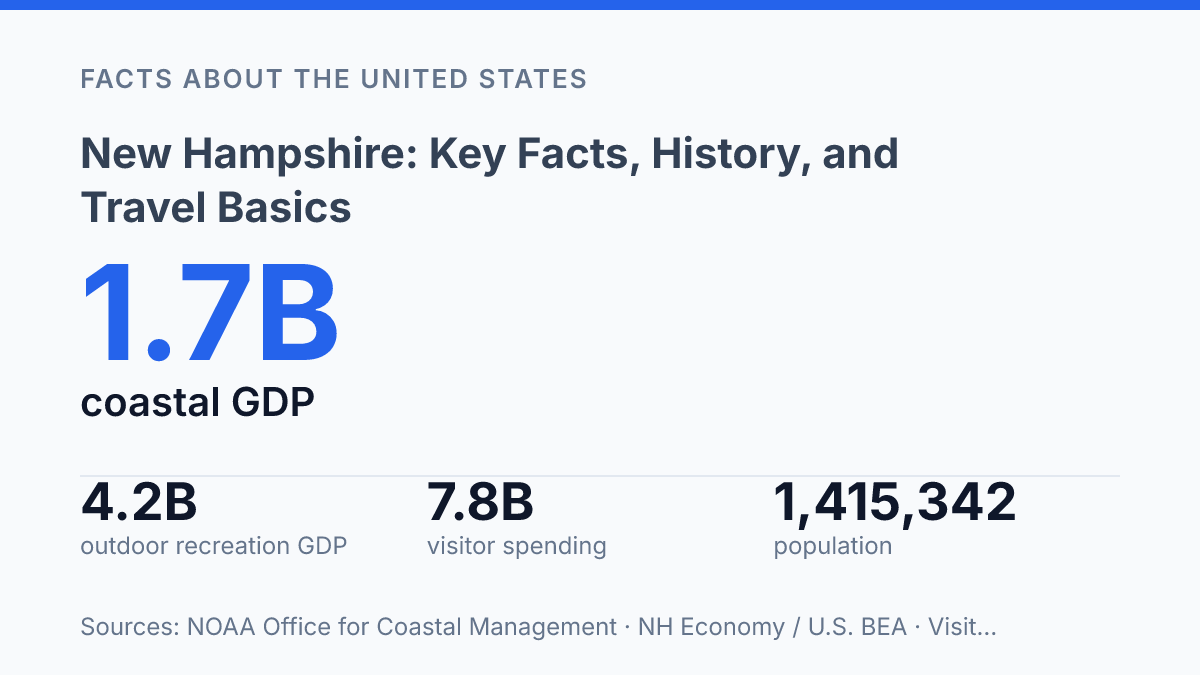
A state best known for steep northern peaks also has a brief Atlantic edge near Portsmouth, and that coastal zone supports hundreds of thousands of residents and a measurable marine economy. The state covers 8,953.75 square miles of land area, while federal coastal data count 131 miles of coastline, 438,400 coastal residents, $1.7 billion in coastal and marine GDP, and $1.2 billion in annual coastal and marine wages, according to U.S. Census Bureau QuickFacts and NOAA Office for Coastal Management, 2025/. That combination explains why the state is geographically compact but not geographically simple: its identity draws from mountains, river valleys, inland towns, and a small but economically active seacoast.
New Hampshire sits in northern New England, bordered by Maine to the east, Vermont to the west, and Massachusetts to the south. Its western boundary largely follows the Connecticut River, which separates it from Vermont, while the southeastern corner reaches the Atlantic near Portsmouth. This position places the state between the broader Gulf of Maine region and the interior uplands of New England, giving it both maritime and mountain influences within a short distance.
The White Mountains dominate the state’s northern physical profile, and Mount Washington is its highest peak at 6,288 feet. The range helps shape local climate, drainage, settlement patterns, and the state’s outdoor image, but it is not where most daily life is concentrated. Much of the population lives in smaller cities, towns, and village centers in southern and central areas, where road connections, employment, and access to Massachusetts have historically made settlement denser than in the high country.
The nickname “The Granite State” reflects more than a slogan. Granite is a visible part of the state’s bedrock and building tradition, and quarrying helped give the nickname practical meaning through stone used in construction, monuments, and civic architecture. The name therefore points to both geology and work: a hard crystalline foundation under much of the state and an industry that turned that stone into a recognizable regional material.
How the state entered the early republic
By ratifying the federal Constitution as the ninth state on June 21, 1788, the state supplied the vote that made the new national frame of government operative under Article VII, according to the U.S. Senate Historical Office. The same source records that John Langdon was elected as one of its first U.S. senators later that year, linking local revolutionary leadership directly to the institutions of the early republic.
Colonial political influence was anchored in commerce as much as ideology. Portsmouth Harbor served as the province’s main maritime outlet, supporting shipbuilding, customs activity, fishing, lumber exports, and trade with wider Atlantic markets. That commercial base helped create merchant networks and public institutions capable of responding quickly when imperial authority weakened.
Revolutionary-era government also moved unusually early. In January 1776, the provincial congress adopted a temporary state constitution, months before the Declaration of Independence, making it one of the first American colonies to create a government independent of royal authority. The document was provisional and practical rather than expansive, but its timing mattered: it showed that local leaders were already treating self-government as an immediate administrative necessity, not only as a political principle.
The state’s later first-in-the-nation presidential primary tradition continued this pattern of influence through timing rather than size. Campaign activity in places such as Manchester and Concord has long drawn candidates, national journalists, and party organizers before larger electorates vote. The effect is not that the state represents the country demographically; rather, its early position can test campaign strength, voter response, and media narratives at a point when nominations are still fluid.
Population, economy, and major industries
A state with just 1,415,342 residents in 2025 supports an economy that looks less rural than its size might suggest, with employment concentrated in health care, trade, professional services, manufacturing, and tourism. According to U.S. Census Bureau QuickFacts, the population rose 2.7% from the April 2020 estimates base, while 23.0% of residents were 65 or older and 17.3% were under 18. That age profile increases demand for medical services and long-term care while tightening the pool of younger workers entering the labor force.
Manchester remains the largest city and the main urban labor market, with hospitals, universities, finance, and technology employers clustered around the Merrimack Valley. Nashua, near the Massachusetts line, is closely tied to the Boston-area economy and has a strong base in electronics, defense, and software-related work, including major operations associated with BAE Systems in Nashua and Merrimack. Concord, the state capital, adds government employment, legal services, health care, and regional retail, while smaller centers such as Lebanon and Dover contribute medical, education, and advanced-manufacturing jobs.
The labor market is broad for a small state. The U.S. Bureau of Labor Statistics reported a 2.8% unemployment rate in July 2026 and 706,300 total nonfarm jobs, led by trade, transportation, and utilities; education and health services; professional and business services; and manufacturing.
Manufacturing remains visible in precision components, defense electronics, medical devices, and specialty materials rather than in a single dominant heavy industry. Health care is anchored by systems such as Dartmouth Health in Lebanon, Concord Hospital, Elliot Hospital, and Catholic Medical Center, reflecting both statewide demand and the needs of an older population.
Tourism and outdoor recreation also function as core industries rather than seasonal extras. Visit NH and Coraggio Group reported $7.8 billion in visitor spending in 2024, with retail and food service making up large shares, while U.S. Bureau of Economic Analysis data cited by NH Economy put outdoor recreation at $4.2 billion in value that year. Lodging, restaurants, ski areas, campgrounds, outfitters, and tax-free retail all benefit from this flow of visitors and shoppers.
The absence of a broad sales tax is one of the state’s most distinctive fiscal features. It supports retail activity and cross-border shopping, especially in places such as Nashua and Salem, but it also narrows the revenue mix. State and local finance therefore depends more heavily on property taxes, business taxes, meals and rooms taxes, and other targeted sources than on a general tax applied to most consumer purchases.
Places, seasons, and what visitors usually see
Travel demand is not confined to one high season: the NH Division of Travel and Tourism Development projected 4.8 million visitors for summer 2026, while separate state forecasts estimated 3.7 million fall visitors in 2024 and 3 million winter visitors for 2024–25. Those figures reflect a climate pattern that changes the practical experience of travel as much as the scenery. Warm summers favor lakes and beaches, autumn concentrates traffic on foliage routes, and cold winters shift attention toward mountain snow sports.
Fall travel is most closely associated with the North Country and the White Mountains, where elevation changes and mixed hardwood forests produce some of the state’s best-known foliage viewing. Routes such as the Kancamagus Highway and areas around Franconia Notch often draw heavy leaf-season traffic, particularly from late September into October depending on elevation and weather. The appeal is highly time-sensitive, which means lodging demand and road congestion can rise sharply during peak color weekends.
Winter brings a different geography of access, with ski areas such as Loon Mountain and Bretton Woods anchoring trips to the mountain interior. Snow, ice, and shorter daylight hours can make driving conditions more variable than in the warmer months, especially outside major corridors. At the same time, the season opens activities that are unavailable or marginal in summer, including alpine skiing, snowboarding, snowshoeing, and Nordic skiing where trail systems are maintained.
Warm-weather travel is often organized around Lake Winnipesaukee and the Seacoast, two areas that offer different versions of summer recreation. The lake region centers on boating, swimming, resort towns, and waterfront communities such as Meredith, Wolfeboro, and the Weirs Beach area.
Along the Seacoast, Hampton Beach and Rye draw beachgoers, seafood traffic, and day trips, with weather conditions playing a direct role in crowd levels. The same seasonal variety that makes the state attractive also creates practical contrasts: spring can limit trail access through mud and lingering snow, summer can compress demand around water destinations, fall is tied to a brief foliage window, and winter rewards preparedness for mountain weather.
What the numbers suggest about the state’s next chapter
The state’s next phase will depend on how well it balances prosperity with capacity. A tourism economy that draws millions of seasonal visitors, an outdoor recreation sector worth $4.2 billion, and a tight labor market all strengthen local income, but they also raise practical questions about housing, workforce supply, transportation, and services for an older population.
The useful way to read the state is not as a fixed New England profile, but as a compact case study in competing demands. Its small size makes each pressure more visible: a new employer, a weak snow season, a housing shortage, or a shift in coastal activity can register quickly in local communities.
Frequently Asked Questions
Q: What is New Hampshire known for?
A: New Hampshire is known for its White Mountains, lakes, fall foliage, and a long tradition of town-centered local government. It is also one of the states without a general sales tax or broad personal income tax, which often draws attention from residents and businesses. These features shape both its tourism profile and its public-finance model.
Q: What is the capital of New Hampshire?
A: Concord is the state capital of New Hampshire. It is the seat of state government and one of the main civic centers in the state. The city is smaller than some nearby regional hubs, which gives it a more administrative than metropolitan character.
Q: What is the largest city in New Hampshire?
A: Manchester is the largest city in New Hampshire by population. It functions as the state’s main urban center for business, health care, and transportation. That concentration makes it a common starting point for travel in the southern part of the state.
Q: When did New Hampshire become a state?
A: New Hampshire ratified the U.S. Constitution on June 21, 1788, becoming the ninth state. Its colonial and Revolutionary-era history remains visible in older towns, historic buildings, and preserved public sites. That early date also places it among the original core of the United States.
Q: What is the best time to visit New Hampshire?
A: The best time depends on the intended trip. Summer is usually strongest for lakes, hiking, and mountain travel, while fall is known for foliage and cooler weather. Winter supports skiing and other snow sports, but road conditions and daylight can make travel more demanding.