
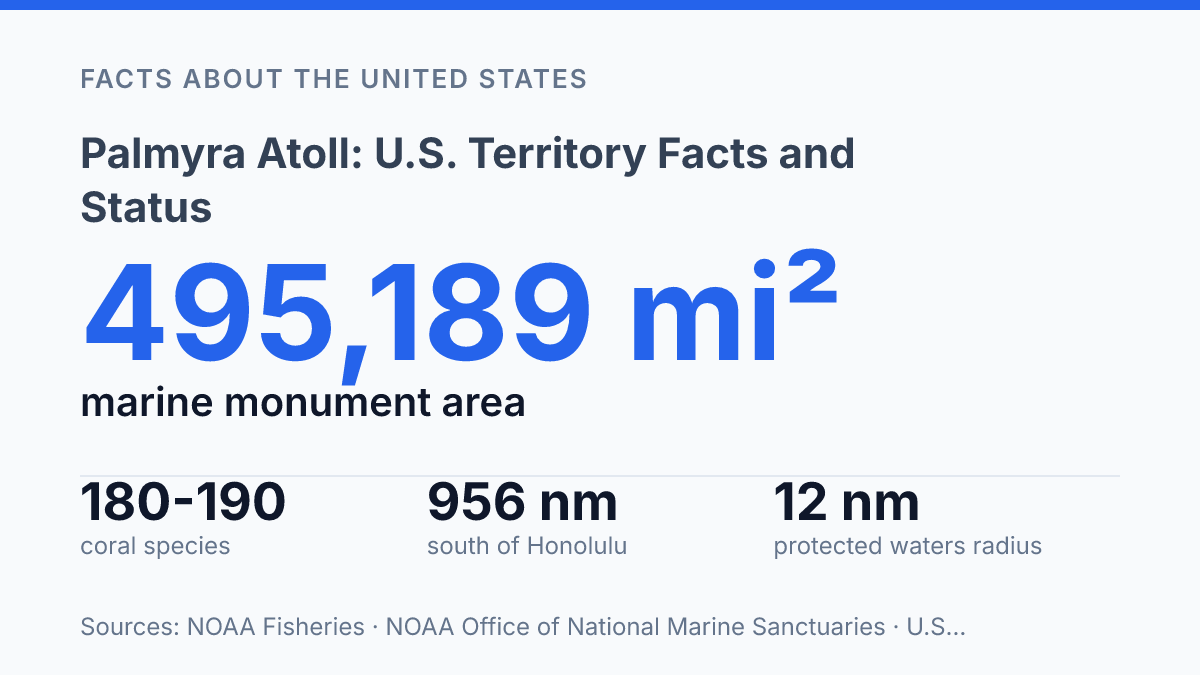
Palmyra Atoll sits about 956 nautical miles south of Honolulu, but its distance from Hawaiʻi is less unusual than its legal status: it is the only incorporated U.S. territory among the 14 U.S. insular areas. The atoll consists of about 26 islets surrounded by roughly 15,000 acres of shallow and submerged reefs, yet its governance extends far beyond the land visible above water. Federal refuge rules, private fractional ownership, The Nature Conservancy’s holdings, and a large marine monument all apply in different ways.
That layered arrangement makes Palmyra a useful case for understanding how U.S. territory status, conservation authority, and ownership can overlap in a remote Pacific setting. The article explains where the atoll is, how its unusual U.S. status developed, who manages it, and why its reefs and species-recovery work have given it significance beyond its size.
Where the atoll is and what it is
Roughly 26 islets ringed by 15,000 acres of shallow and submerged reefs lie approximately 956 nautical miles south of Honolulu, Hawaii, according to the U.S. Fish & Wildlife Service. Palmyra Atoll, also called Palmyra Island, is a small, low-lying, uninhabited atoll in the central Pacific Ocean rather than a single large island. Its visible land is fragmented across coral islets, while much of its geographic footprint is reef, lagoon, and surrounding marine habitat.
That physical form matters because an atoll is shaped as much by water and reef structure as by dry land. Low elevation leaves the islets exposed to storms, overwash, erosion, and changes in sea level, while coral reef health influences the stability of beaches and lagoon habitats. The result is a place with limited land area but an environmental profile that extends well beyond the shoreline.
Remoteness gives the atoll a different kind of scale. Its position far south of Hawaiʻi places it within a wide central Pacific ocean setting, where small landforms can anchor large areas of reef habitat and scientific interest. This contrast between tiny, fragile land and a much broader marine setting is one reason the atoll’s geography is central to understanding its later legal and conservation treatment.
How U.S. territory status works here
The legal oddity is that Palmyra Atoll is part of the United States in a fuller constitutional sense than other U.S. insular areas, even though it has no ordinary territorial government. It is a Territory of the United States and an insular area, a category used for U.S.-associated lands that are not states or part of any state. According to the U.S. Department of the Interior’s Office of Insular Affairs, it is the only incorporated U.S. territory among 14 U.S. insular areas, which makes its status unusually specific rather than merely remote or obscure.
In plain terms, incorporation concerns how the U.S. Constitution applies. An incorporated territory is treated as part of the United States for constitutional purposes, with the understanding that the Constitution applies there in full.
An unincorporated territory, by contrast, belongs to the United States but is not considered fully incorporated into the Union; only certain constitutional protections apply automatically, with other questions shaped by federal law and court doctrine. That distinction explains why Palmyra’s legal label is not just administrative wording.
The origin of that status is tied to Hawaiʻi’s territorial period rather than to a separate modern political settlement. The Interior Department notes that Hawaiʻi, including Palmyra, became an incorporated U.S. territory on April 30, 1900; when Hawaiʻi later became a state without including Palmyra, the atoll retained its incorporated status. The result is a rare leftover category: incorporated into the Union, but not organized as a populated territory with its own legislature, governor, or routine civic institutions.
That distinction is central to understanding the atoll’s status today. Incorporation gives it an exceptional place in U.S. territorial law, but it does not make it function like Puerto Rico, Guam, the U.S. Virgin Islands, or the Northern Mariana Islands. Its legal identity is stronger than its political footprint, which is why discussions of the atoll often separate constitutional status from day-to-day governance and land management.
Who manages the atoll and why it matters
A territory with no local government is managed through a property map: federal refuge acres, conservation-owned islands, and a small private holding. According to the Federal Register and U.S. Fish & Wildlife Service in 2023, the United States owns and manages 390 acres as part of Palmyra Atoll National Wildlife Refuge, while The Nature Conservancy owns 226 acres on Cooper and Menge Islands and Home Island remains in private fractional ownership at 1.8 acres. That split makes stewardship a coordinated arrangement rather than a conventional territorial administration, with land title, wildlife protection, and permitted access all shaping day-to-day decisions.
Why Palmyra Atoll stands out among U.S. territories
Palmyra is exceptional because its territorial importance is not anchored in residents, elections, or a local economy, but in the way a remote ocean site fits into U.S. constitutional and administrative geography. Better-known territories such as Guam and Puerto Rico are usually discussed as inhabited places with public institutions, civic identity, and policy debates affecting large resident communities. Palmyra instead has no permanent population, which is unusual among U.S. territories and changes the practical meaning of territorial status there.
That absence of a resident community helps explain why the atoll can be easy to overlook even though its status is highly distinctive. In most territories, legal classification, local government, and demographic reality are closely connected. On Palmyra, those elements separate: the place remains a U.S. territory, but everyday governance is shaped less by municipal services or representative politics than by federal stewardship, access control, conservation administration, and land management.
The combination of federal control and official incorporation gives the atoll its central significance. Federal control means Palmyra functions primarily as a nationally administered site rather than as a self-governing territorial community.
Official incorporation, by contrast, places it in a rare constitutional category within U.S. territorial geography. The result is a territory that is politically quiet but legally conspicuous: small in human terms, prominent in how it tests the usual assumptions about what a U.S. territory looks like.
Compared with American Samoa, Guam, or Puerto Rico, Palmyra shows that territorial status is not only a question of population size or public visibility. It can also describe jurisdiction over remote land and surrounding waters where sovereignty, constitutional classification, and federal management matter more than settlement. That makes the atoll notable less as a demographic place than as an unusually clear example of how varied U.S. territorial arrangements can be.
Why the legal anomaly still matters
Palmyra Atoll matters less as a conventional territory than as a stress test for categories that are usually kept separate: constitutional status, land title, refuge management, marine protection, and species recovery. Its future is likely to be shaped through management decisions rather than population growth or political institutions.
The 2024 release of nine sihek, followed by the first wild eggs in almost 40 years, shows how a remote U.S. possession can become a practical site for conservation choices with consequences far beyond its shorelines. The same legal oddity that makes Palmyra difficult to classify also helps explain why it remains available for a rare combination of territorial administration and ecological experimentation.
Frequently Asked Questions
Q: Is Palmyra Atoll part of the United States?
A: Yes. Palmyra Atoll is a Territory of the United States and an insular area. It is also the only officially incorporated territory in the Union, which gives it a distinct legal status compared with most other U.S. territories.
Q: Does anyone live on Palmyra Atoll?
A: No permanent population is associated with Palmyra Atoll. It is described as a small, low-lying, uninhabited atoll in the central Pacific Ocean, so there is no resident civilian community there.
Q: Where is Palmyra Atoll located?
A: Palmyra Atoll is in the central Pacific Ocean. Its remote location helps explain why it remains uninhabited and why its status is often discussed in terms of territory rather than settlement or local governance.
Q: What does it mean that Palmyra Atoll is an incorporated territory?
A: An incorporated territory is generally treated as part of the United States for constitutional purposes, unlike most unincorporated territories. In Palmyra Atoll’s case, that status is especially notable because it is the only officially incorporated territory in the Union.
Q: Is Palmyra Atoll the same as Palmyra Island?
A: Palmyra Atoll is also called Palmyra Island. The two names refer to the same place, a small atoll in the central Pacific with U.S. territorial status.