
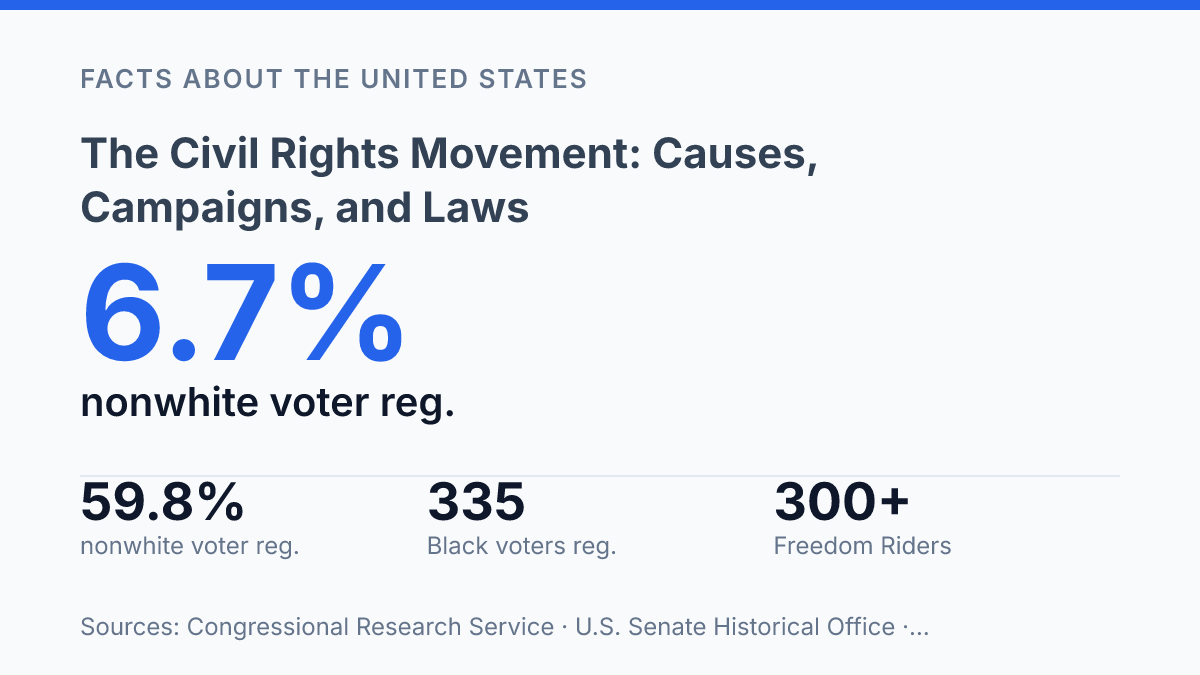
The civil rights movement exposed a stark democratic gap: before the Voting Rights Act, 69.9% of white Mississippians were registered to vote, compared with only 6.7% of nonwhite Mississippians. That imbalance was not an accident of participation; it reflected a legal and administrative system built to narrow citizenship through segregation, intimidation, literacy tests, and local control over registration. The movement’s power came from forcing those local practices into national view, then converting public pressure into federal action.
Freedom Rides, jail-ins, mass meetings, music, court cases, and marches worked together as political instruments, not isolated symbols. The article traces how disfranchisement shaped the struggle, how nonviolent campaigns altered the choices available to Congress and presidents, why the 1960s produced major civil rights laws, and how the years after 1968 changed representation, housing access, and the meaning of federal enforcement.
How segregation and disfranchisement shaped the struggle
In Mississippi before federal voting-rights enforcement, 6.7% of nonwhite residents were registered to vote compared with 69.9% of white residents, and after enactment the figures rose to 59.8% and 91.5%, respectively, according to the Congressional Research Service. The scale of that gap shows that disfranchisement was not a secondary grievance. It was a central mechanism for preserving racial hierarchy because it reduced Black influence over sheriffs, judges, school boards, tax policy, and congressional representation.
The origins of that system reached back to the Reconstruction era in the late 19th century, when the defeat of the Confederacy briefly opened political space for formerly enslaved people. Black men voted, held office, and participated in constitutional changes across the South, but those gains faced organized white resistance and were progressively weakened after federal protection receded. The rollback did not simply restore prewar social customs; it built new legal and administrative barriers designed to make equal citizenship difficult to exercise.
Under Jim Crow laws, Southern states converted racial separation into a formal public order. Schools, railway cars, waiting rooms, parks, restrooms, hospitals, and other public facilities were commonly divided by race, with Black institutions receiving inferior funding and protection.
Segregation also shaped private life through employment practices, housing exclusion, credit discrimination, and the threat of punishment for violating racial etiquette. These rules made inequality visible in everyday spaces while giving local officials broad power to enforce it.
Voting restrictions reinforced that order by narrowing the electorate. Literacy tests allowed registrars to pass or fail applicants selectively, poll taxes placed a financial barrier between poor citizens and the ballot, and intimidation made registration physically and economically dangerous. Violence, job loss, eviction, and police harassment were not incidental to the system; they made the formal rules more effective by warning Black citizens that political participation carried personal costs.
The civil rights movement responded to these long-standing structures, yet its modern phase became more achievable in the 1940s and 1950s than earlier campaigns had been. Black wartime service, migration to cities, labor organizing, court challenges, and national media attention all increased pressure on federal institutions. The result was not an automatic path to reform, but a changed political setting in which local segregation and disfranchisement could be exposed as national problems rather than treated as regional custom.
Nonviolent protest methods that changed national politics
A bus boycott that lasted 381 days showed that disciplined economic withdrawal could turn a municipal transit dispute into a national test of democratic legitimacy. The Montgomery bus boycott began in December 1955 after Rosa Parks was arrested for refusing to give up her seat, but its force came from organized collective action: car pools, mass meetings, church networks, and sustained refusal to pay fares. By making everyday participation possible, the boycott demonstrated that nonviolent protest could impose financial and political costs without relying on armed confrontation.
Nonviolent strategy drew partly from Gandhi and the campaigns against British rule in India, especially the use of disciplined resistance to expose the injustice of an opponent’s response. Activists adapted those ideas to American conditions through training sessions, codes of conduct, and careful preparation for arrest or assault. The point was not passivity; it was a method of confrontation designed to make discrimination visible, force public officials to choose between negotiation and repression, and invite national scrutiny.
Different tactics applied the same logic in different settings. Boycotts targeted economic dependence, sit-ins challenged exclusion at lunch counters and other public accommodations, marches dramatized collective demands in public space, and civil disobedience deliberately tested unjust rules through arrests.
Freedom Rides expanded this approach across state lines; in summer 1961, more than 300 riders traveled to Jackson, Mississippi, by bus, plane, and train, where they were arrested and jailed at Parchman Prison, according to the Library of Congress. Mass arrest became a political instrument because it converted local enforcement into a national spectacle.
The Birmingham campaign of 1963 showed both the power and the cost of this strategy. Demonstrators faced jail, police dogs, and fire hoses, and images of the repression circulated through newspapers and television. That visibility widened public sympathy, but it did not mean federal action was immediate or automatic; pressure had to be sustained through repeated campaigns and negotiations.
The March on Washington in 1963 translated local protest into a national political demand. With about 250,000 people gathered at the Lincoln Memorial, according to the National Park Service, the march linked jobs, freedom, and federal responsibility in a single public event. Its scale made clear that nonviolent direct action had become more than a regional challenge to segregation: it was a national campaign capable of shaping the political agenda.
Federal laws passed in the 1960s
In less than four years, Congress turned several core civil rights demands into federal rules that reached schools, workplaces, polling places, and housing markets. The Civil Rights Act of 1964 was the broadest of these measures: it barred segregation in public accommodations such as hotels, restaurants, and theaters, and it prohibited employment discrimination based on race, color, religion, sex, or national origin. It also strengthened federal authority by allowing the Justice Department to bring school desegregation cases and by creating the Equal Employment Opportunity Commission to address workplace discrimination.
The law’s passage showed how difficult national civil rights legislation remained even after public pressure had intensified. According to U.S. House History, Art & Archives, the House passed H.R. 7152 by 290–130 on February 10, 1964; the Senate broke a filibuster by 71–29 on June 10; and the House accepted the final Senate version by 289–126 on July 2. Those votes mattered because the statute shifted civil rights enforcement from scattered local challenges toward national legal standards.
Voting access became the next major federal priority. The Voting Rights Act of 1965 attacked disfranchisement directly by suspending devices such as literacy tests in covered jurisdictions, authorizing federal examiners, and requiring certain states and localities with records of discrimination to obtain federal approval before changing voting rules.
The Senate invoked cloture on May 25, 1965, by 70–30, passed the bill the next day by 77–19, and President Lyndon B. Johnson signed it on August 6, according to the U.S. Senate Historical Office. In practice, the law gave federal officials tools to protect Black voting access where local registration systems had been used to exclude eligible voters.
The Civil Rights Act of 1968, commonly called the Fair Housing Act, extended federal civil rights protections into the housing market. It restricted discrimination in the sale, rental, and financing of housing on grounds including race, color, religion, and national origin.
The House approved the Senate bill 250–172, Johnson signed it on April 11, and the law outlawed discrimination in roughly 80% of U.S. housing by 1970, according to U.S. House records and GovInfo. These statutes marked a major federal turn, but their effects depended on enforcement, court interpretation, and local compliance, so discrimination persisted in many forms after passage.
What the movement changed after 1968
By 1970, the number of Black elected officials had risen to 1,469, up from 72 five years earlier, according to the Joint Center for Political and Economic Studies. That increase did not mean political power had become equal, but it showed that federal voting-rights enforcement and local organizing had changed who could realistically compete for office. Representation became one of the clearest measurable consequences of the movement: legal access to the ballot began to alter city councils, school boards, state legislatures, and congressional politics.
The post-1968 settlement also changed the federal government’s role in civil rights enforcement. Protections that had once been contested mainly through local courts, protests, and municipal negotiations were now embedded in national rules covering public accommodations, employment, voting procedures, and housing access. This shift mattered because discrimination in one sphere often reinforced exclusion in another; unequal schooling, restricted neighborhoods, limited job access, and blocked political participation had operated as connected systems rather than isolated problems.
Other equality campaigns drew directly from the movement’s methods, legal arguments, and moral vocabulary. Latino, Native American, Asian American, women’s rights, disability rights, and gay rights organizers adapted mass protest, litigation, voter registration, boycott tactics, and appeals to equal protection for their own campaigns. The influence was not a simple copy, since each group faced distinct laws and histories, but the earlier movement helped establish a practical model for turning public pressure into institutional change.
Legal equality, however, did not automatically produce lived equality. Formal barriers could be removed while wealth gaps, residential segregation, school inequality, workplace discrimination, and unequal treatment by public institutions persisted. The central legacy after 1968 was therefore double-edged: the movement secured decisive changes in American law and public life, yet it also revealed that rights written into statute required enforcement, resources, and continued civic pressure to affect everyday conditions.
Why enforcement changed the scale of representation
The clearest measure of change lies in what became administratively possible after federal law entered areas once controlled by local custom. Registration drives, candidate recruitment, fair-housing enforcement, and court-supervised compliance could not erase inequality by statute alone, but they changed the machinery through which inequality had been protected.
The rise in Black elected officials from 72 in 1965 to 1,469 by 1970 shows how quickly access to the ballot could alter public officeholding when barriers were removed. The later count of more than 10,000 Black elected officials points to a longer consequence: civil rights reform was not only a moral claim, but a redesign of political access that still depends on enforcement, participation, and institutional memory.
Frequently Asked Questions
Q: What started the civil rights movement in the United States?
A: The movement grew from long-standing opposition to legalized segregation, discrimination, and disenfranchisement, especially against African Americans. Its roots reached back to Reconstruction in the late 19th century, while modern organizing accelerated in the 1940s. Nonviolent resistance also drew ideas from Mahatma Gandhi’s campaign in India.
Q: What were the main goals of the civil rights movement?
A: Its central aim was to end legal racial segregation and expand equal political and civil rights. That included removing barriers to voting, public accommodation, and other forms of state-sanctioned discrimination. The movement sought federal protection because local and state systems had often failed to enforce equality.
Q: How did nonviolent protest help the civil rights movement?
A: Nonviolent protest gave the movement a disciplined way to challenge unjust laws and public practices through boycotts, marches, sit-ins, and civil disobedience. These tactics created pressure on lawmakers and courts while keeping public attention on unequal treatment. The approach helped win support for federal intervention.
Q: What major laws came out of the civil rights movement?
A: Three landmark laws are usually identified with its legislative successes: the Civil Rights Act of 1964, the Voting Rights Act of 1965, and the Civil Rights Act of 1968. Together, these laws strengthened federal protections against discrimination and expanded legal access to voting and housing. Their passage marked a major shift in the role of federal law in civil rights.
Q: When did the civil rights movement take place?
A: The movement is generally dated from 1954 to 1968. That period covers the main phase of mass protest, legal challenges, and federal lawmaking associated with the movement. Its earlier roots and later effects extended beyond those years, but the core campaign is tied to that span.