
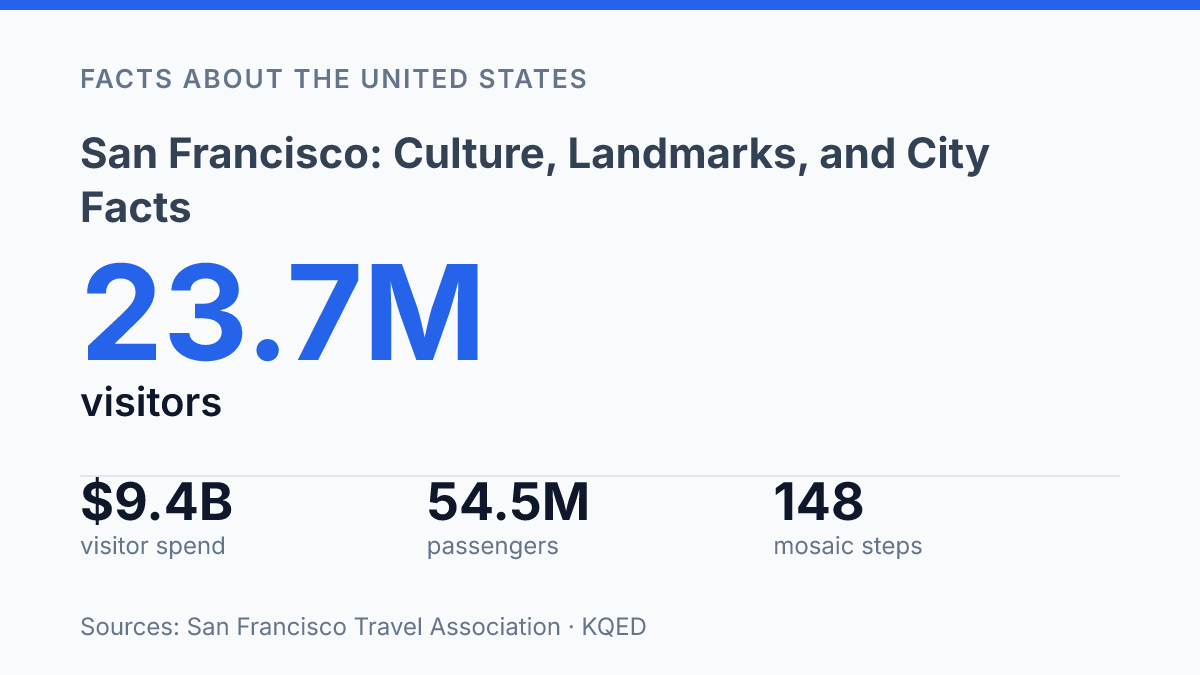
San Francisco drew 23.7 million visitors in 2025, and their $9.4 billion in spending placed the city’s visitor economy close to its pre-pandemic peak. That recovery is only one measure of a place whose identity is built from unusually compact contrasts: a global airport with nonstop service to more than 140 destinations, neighborhoods defined by steep public stairways, and cultural institutions rooted in communities that predate modern tourism. The city’s character is not explained by one landmark or industry.
It comes from the way geography, architecture, immigration history, public space, and technology overlap within a small peninsula. This article examines how Northern California’s most recognizable city is shaped by its hills and districts, why certain landmarks carry unusual symbolic weight, and how tourism, conventions, cultural preservation, and the Bay Area’s AI economy now influence its public image.
Why San Francisco stands out in Northern California
The city’s influence is unusually concentrated: roughly 47 square miles support a finance-and-tourism hub whose reach extends well beyond the Bay Area. Positioned at the northern tip of the San Francisco Peninsula, it occupies a strategic urban site between the Pacific coast and San Francisco Bay, giving it both a maritime identity and close links to the wider metropolitan region. That geography helps explain why a relatively compact city functions as one of Northern California’s principal civic and commercial centers rather than simply as another coastal municipality.
Its regional role is especially visible in services, finance, conventions, and visitor spending. In 2025, the city welcomed 23.7 million visitors, who spent $9.4 billion and supported 63,900 jobs, according to the city’s travel association.
Those figures show that tourism is not only a cultural marker but also a major part of the local tax base and employment structure. The same source forecast visitor spending of $9.9 billion in 2026, above the 2019 record, indicating that the sector has moved beyond basic recovery and back toward growth.
Population scale adds useful context to the city’s outsized profile. U.S. Census Bureau estimates place it below San Jose, the Bay Area’s largest city by population, but above Oakland, another major urban center across the bay.
This comparison clarifies an important distinction: the city is not dominant because of geographic size or regional population rank alone. Its prominence comes from the concentration of financial institutions, professional services, tourism infrastructure, cultural institutions, and international visibility within a small civic footprint.
How the city’s hills, architecture, and districts shape its identity
Historic character is not static, because the same districts that attract preservation interest also face renovation, infill construction, rising land values, and changing commercial patterns. The municipal Cultural Districts Program, established in May 2018, now recognizes 10 cultural districts, according to SF.gov, which shows how identity is increasingly documented through public policy as well as architecture. The result is a built environment where steep terrain, older housing stock, and named neighborhoods remain central to the city’s image, while redevelopment and modernization continually reshape how that image is experienced.
Iconic places visitors usually want to see
The Golden Gate Bridge is famous less for being golden than for its International Orange color, a practical choice that made the span visible against fog, water, and sky. Since opening in 1937, it has served as the city’s signature structure: a suspension bridge, a transportation route, and a visual shorthand for the bay all at once. Its appeal comes from that compression of function and symbolism, which is why viewpoints on both sides of the bridge remain among the most photographed visitor stops.
Alcatraz Island draws attention for a different reason: it turns isolation into the central feature of the visit. The island’s best-known period was its use as a federal penitentiary from 1934 to 1963, a history associated with strict confinement, escape attempts, and high-profile inmates. That prison history gives the site a stronger narrative pull than a standard harbor viewpoint, because the ferry trip, cellhouse, and surrounding water all reinforce the same story of separation.
High-traffic areas such as Fisherman’s Wharf and Union Square show how landmark tourism often clusters around access, hotels, shopping, and easy navigation. Fisherman’s Wharf concentrates waterfront dining, souvenir retail, bay tours, and family-oriented attractions, while Union Square functions as a central shopping and hotel district for many visitors. The pressure around these headline attractions aligns with the wider visitor economy: the San Francisco Travel Association reported that visitors generated $655 million in city tax revenue in 2025, while 2026 visitor spending was forecast to exceed the 2019 record of $9.6 billion.
The same concentration that makes these places convenient can also make parts of the waterfront feel more commercial than local. That does not reduce their importance, but it helps explain the difference between seeing the city’s best-known icons and experiencing its everyday neighborhood life.
Culture, economy, and what the city is known for today
AI now occupies a measurable share of the regional labor market: according to CBRE’s 2025 Scoring Tech Talent report, AI-related roles made up 42% of Bay Area tech talent job postings in June 2025, up from 20% in mid-2022. That shift reflects a broader economy anchored by technology, venture capital, and corporate services, with employers such as Salesforce and OpenAI in the city and major regional firms including Apple, Google, Meta, Visa, and Wells Fargo shaping commuting patterns, office demand, and investment. Finance remains part of this base, but the city’s current economic identity is increasingly tied to software, artificial intelligence, professional services, and the business networks that connect them.
What growth will test at street level
The city’s next chapter will be judged by how well growth preserves specificity. Visitor spending may exceed the 2019 record in 2026, and AI-related hiring has become a defining regional force, but those figures matter differently when placed beside smaller civic investments such as Japantown’s 32,000-square-foot Peace Plaza renovation. The strongest version of the city is not a choice between global capital and local identity.
It is a place where convention traffic, research firms, Victorian blocks, public stairways, and protected cultural districts remain legible at street level. If that balance holds, the city’s economic recovery will be visible not only in hotel rooms and tax receipts, but in neighborhoods that still read as distinct places.
Frequently Asked Questions
Q: What is San Francisco best known for?
A: San Francisco is best known for its steep hills, Victorian-era houses, and landmark waterfront views. It is also widely recognized as a center for finance, tourism, and cultural institutions in Northern California.
Q: Which landmarks are most associated with San Francisco?
A: The city is closely associated with the Golden Gate Bridge, Alcatraz Island, Fisherman’s Wharf, and Lombard Street. These sites draw visitors because they combine distinctive scenery with strong historical and civic identity.
Q: Why is San Francisco considered a major cultural center?
A: San Francisco has long supported museums, theaters, music venues, and neighborhood-based arts scenes. Its cultural profile is shaped by immigration, civic institutions, and a dense urban setting that concentrates public life.
Q: What makes the city’s geography unusual?
A: The city is built on steep, rolling terrain that creates dramatic street grades and wide views across the bay. That geography has influenced transportation, neighborhood development, and the visual character of the city.
Q: Is San Francisco mainly a tourist city or a business city?
A: It functions as both. Tourism is a major part of the local economy, but the city is also a financial hub with a significant concentration of business activity and professional services.