
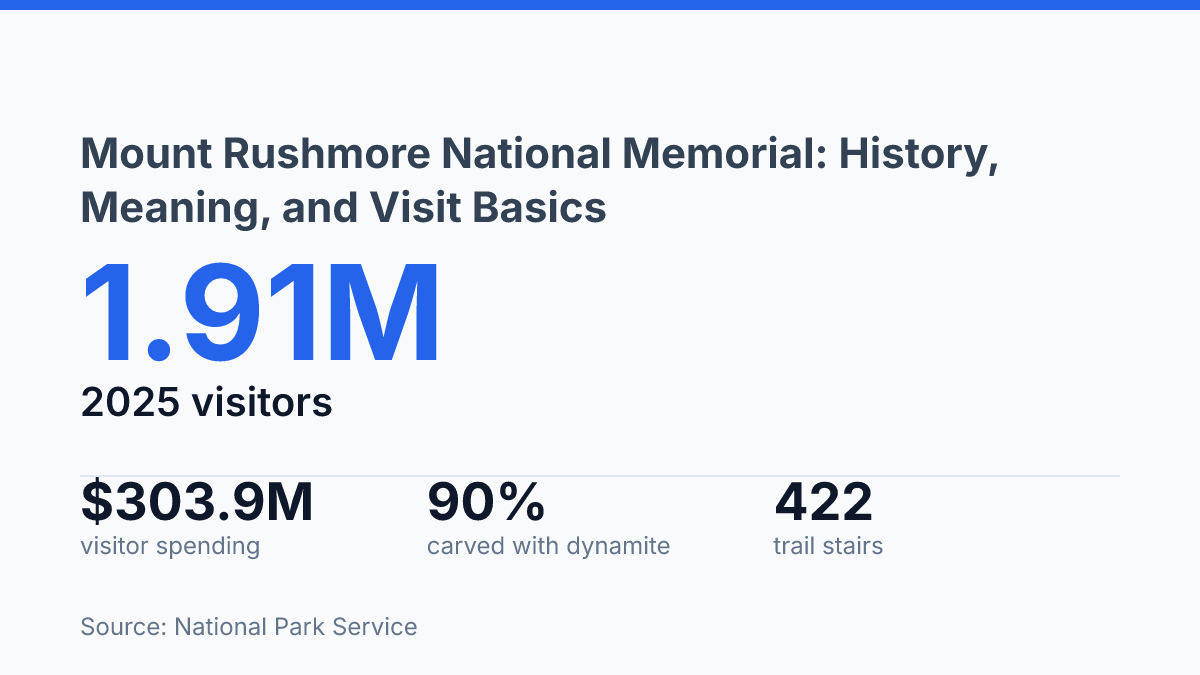
Mount Rushmore National Memorial drew 1,905,649 recreation visitors in 2025, more than any other National Park Service unit in South Dakota and well ahead of Badlands National Park’s 1,139,361. That scale reflects more than a famous photo stop: the site combines federal commemoration, Black Hills engineering, museum interpretation, and the practical pressures of moving large crowds through a compact memorial. The carving itself was not a simple chisel-and-hammer project; the National Park Service reports that about 90% of the mountain was shaped with dynamite, while workers operated from cables on a 500-foot granite face.
The presidents, exhibits, visitor-center film, and Presidential Trail each add a different layer to how the memorial is understood. A short visit can be straightforward, but the site rewards knowing what was carved, why those figures were chosen, and how much can realistically be seen on arrival.
How the monument was carved into the Black Hills
Dynamite, not chisels, did most of the work: about 90% of the mountain was removed by blasting, according to the National Park Service’s carving history. The memorial was cut into granite in the Black Hills of South Dakota, where the hardness of the rock made the project physically possible but also technically demanding. Workers had to translate a sculptural design into a mountainside surface that could be blasted, drilled, and finished without losing the proportions of the intended forms.
Construction began in 1927 and was completed in 1941 under the direction of Gutzon Borglum and, after his death, his son Lincoln. The long schedule reflected both the ambition of the design and the limits of working on an exposed granite face through changing weather, funding pressures, and the practical risks of high-elevation labor. National Park Service history notes that workers were lowered over a 500-foot face on 3/8-inch steel cables after climbing 700 stairs to clock in, yet no fatalities occurred during the 14 years of construction.
The faces are roughly 60 feet high, a scale that explains why the sculpture reads clearly from a distance rather than as a conventional close-view monument. At that size, small errors in proportion would have become visible across the mountain, so the carving process depended on careful measurement as much as force. The result is not only a large artwork but an engineered alteration of a granite peak.
The monument’s physical significance also comes from its setting. Its size draws attention first, but its location in the Black Hills gives the work a meaning that cannot be separated from the mountain itself. The memorial is therefore best understood as both a feat of twentieth-century carving and a permanent intervention in a place with its own geographic and cultural weight.
Which presidents are shown on the monument?
The monument is less a presidential ranking than a compressed national origin story, assigning four leaders to founding, expansion, conservation, and preservation of the Union. The faces depict George Washington, Thomas Jefferson, Theodore Roosevelt, and Abraham Lincoln. Their order on the mountain does not create a simple chronology of the presidency; instead, the grouping spans different eras and political priorities to express selected themes in U.S. history.
Washington represents the founding of the United States because of his role as commander of the Continental Army and the nation’s first president. Jefferson is commonly associated with expansion, especially through the Louisiana Purchase, which greatly enlarged the country’s claimed territory.
Theodore Roosevelt represents a later phase of national development, including federal conservation policy and a more active executive role in public life. Lincoln stands for the preservation of the Union during the Civil War and the constitutional crisis over secession.
That symbolic framework explains why the memorial is best understood as a national emblem rather than a literal portrait gallery. It does not attempt to present a complete or balanced account of every major presidency, nor does it arrange the figures as a neutral historical sequence. The selection condenses broad ideas about the nation’s creation, growth, stewardship, and survival into four recognizable faces, which is why interpretation of the memorial often focuses as much on meaning as on biography.
What the museum and exhibits add to the site
The need for interpretation is clear from the site’s audience size: according to National Park Service IRMA Stats, the memorial drew 1,905,649 recreation visitors in calendar year 2025, up 2.99% from 2024 and more than Badlands National Park’s 1,139,361 visitors, making it South Dakota’s most-visited National Park Service unit that year. For a site that many people first encounter as a distant image, indoor interpretation helps turn a famous outline into a more legible historical object.
The site includes a museum with interactive exhibits that add context not available from the main viewing area alone. Displays can explain how workers moved from design to finished stone, how scale affected engineering decisions, and why the project belonged to a specific period of American public commemoration. That context matters because the sculpture’s visual simplicity can obscure the planning, labor, funding, and symbolic choices that shaped it.
A refreshed visitor-center theater experience has also strengthened the interpretive layer. The new film Mount Rushmore: Carved in Stone debuted on May 23, 2025, alongside remodeled theaters, giving the site another structured way to connect construction history with the meaning attached to the memorial. Film and exhibits can place the carving within its era while also explaining why the monument was intended to communicate national identity, not merely technical achievement.
This interpretation makes the memorial easier to understand, but it also frames the encounter. Exhibits select themes, sequence facts, and emphasize particular connections between workmanship, history, and national symbolism. That does not diminish the sculpture itself; rather, it shows that the visitor experience is shaped by both the carved granite and the explanations surrounding it.
Planning a short visit: what to expect on arrival
A well-planned short stop can take in the main terrace view, the museum, and the 0.6-mile Presidential Trail without turning the visit into a full-day itinerary. Mount Rushmore National Memorial functions as a major attraction in South Dakota’s Black Hills region, so the arrival experience is closer to a structured national-park site than a remote overlook: visitors typically move from parking and entry areas toward the central viewing spaces, then decide how much time to spend indoors and on nearby walks.
The essential visit combines two parts: seeing the sculpture from the primary viewing areas and using the museum to place that view in context. For a short visit, the outdoor viewing area provides the immediate visual focus, while the museum helps explain what is being seen without requiring a long hike or a specialized tour. That pairing is useful because the memorial is not only a photo stop; its meaning depends partly on the historical interpretation available at the site.
Crowd levels can shape the pace more than the basic layout. Late-summer travel is a useful example: according to the National Park Service IRMA Daily and Monthly Report, August 2026 recorded 355,427 recreation visits, down 6.8% from the previous August, yet still represented heavy monthly use. Even when visitation softens year over year, parking, walkways, exhibits, and viewing areas may feel busy at peak times.
Weather is the other practical variable because much of the experience is outdoors. Clear conditions improve long-distance visibility and make the terrace and trail more comfortable, while rain, heat, cold, or smoke can shorten the time visitors spend outside.
The Presidential Trail is manageable for many short itineraries, but the National Park Service notes that only its first 0.2 miles are accessible, while the remaining 0.4 miles include 422 stairs and usually take 20 to 45 minutes to walk. A brief visit can cover the highlights, but conditions on arrival determine whether that visit feels efficient or rushed.
Why context changes the stop
A short stop at the memorial works best when it is planned as an interpretive visit rather than only a viewpoint. The most useful choice is sequencing: the updated visitor-center film can supply context before the overlook, while the 0.6-mile Presidential Trail offers a closer view for visitors who can manage stairs and changing grades.
The site’s scale also affects nearby communities, with 2024 visitor spending estimated at $303.904 million, so arrival patterns are part of a wider tourism system, not just a parking decision. The practical result is clear: even a one-hour visit gains depth when time is reserved for at least one exhibit or trail segment, not only the terrace photograph.
Frequently Asked Questions
Q: Who is shown on Mount Rushmore National Memorial?
A: The sculpture depicts four U.S. presidents: George Washington, Thomas Jefferson, Theodore Roosevelt, and Abraham Lincoln. Their faces were selected to represent different periods in the nation’s development and to give the monument a broader symbolic meaning.
Q: When was Mount Rushmore completed?
A: Mount Rushmore was completed in 1941. The work was directed by Gutzon Borglum, with his son Lincoln Borglum overseeing the final phase after Gutzon’s death.
Q: How big are the faces carved into Mount Rushmore?
A: The granite faces are roughly 60 feet high. That scale is a major reason the memorial reads as both a work of sculpture and a feat of engineering.
Q: Where is Mount Rushmore National Memorial located?
A: It is located in the Black Hills region of South Dakota. The setting is significant because the monument was carved directly into the granite of Mount Rushmore rather than built as a freestanding structure.
Q: Is there a museum at Mount Rushmore National Memorial?
A: Yes. The site includes a museum with interactive exhibits that helps explain the memorial’s history, construction, and symbolism. That makes the visit more than a viewing stop, since it provides context for the sculpture and the people behind it.