
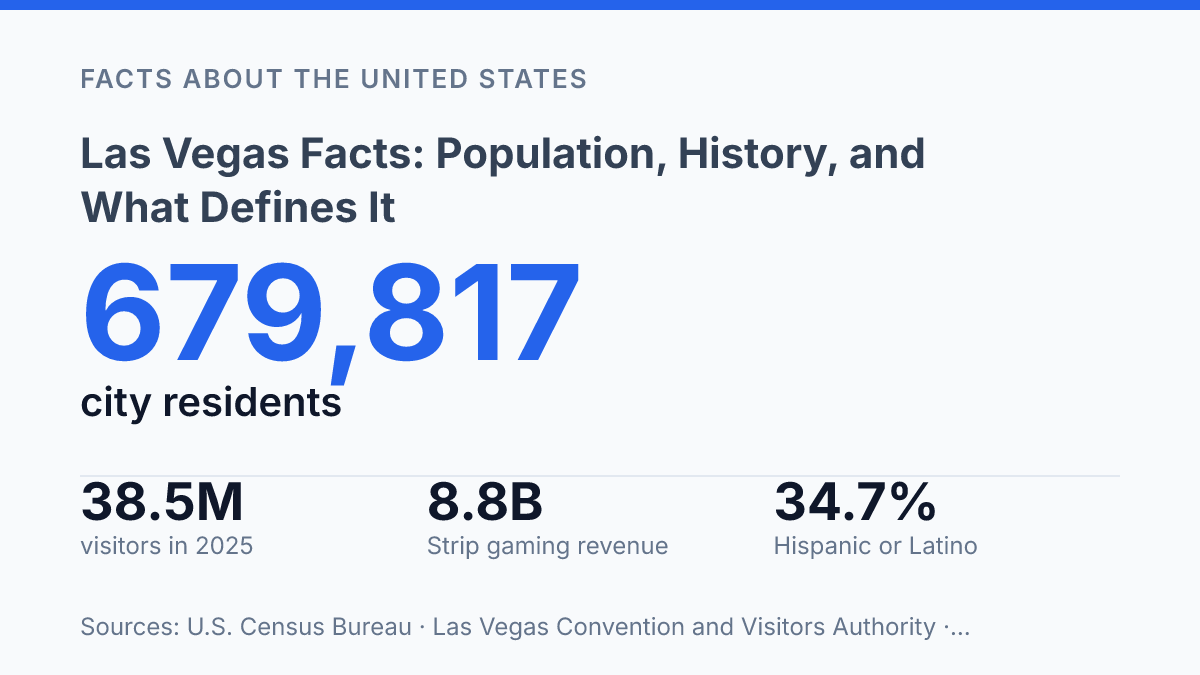
Las Vegas had 679,817 residents in 2025. The place most tourists picture first isn’t technically inside the city at all.
That mismatch explains more than a trivia question ever could. The city began with a 110-acre railroad land auction on May 15, 1905. The Strip, meanwhile, sits outside city limits in unincorporated Clark County, where county government handles services for a huge urban population.
So the real story isn’t just neon, casinos, and weekend crowds. It’s a fast-growing desert city with immigrant neighborhoods, younger visitors, downtown money, and water limits pressing against every new subdivision. In my honest opinion, the most revealing facts are the ones that separate the brand from the place people actually live.
How Las Vegas grew into Nevada’s largest city
A city that began with a railroad land sale now outranks every other Nevada city by a margin no mining camp ever came close to matching.
Its civic story starts in 1905, when a 110-acre railroad land auction turned a desert stop into a plotted town. The early logic was practical, not glamorous.
Trains needed a service point between Salt Lake City and Southern California. The valley had enough water to make that stop useful.
Las Vegas is now the county seat of Clark County and the biggest city in Nevada. That status matters. It means the city became the administrative center as well as a population center, even as much of the region’s famous resort economy grew outside city limits.
The 2020 census counted 641,903 residents, placing the city 24th among U.S. cities. That number gives the growth a national frame.
This isn’t just a large Nevada municipality. It’s one of the country’s major urban centers.
Growth didn’t move in a clean straight line. The city can look like a planned desert success story, but its rise came through risk, scarcity, and repeated changes in identity.
Railroad logistics came first. Then federal projects, defense work, tourism, suburban construction, and service jobs pulled more people into the valley.
Recent estimates show that the expansion hasn’t stopped. The city had 679,817 residents as of July 1, 2025, up 5.3% from the April 2020 estimates base of 645,774, according to the U.S. Census Bureau, 2025 QuickFacts. That gain is meaningful for a desert city where every new household adds pressure on roads, housing, and water systems.
The surprising part is not that people came. It’s that the city kept making room for them in a place built around limits. In my view, that tension is the key to understanding its growth: the city sells ease and escape. It expanded through hard tradeoffs that never really disappeared.
Why the Strip is only part of the story
One of the best-known streets in America isn’t actually governed by the city most tourists think they’re visiting.
The Las Vegas Strip is a resort corridor south of the city proper, in unincorporated Clark County. According to Clark County, Sahara Avenue marks the city boundary. The county provides city-like services to roughly 1 million urban unincorporated residents.
That detail sounds dry. It shapes roads, policing, planning, and much of the visitor experience people casually call Vegas.
That split creates two distinct visitor zones. Bellagio and Caesars Palace sell the resort-corridor version: luxury scale, themed spectacle, and casino-hotel theater. Fremont Street belongs to downtown, where the visitor experience sits closer to the historic city core and feels less like a sealed resort campus.
Most visitors think they know the city after one trip. They usually know a corridor, an airport ride.
A few massive interiors. In my honest opinion, that mistake matters because it turns a living metro into a postcard. The famous resort core is real, profitable, and hard to ignore… but it isn’t the whole place.
The money also shows the divide. LVCVA’s 2025 FAQ reported $8.8 billion in Strip gaming revenue, compared with $952.2 million downtown and $13.7 billion across the county. Downtown isn’t just nostalgia, then.
It’s smaller. It still carries serious economic weight and gives the city a second public face.
What the population mix tells you about daily life
A city ranked 24th among U.S. cities by population doesn’t behave like a resort town. It behaves like a major metro center with school runs, rent fights, shift work, and long commutes.
The 2020 census is the clean reference point for that scale. It puts the city in the same growth conversation as Phoenix, Austin, and other Sun Belt magnets that turned warm weather, jobs, and migration into daily pressure on roads and housing.
The numbers also show a city shaped by movement, not just by visitors. According to the U.S. Census Bureau QuickFacts, 34.7% of residents are Hispanic or Latino, 20.9% are foreign-born, and 33.3% of people age 5 and older speak a language other than English at home.
That changes ordinary life in visible ways: storefront signs, church communities, family networks, school language services. The kinds of small businesses that fill neighborhood shopping centers.
Work is where the city’s image and reality collide hardest. Tourism, hospitality, restaurants, entertainment, transportation, and personal services support a huge share of local employment.
That brings steady opportunity for people who need entry points into the labor market. It also ties many paychecks to visitor demand, tips, room occupancy, event calendars, and late-night schedules.
That tradeoff matters. The city’s fame draws workers, entrepreneurs, and families who see a place with momentum.
But an economy tied so closely to guests can make ordinary life less stable than the postcard suggests. A softer travel season can hit hours before it shows up in headlines.
Housing feels the strain first. Service workers need to live near jobs that don’t always pay like professional offices, yet growth keeps pushing demand into more neighborhoods. In my humble opinion, this is the clearest way to understand modern Vegas: not as a playground, but as a working city trying to make a visitor-driven economy livable for the people who keep it running.
Why Las Vegas keeps changing faster than its image
Southern Nevada has pulled off a strange double move: from 2002 to 2025, regional population rose 58% while Colorado River water consumption fell, according to the Southern Nevada Water Authority. That one fact cuts through the neon mythology.
The city is not only an entertainment machine. It’s an urban experiment in the Mojave Desert.
The postcard version still sells escape, speed, appetite, and reinvention on demand. But the real identity is more disciplined than that. In my view, the harder, more revealing story is how a desert city keeps remaking itself under limits that other places can ignore for longer.
Downtown makes that reinvention visible block by block. Around Fremont Street, redevelopment has tied older casino blocks to Fremont East, the Mob Museum, new restaurants, apartments, and civic projects that pull attention away from the old casino-only script.
It’s not pure nostalgia. It’s a bet that history can become working urban fabric again.
Newer off-resort neighborhoods tell the same story in a different form. Summerlin, Skye Canyon, Mountain’s Edge, and Inspirada show how the metro area keeps stretching into planned communities with parks, schools, retail centers, and trail systems built for daily life rather than weekend spectacle.
The tradeoff is obvious: each new district adds comfort and choice. It also adds heat exposure, road demand, and pressure on desert infrastructure.
Water is the constraint that gives all this growth its edge. The Southern Nevada Water Authority says per-capita use fell sharply over the same period, and its conservation target is 86 gallons per person per day by 2035. That’s not a side issue.
It shapes yards, development rules, resort operations. The way residents think about ordinary habits.
The city sells escape, but its long-term story is about constraint… and that makes its future more interesting than the postcard version. Reinvention here isn’t branding. It’s survival with a skyline.
What the next version of the city will reveal
The next version of Las Vegas won’t be judged only by visitor counts or casino revenue. Watch the quieter measures instead: school languages, housing pressure, downtown foot traffic, and water use.
The Southern Nevada Water Authority has set a conservation target of 86 gallons per person per day by 2035. That number matters.
Growth in the desert always has a price. This city keeps proving that limits can force reinvention rather than decline.
In my humble opinion, the old image is now the least useful guide. The sharper question is whether the city can keep absorbing people, cultures, and expectations without becoming a place only visitors can afford to enjoy.
Frequently Asked Questions
Q: How many people live in Las Vegas?
A: Las Vegas had 641,903 residents in the 2020 census. That makes it the most populous city in Nevada. It still sits outside the top tier of U.S. cities by size.
Q: Is Las Vegas the biggest city in Nevada?
A: Yes. Las Vegas is Nevada’s most populous city, and that’s a big part of why it dominates the state’s identity. But population alone doesn’t tell the whole story… its role as Clark County’s seat matters just as much.
Q: What county is Las Vegas in?
A: Las Vegas is the county seat of Clark County. That gives it political weight beyond tourism and nightlife. In my view, that’s one reason the city feels bigger than its population number suggests.
Q: Why is Las Vegas called Vegas?
A: “Vegas” is just the common shorthand for Las Vegas. People use it because it’s quicker and more natural in conversation. The short name stuck because the city’s identity is already so widely recognized.
Q: What is Las Vegas best known for?
A: Las Vegas is best known for its casino resorts, entertainment, and nonstop visitor traffic. But the city is more than the Strip. It’s also a major population center with real civic and county-level importance. That mix is what defines it.