
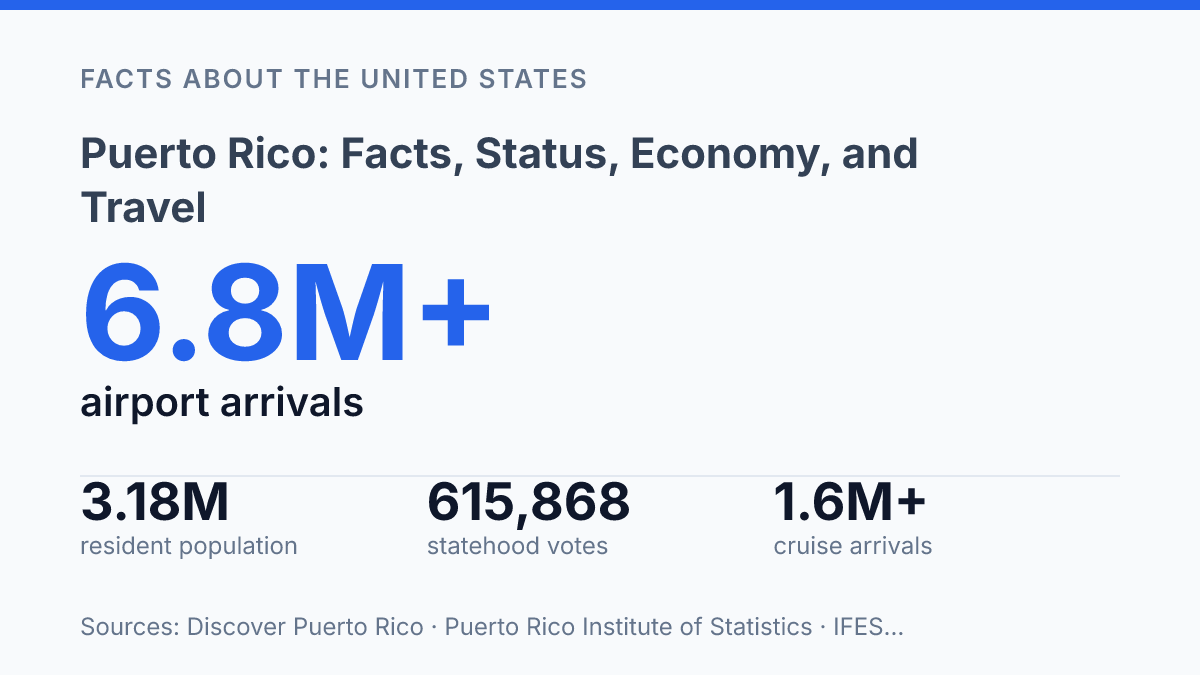
Puerto Rico sends one nonvoting delegate to the U.S. House, has no U.S. senators, and has held seven nonbinding status votes since 1967, a combination that explains why its place in the United States is legally settled in some ways and politically unresolved in others. The island’s current picture is shaped by more than constitutional status. Its estimated resident population fell to 3,184,835 in 2025, while Pew Research Center counted 6.1 million Puerto Ricans living in the 50 states and Washington, D.C. Tourism and exports remain major economic forces, yet federal support often operates through rules that differ from those used for states.
The result is a territory whose identity, economy, and practical travel realities cannot be understood through a single label. The sections ahead connect political representation, demographics, public funding, and visitor access into one clearer reference point.
Where Puerto Rico fits in the United States
A person born on the island is a U.S. citizen, but that citizenship does not carry a presidential vote while the person lives there. Puerto Rico is an unincorporated U.S. territory rather than a state, and it has been under U.S. sovereignty since the Treaty of Paris in 1898. “Unincorporated” is the key legal distinction: the territory belongs to the United States, but it has not been admitted as a state and does not have the same constitutional footing as one.
The unevenness shows most clearly in federal representation. According to Pew Research Center, the territory has 1 nonvoting House delegate, no U.S. senators, residents on the island cannot vote in federal elections, and it has held seven status votes since 1967, all nonbinding. Residents who move to a state or Washington, D.C., can vote in presidential elections there, which means the limitation is tied to residence in the territory rather than to citizenship alone.
Congress remains central to the territorial relationship because it has broad authority over U.S. territories, including the power to change the island’s political status through federal law. Local government still operates on the island: the Office of the Governor in San Juan leads the executive branch for territorial affairs, while the elected legislature handles local lawmaking. That arrangement creates a dual structure in which local institutions manage many domestic matters, but the territory’s future status and federal voting rights remain dependent on national-level decisions.
Population, language, and identity
A territory of just over 3.2 million residents is connected to a stateside Puerto Rican population that is now much larger than the island’s own. The U.S. Census Bureau estimated the resident population at 3,203,295 as of July 1, 2024, an estimate rather than a decennial head count.
More recent local estimates point in the same direction: the Puerto Rico Institute of Statistics reported 3,184,835 residents as of July 1, 2025, with deaths outnumbering births from 2024 to 2025. That pattern helps explain why demographic change is driven not only by migration after Hurricane Maria, but also by aging and low birth rates.
Spanish remains the main language of household life, local government interaction, schooling, and everyday public communication, even though English also has official status. Census QuickFacts reports that 95.5% of residents age 5 and older spoke a language other than English at home in the 2020–2024 American Community Survey period, a figure that mostly reflects Spanish use. Official bilingualism therefore does not mean equal daily use: English is widely taught and visible in federal settings, airports, tourism, higher education, and some professional workplaces, but fluency varies by region, class background, occupation, and age group.
The San Juan metropolitan area concentrates much of the island’s population, employment, universities, and bilingual service work, so English exposure is often higher there than in many rural municipalities. Even within metro areas, however, language practice is uneven; a household may function almost entirely in Spanish while younger members encounter English through school, media, or work.
Identity is similarly layered rather than uniform. Pew Research Center reported in 2026 that 6.1 million Puerto Ricans lived in the 50 states and Washington, D.C., showing how family networks and migration link island and mainland communities. At the same time, language, local institutions, municipal roots, and shared demographic experience help sustain a distinct identity that cannot be reduced to a single political preference or level of attachment to the mainland United States.
Economy, taxes, and federal support
Pharmaceutical plants make the island’s output far more export-heavy than its visitor economy alone would suggest. Manufacturing remains a central pillar, especially pharmaceuticals, medical devices, and other high-value goods, with companies such as Pfizer, Medtronic, and Amgen operating on the island. Tourism also matters, but here it is best understood as a services-export sector tied to hotels, air travel, restaurants, transportation, and local suppliers rather than as a list of attractions.
Official economic data show a mixed but active economy rather than a single-story profile of hardship. The U.S. Bureau of Economic Analysis reported that real GDP rose 3.0% in 2023 after falling in the prior year, with real exports up 6.4% and travel-services exports up 15.1%. That pattern points to two different engines working at once: export manufacturing on one side and visitor-linked services on the other, each sensitive to different risks such as global pharmaceutical production decisions, energy costs, air access, and household purchasing power.
Federal assistance is also a major part of public finance and household support, but it operates through territorial rules that differ from state treatment. Medicaid funding has historically been shaped by capped or specially adjusted formulas, requiring Congress to approve periodic funding changes to avoid sharp shortfalls. The Nutrition Assistance Program is another example: the USDA Food and Nutrition Service says the territory receives a capped block grant, with FY2026 funding of $2,978,891,000, rather than participation in the open-ended SNAP structure used by states.
Disaster recovery funding has carried unusual weight since Hurricane Maria, with FEMA aid and related federal recovery programs financing repairs to housing, public buildings, roads, power systems, and community infrastructure. These funds can support construction activity and public investment, yet they are restricted by federal eligibility rules, documentation requirements, and project approval timelines.
The same broader tension appears in tax policy: residents generally pay federal payroll taxes, while many island-source earnings are outside the regular federal individual income tax system, leaving the local government more dependent on its own tax base. Federal support is substantial, but territorial status helps determine the formulas, limits, and fiscal room available to policymakers.
Getting there and what visitors should know
More than 6.8 million passenger arrivals came through the island’s main airport in 2025, a 3% increase from 2024, according to the island’s official tourism marketing organization in its 2026 reporting. Most air travelers arrive at Luis Muñoz Marín International Airport in Carolina, just east of San Juan, which makes the capital area the primary air gateway for mainland routes. U.S. citizens traveling from the mainland United States do not need a passport, though standard airline identification and federal airport screening rules still apply.
For geographic orientation, Old San Juan sits on the north coast near the main cruise piers and airport access routes, while destinations outside the metropolitan area often require more planning. Rental cars are common for reaching beaches, mountain towns, and southern cities such as Ponce, but dense traffic around San Juan and narrower rural roads can affect travel times. Public transportation is useful in limited urban contexts rather than as a full-island network, so on-island movement often depends on taxis, ride-hailing, organized tours, or private vehicles.
Seasonal conditions can matter as much as distance. The Atlantic hurricane season runs from June 1 to November 30, and severe weather can disrupt flights, ferries, roads, and electric service. Power reliability and road conditions vary by area, especially after storms, so transport schedules and lodging arrangements can be less predictable during active weather periods.
Ferries also shape access to the smaller eastern islands. Passenger routes from Ceiba connect travelers with Vieques and Culebra, making those islands reachable without a flight but also tying plans to marine schedules and sea conditions. Cruise travel is another major entry pattern: the same 2026 tourism reporting said cruise arrivals topped 1.6 million in 2025, up nearly 8% from the previous year, which helps explain why visitor activity is especially concentrated around the San Juan waterfront and nearby historic district.
Why the next data gap matters
The next challenge is not only a status choice but the evidence available to judge it. The U.S. Bureau of Economic Analysis decision to stop producing island GDP statistics after the 2023 release leaves policymakers, investors, and researchers with less comparable economic data just as travel, exports, aging, and federal program design are moving in different directions. That gap raises the stakes for local statistical agencies and federal reporting systems.
Without consistent measures, debates over representation, aid formulas, tax policy, and tourism capacity become easier to frame politically and harder to test empirically. The practical consequence is clear: future assessments of the island will depend as much on data continuity as on constitutional terminology.
Frequently Asked Questions
Q: Is Puerto Rico a U.S. state or a territory?
A: Puerto Rico is an unincorporated territory of the United States, not a state. Residents are U.S. citizens, but they do not vote in presidential elections unless they live in a state and their representation in Congress is limited. That status shapes taxation, federal program access, and local self-government.
Q: Do people in Puerto Rico need a passport to visit?
A: U.S. citizens generally do not need a passport for travel between the mainland United States and Puerto Rico. A government-issued photo ID is usually enough for domestic travel, though airlines and security rules still apply. Non-U.S. citizens should follow the same entry requirements that apply to travel within the United States and any documentation tied to their own status.
Q: What currency is used in Puerto Rico?
A: The U.S. dollar is the official currency in Puerto Rico. That makes pricing, banking, and card use familiar to most U.S. visitors, although local taxes and merchant practices can still differ from those on the mainland. Cash access can vary by area, so it is sensible to confirm payment options before traveling.
Q: What language is spoken in Puerto Rico?
A: Spanish is the dominant language in everyday life, public culture, and most local communication. English is also widely used in government, tourism, and business, especially in areas that serve visitors. The balance between the two depends on location, age group, and setting.
Q: What is Puerto Rico known for economically?
A: Puerto Rico’s economy is shaped by services, manufacturing, tourism, and trade tied to its U.S. connection. Pharmaceuticals and other advanced manufacturing have long been important, while tourism supports hotels, restaurants, and transport. The mix creates opportunity, but it also leaves the island exposed to external shocks, shipping costs, and broader fiscal pressures.