
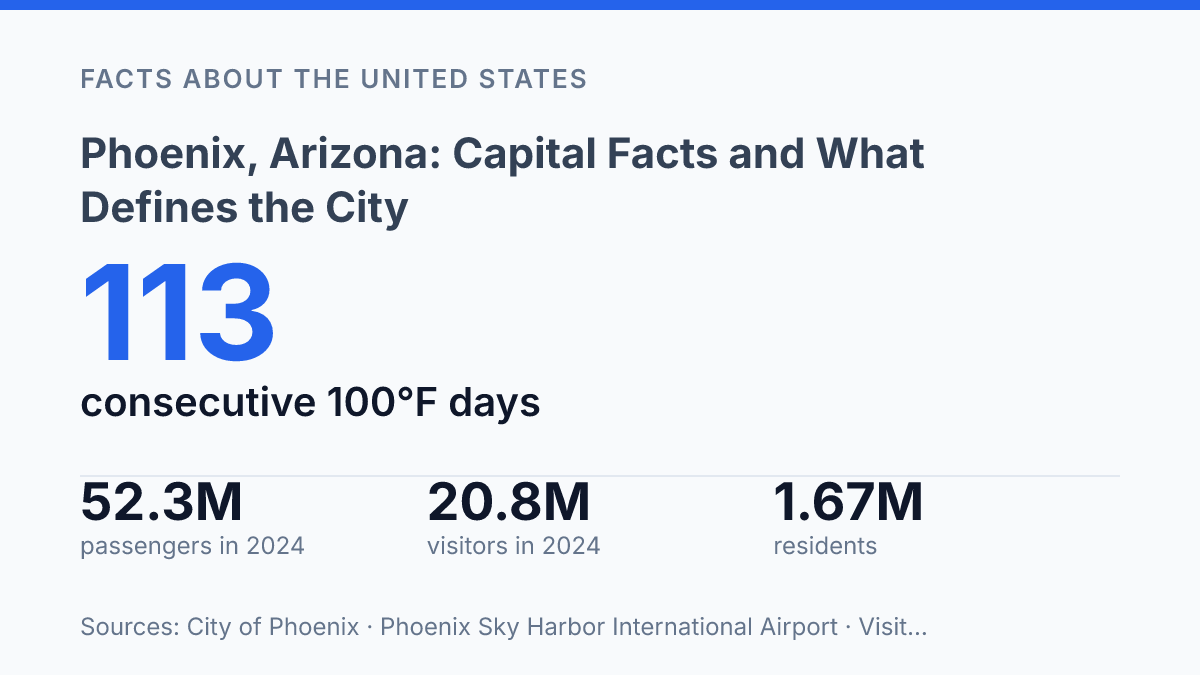
Phoenix had 1,665,481 residents on July 1, 2025, making it the fifth-largest U.S. city, yet its role as Arizona’s capital dates to an 1889 territorial decision that moved the seat of government from Prescott. That pairing of administrative history and modern scale explains why the city cannot be understood only through state politics or desert growth.
It anchors a metro area of roughly 5 million people across 24 municipalities, while its climate now defines daily life as sharply as its government functions: in 2024, the city recorded 70 days at or above 110°F and 113 consecutive days at or above 100°F. The same place also supports major tourism, arts spending, airport traffic, desert conservation, and an expanding downtown food and nightlife district. The useful question is not simply what the capital is, but what forces make it distinctive.
Why Phoenix Is Arizona’s Capital and Largest City
Only four U.S. cities have more residents than Phoenix proper, a scale that makes Arizona’s capital unusually large among state seats of government. The U.S. Census Bureau estimated the city at 1,665,481 residents as of July 1, 2025, ranking it fifth nationally behind New York, Los Angeles, Chicago, and Houston. That ranking refers to the incorporated city itself, not the full urban region surrounding it.
Its capital status predates statehood: Arizona’s territorial capital moved from Prescott to the city in 1889 and has remained there since, according to the Arizona State Library, Archives and Public Records agency history. When Arizona became a state in 1912, the city continued as the seat of state government, giving it a civic role that extends beyond population size. State agencies, legislative activity, and statewide political administration all concentrate there, reinforcing its function as the institutional center of Arizona.
Geography helps explain why the city became both a capital and a regional anchor. It sits in the Salt River Valley in central Arizona, a location that placed it within a broad desert basin rather than on the state’s mountainous or borderland edges. That central position supports its role as a hub for government, transportation, commerce, and regional growth.
Citywide population and metropolitan scale are often conflated, but they describe different things. Greater Phoenix includes 24 municipalities and roughly 5 million residents across more than 500 square miles of Sonoran Desert, according to Visit Phoenix. The distinction matters because the incorporated capital is already one of the largest cities in the country, while the surrounding metro area represents a much wider multicity economic and residential region.
Climate, Sun, and the Valley of the Sun
In 2024, the city logged a record 113 straight days at or above 100°F, a figure that makes its summer climate a practical public-safety issue rather than a background weather detail. Municipal heat reporting released in 2025 also recorded 70 days at or above 110°F and 39 nights above 90°F, showing why shade, cooling access, hydration planning, and heat-warning systems are central to daily life during the hottest months.
The city’s arid desert climate is defined by very hot summers, low rainfall, and mild winters. That winter pattern is a major reason the area attracts seasonal visitors, golfers, hikers, resort guests, and event planners when much of the country is colder. The same climate cannot be treated as uniformly comfortable across the year, however, because summer heat can limit outdoor activity for long stretches and raise risks for outdoor workers, older residents, unhoused people, and anyone without reliable cooling.
Sunshine is one of the area’s strongest identity markers, with the city averaging more than 300 sunny days a year. This helps explain why outdoor recreation, patios, desert gardens, pools, and winter travel feature so prominently in the area’s visitor economy. Reliable sun also shapes the look and rhythm of development, from shade structures and covered walkways to the timing of festivals, sports, and school activities.
The wider metropolitan area is commonly known as the Valley of the Sun, a nickname that reflects both geography and climate. It is an effective tourism label, but it also points to the planning pressures that come with growth in a hot, dry place. Long-term livability depends not only on promoting sunshine as an asset, but also on managing heat exposure, conserving water, and designing public spaces that remain usable outside the mildest months.
Things Phoenix Is Known For Beyond Government
Visitor spending reached $5.0 billion in 2024, showing that the city’s national profile rests as much on leisure travel as on state government. According to the local tourism bureau and Tourism Economics, 20.8 million visitors came that year, with spending averaging $13.7 million per day and producing an estimated $8.5 billion in total economic impact. Those figures help explain why hospitality is not a secondary feature of the local economy but one of its defining public-facing industries.
High-end spa resorts form a major part of that hospitality identity, particularly because they package the desert setting as a wellness and retreat experience. Resort design often emphasizes mountain views, outdoor courtyards, shaded pools, native landscaping, and treatments associated with relaxation rather than dense urban sightseeing. This makes the destination distinct from convention-only or beach-oriented markets, since much of the appeal comes from combining resort privacy with access to a large metropolitan service base.
Golf tourism adds another recognizable layer, and Jack Nicklaus-designed courses are part of the area’s reputation among visiting players. His association signals a particular segment of the market: destination golf built around signature course architecture, resort stays, and planned desert fairways. The same environment that gives these courses their visual identity also creates maintenance constraints, so turf management, irrigation choices, and desert landscaping are central to how golf properties operate.
The Desert Botanical Garden presents the clearest example of leisure appeal tied directly to the Sonoran environment rather than built around escaping it. The garden reports 140 acres, more than 50,000 plant displays, 4,818 species in its Living Collection, 520 rare and endangered species, and more than 650,000 annual attendees.
Its displays of cacti and other native plants turn regional ecology into a visitor attraction while also supporting conservation, education, and plant research. That dual role matters because the city’s desert appeal is not unlimited scenery; it requires institutions and businesses to work within water scarcity, heat exposure, and habitat sensitivity when designing attractions that can endure.
Nightlife, Culture, and Regional Identity
Downtown alone now contains more than 225 bars and restaurants, evidence that the region’s dispersed form has not prevented concentrated nightlife from taking shape. Invest in Phoenix and Downtown Phoenix Inc. reported in 2024 that about 100 of those establishments had been added since 2015, alongside 7 breweries and more than 30 coffee shops. That concentration helps explain why evening activity is not limited to one type of venue: bars, dance clubs, breweries, performance spaces, and live-music rooms all contribute to the city’s after-dark economy.
What growth and heat will test next
Phoenix’s identity is likely to be shaped less by a single civic label than by how well its institutions manage scale in a hotter, busier region. The same growth that supports a $5.0 billion visitor economy and rising airport traffic also increases pressure on shade, transit, water planning, housing, and public space. That does not reduce the city to a climate challenge; it makes climate competence part of its civic character.
For residents, planners, visitors, and businesses, the practical measure will be whether the capital can keep converting desert constraints into livable systems rather than treating heat as background weather. The next chapter will be read in cooling corridors, nighttime activity patterns, airport capacity, and the durability of cultural districts after the sun goes down.
Frequently Asked Questions
Q: Is Phoenix the capital of Arizona?
A: Yes. Phoenix is the capital of Arizona and serves as the state’s largest metropolitan center. Its government role is one reason the city remains a major administrative and economic hub in the Southwest.
Q: Why is Phoenix called the Valley of the Sun?
A: The phrase refers to the wider metropolitan area that surrounds the city and its surrounding communities. It reflects the region’s strong association with sun exposure and warm weather throughout much of the year.
Q: What is Phoenix best known for?
A: Phoenix is known for year-round sun, warm temperatures, and a metropolitan mix of resorts, golf, and nightlife. The city also draws attention for desert attractions such as the Desert Botanical Garden, which showcases cacti and native plants.
Q: How hot does Phoenix get during the year?
A: The city is known for warm temperatures for much of the year, with intense heat being a defining feature of its climate. That weather pattern shapes daily life, tourism, and outdoor planning across the region.
Q: What outdoor attractions are popular in Phoenix?
A: The Desert Botanical Garden is one of the city’s best-known outdoor attractions. It features cacti and numerous native plants, making it a useful place to see Sonoran Desert flora in a curated setting.