
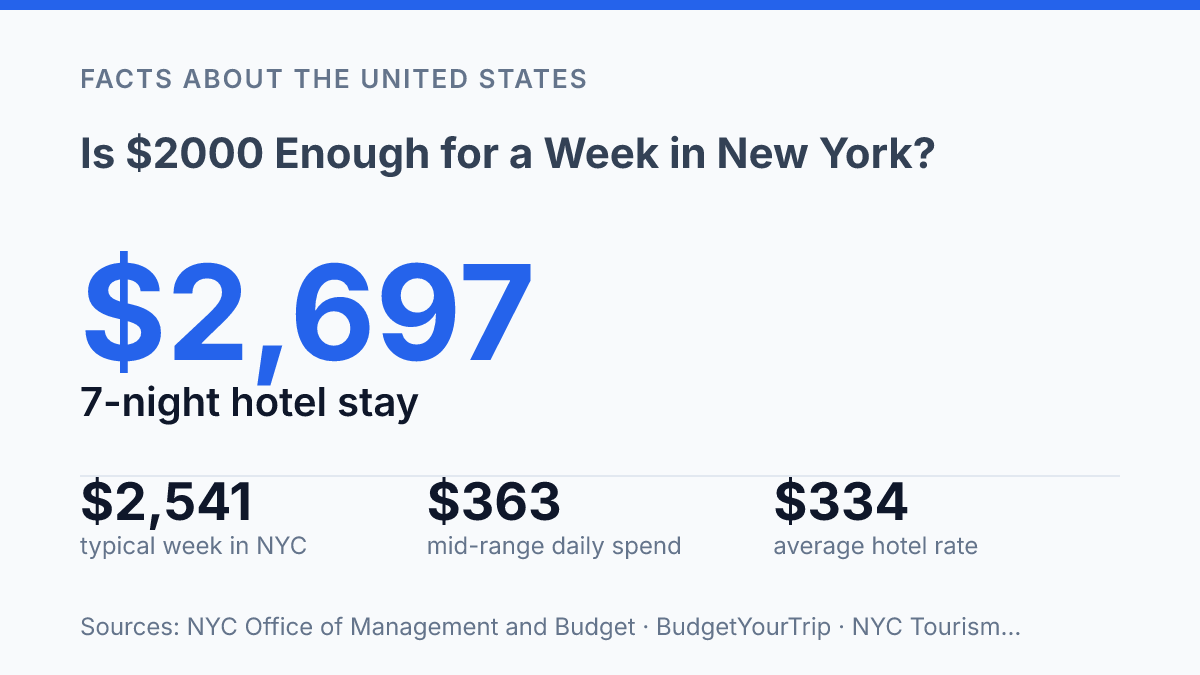
“Is $2000 enough for a week in New York?” is best answered by looking first at lodging, because BudgetYourTrip’s 2026 benchmark puts a typical one-week visit at $2,541 per person. The amount can work, but it sits below the city’s mid-range pattern once accommodation is included. The reason is not the subway, which can be capped at $35 over seven days through OMNY, but the bed: NYC’s 2025 average daily hotel rate was $334, and seven nights at that rate would reach about $2,697 after hotel tax and a daily room fee, before resort or destination charges.
That contrast explains why the same budget can feel adequate for one traveler using a hostel, outer-borough room, or free lodging, yet restrictive for another booking a Manhattan hotel and several paid attractions. The real question is how much of the $2,000 is already committed before the first meal, museum ticket, or airport transfer is paid for.
What $2,000 covers over seven days
$2,000 becomes a very different number once the bed and plane ticket are removed from the equation: it leaves about $285 per day for the parts of New York City that are easiest to control. For one traveler, that is a strong spending allowance for meals, subway and bus rides, sightseeing, and modest shopping, provided the budget is not also absorbing major accommodation costs.
For context, BudgetYourTrip puts a typical visitor in 2026 at $363 per day and $2,541 for one week per person, including lodging, food, local transport, and sightseeing. That benchmark helps explain the main distinction: $2,000 is below a typical all-in week, but it is much more comfortable when the two largest fixed costs are already paid.
Everyday spending can stay relatively low because many common New York purchases are small on their own. A bagel breakfast might cost a few dollars before coffee, a pizza slice is often a low-cost lunch, a food truck or halal-cart meal can replace a sit-down dinner, and a subway ride is inexpensive compared with taxis or rideshares. A simple museum visit or basic attraction ticket changes the math more noticeably, especially when paired with shopping or a full-service meal.
A frugal day might land around $50 to $90 if it is built around casual food, subway travel, parks, neighborhoods, waterfront walks, and free viewpoints. A higher-spend day can move into the $180 to $300 range with a paid attraction, a sit-down dinner, drinks, souvenirs, or a show-style evening. The same weekly total can therefore feel generous during a trip centered on casual meals and free sights, but tighter when several days include ticketed experiences and retail spending.
How lodging changes the budget
Seven nights at New York City’s 2025 average hotel rate would cost more than the entire $2,000 budget before a traveler has bought a meal or subway fare. According to NYC Tourism + Conventions, the city’s average daily hotel rate was $334, and seven nights at that average would total $2,338 before taxes and fees. New York hotel bills also carry hotel and sales taxes, plus possible daily room fees, so the advertised nightly rate can understate the real lodging cost.
A hotel or Airbnb in New York City can average roughly $200 to $300 or more per night, with prices varying by season, location, room type, event demand, and booking timing. At that range, accommodation can absorb most or all of a $2,000 trip fund over seven nights. This is why the same headline budget can feel workable in one case and restrictive in another: prepaid lodging leaves the money available for meals, local transport, attractions, and incidental spending, while unpaid lodging turns those same categories into whatever remains after the room is covered.
Borough and neighborhood choice often determines how much pressure accommodation puts on the budget. Manhattan typically costs more because it places visitors closer to major business districts, theaters, museums, and heavily visited sights. Outer-borough options in Queens or Brooklyn may offer lower nightly averages, especially away from the most central or high-demand areas, but the savings can come with longer subway rides and less convenient late-night returns.
Lower lodging costs can preserve spending room for paid attractions and better meals, but the cheapest room is not always the cheapest overall trip choice. A distant stay may add time, occasional rideshare costs, or less flexibility between daytime sightseeing and evening plans. For a one-week budget, the practical question is not only the nightly rate, but how much of the total trip fund remains after the full lodging bill is paid.
Food, transit, and attractions that move costs the most
A single Broadway ticket can cost more than several days of subway rides, which is why dining and entertainment usually decide whether a New York week stays controlled or starts to feel tight. Food has the widest everyday range: a traveler relying on bagels, pizza slices, food trucks, counter-service meals, and grocery snacks can keep eating costs around $15 to $30 per day, while sit-down meals can push the same category to $100 to $200 or more per day, especially once drinks, tax, and tips are included. BudgetYourTrip estimates typical New York food spending at $87 per person per day, with budget travelers at $36 and luxury travelers at $199, according to its 2026 data, which shows how strongly meal choices shape the total.
When $2,000 feels comfortable and when it does not
The same $2,000 can feel generous or restrictive depending less on New York prices in the abstract than on whether it is funding the fixed costs of the trip. When flights and accommodation are already covered, that amount is enough for a week in New York City for a single traveler who keeps spending moderate, chooses local transit over frequent cars, and treats higher-cost experiences as selective purchases rather than daily defaults.
The budget becomes much less forgiving when it must absorb seven nights of lodging, several paid attractions, and regular restaurant meals. In that version of the trip, the traveler is not managing discretionary spending alone; the same pool of money is also carrying the largest fixed expense. That leaves less room for normal variation, such as a higher-than-expected dinner, an airport transfer, a ticketed evening activity, or a last-minute change in plans.
A useful rule of thumb for solo travel is to plan around one or two anchor expenses for the week, then fill the remaining days with lower-cost meals, public transit, and free or no-admission sights. An anchor expense might be a major show, a paid observation deck, a special restaurant meal, or a guided tour. Treating those choices as priorities keeps the trip structured without assuming that every meal, view, museum, and evening activity has to be paid at full price.
This is the practical dividing line: $2,000 works well as a spending budget after the largest costs are removed, but it is tight as an all-in budget for a full week. The more the trip depends on paid convenience, central lodging, and sit-down dining, the more quickly that amount shifts from comfortable to constrained.
Why the hotel bill decides the answer
The most useful way to treat a $2,000 New York budget is as a ceiling that must be tested before dates are fixed, not as a general spending allowance. A traveler who secures low-cost lodging first can make the remaining math predictable, especially because subway and local bus travel can stay near $35 for the week. A traveler starting with average hotel prices is working against arithmetic before food or attractions enter the plan.
The next practical step is to price seven actual nights, with taxes and fees shown, then subtract that figure from $2,000. If the remainder cannot cover meals, airport transfers, and one or two paid experiences without strain, the trip needs different lodging, different dates, or a higher budget.
Frequently Asked Questions
Q: Is $2,000 enough for a week in New York City?
A: Yes, $2,000 is enough for a week in New York City if spending is managed carefully. It is especially comfortable when flights and accommodation are already paid for, because that leaves about $285 per day for food, transport, sightseeing, and shopping.
Q: How much of a daily budget does $2,000 give for a 7-day NYC trip?
A: If flights and accommodation are already covered, $2,000 works out to roughly $285 per day. That amount is generous for a single traveler and allows for meals, subway rides, and a mix of paid and free activities.
Q: Can I visit New York on $2,000 if I still need to pay for a hotel?
A: It can be done, but the budget becomes much tighter. Hotel or Airbnb rates of $200 to $300+ per night for 7 nights can absorb most or all of the budget, which leaves little room for dining, transit, or attractions.
Q: What can I expect to spend on food in New York for one week?
A: Food costs vary widely depending on the type of dining. Casual meals such as pizza, bagels, or food trucks may run $15 to $30 per day, while sit-down restaurants and drinks can raise that to $100 to $200+ per day.
Q: What are the cheapest ways to get around New York for a week?
A: A 7-day unlimited subway and bus pass or pay-per-ride OMNY or MetroCard costs about $33 to $34 for the week. That keeps transportation relatively low-cost, though occasional taxis or rideshares will increase the total.