
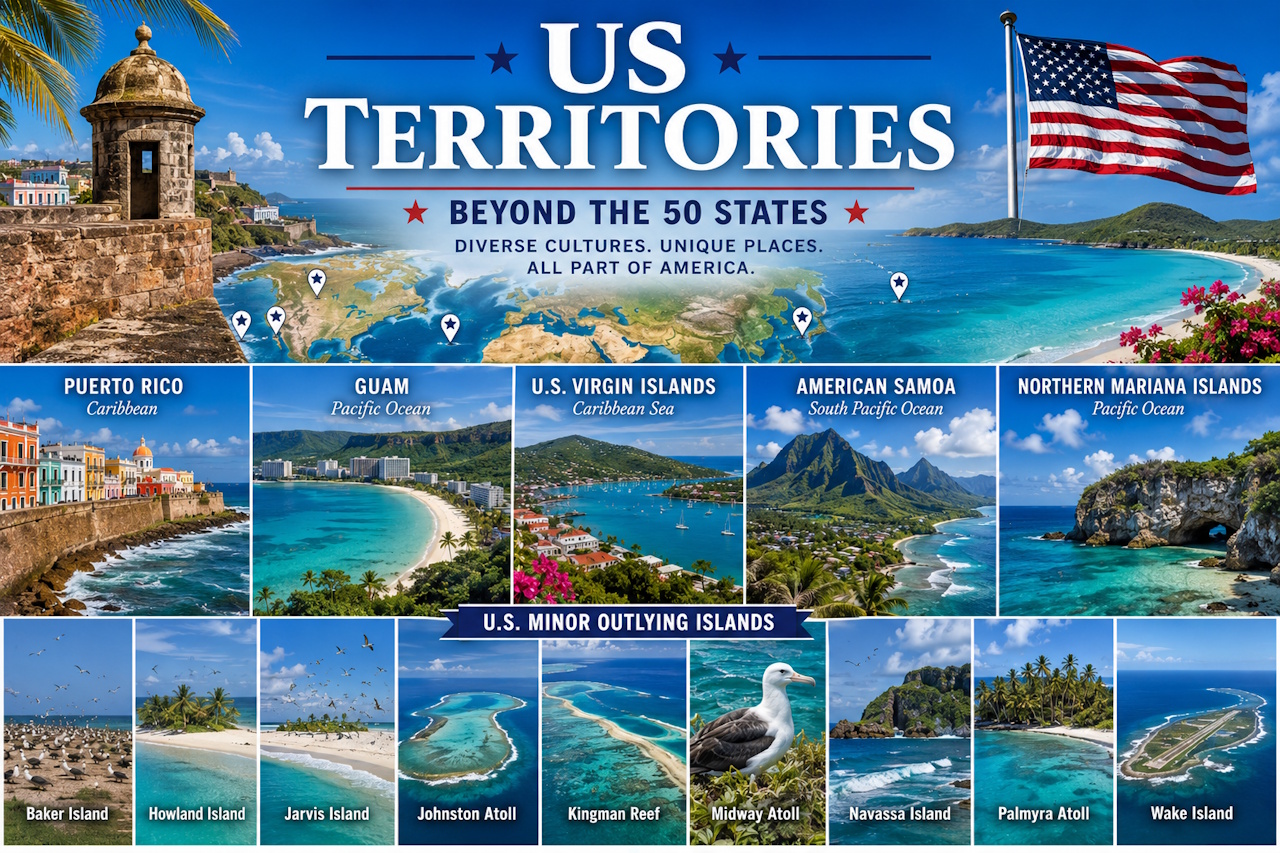
The United States extends far beyond the 50 states. In addition to the states themselves, the country has several territories located throughout the Caribbean Sea and Pacific Ocean. These US territories vary enormously in geography, population, culture, political status, and history. Some are home to large permanent populations and major cities, while others are tiny, remote islands and atolls with no permanent civilian residents. This guide introduces the territories of the United States and provides a brief overview of what makes each one unique.
Puerto Rico
Puerto Rico is the most populous US territory and is located in the northeastern Caribbean Sea. Known for its tropical beaches, mountains, historic towns, vibrant culture, and Spanish-speaking majority, Puerto Rico is one of the most distinctive parts of the United States. Its capital, San Juan, is famous for the colorful colonial architecture and fortifications of Old San Juan.
Guam
Guam is a US territory in the western Pacific Ocean and the largest island in the Mariana Islands. It is known for tropical beaches, coral reefs, Chamorro culture, World War II history, and its important strategic position in the Pacific. Hagåtña is the territorial capital, while Dededo is its most populous village.
US Virgin Islands
The US Virgin Islands are a Caribbean territory consisting primarily of Saint Croix, Saint Thomas, and Saint John, along with numerous smaller islands and cays. The territory is known for beaches, coral reefs, sailing, tropical scenery, and a cultural heritage shaped by Caribbean, African, European, and American influences. Charlotte Amalie, located on Saint Thomas, is the territorial capital.
American Samoa
American Samoa is a group of volcanic islands and coral atolls in the South Pacific Ocean. The territory is known for dramatic mountains, tropical forests, beaches, marine environments, and a strong Samoan cultural identity. Pago Pago, located on the island of Tutuila, is the territorial capital.
Northern Mariana Islands
The Commonwealth of the Northern Mariana Islands is a US territory in the western Pacific Ocean. It consists of a chain of tropical islands, with Saipan serving as the largest island and principal population center. The territory is known for beaches, diving, Chamorro and Carolinian culture, and important sites connected to World War II.
US Minor Outlying Islands
The United States also administers a collection of small and mostly uninhabited islands and atolls known collectively as the United States Minor Outlying Islands. Most are remote conservation areas, wildlife refuges, military sites, or protected environments rather than conventional populated territories.
Baker Island
Baker Island is a small, uninhabited coral island located in the central Pacific Ocean near the equator. It is administered by the United States as a wildlife refuge and provides important habitat for seabirds and marine life.
Howland Island
Howland Island is an uninhabited coral island in the central Pacific Ocean. It is perhaps best known for its connection to aviator Amelia Earhart, who was attempting to reach the island during her final flight in 1937. Today, the island is protected as part of a national wildlife refuge.
Jarvis Island
Jarvis Island is a remote and uninhabited coral island in the South Pacific Ocean. The island has no permanent residents and is protected primarily for its wildlife, marine ecosystems, and surrounding coral reefs.
Johnston Atoll
Johnston Atoll is a remote group of islands in the central Pacific Ocean. It was used extensively by the US military during the 20th century but today has no permanent civilian population. The atoll and its surrounding waters are valued for their marine ecosystems and wildlife.
Kingman Reef
Kingman Reef is a largely submerged coral reef located in the central Pacific Ocean. With very little land above sea level and no permanent population, it is one of the most remote US possessions and forms part of a protected marine environment.
Midway Atoll
Midway Atoll is a remote Pacific atoll best known for the Battle of Midway, a decisive World War II naval battle fought nearby in 1942. Today, the atoll is an important wildlife refuge and is especially famous for its enormous colonies of seabirds, including albatrosses.
Navassa Island
Navassa Island is a small, uninhabited island in the Caribbean Sea between Haiti and Jamaica. Administered by the United States, it is protected as a wildlife refuge and is known for its rugged limestone landscape and relatively undisturbed ecosystems.
Palmyra Atoll
Palmyra Atoll is a remote group of small islands and coral reefs in the central Pacific Ocean. Unlike most other US Minor Outlying Islands, portions of Palmyra are privately owned, while much of the atoll is protected for conservation. Its tropical forests and surrounding reefs support a rich variety of wildlife.
Wake Island
Wake Island is a remote coral atoll in the western Pacific Ocean. It is strategically located between Hawaii and East Asia and has played an important role in US military and aviation history, particularly during World War II. Access to the island is highly restricted.
Understanding the US Territories
The territories of the United States are remarkably diverse. Puerto Rico is home to millions of people, while places such as Kingman Reef and Baker Island have no permanent residents at all. Some territories have locally elected governments and substantial civilian populations, while others are administered mainly for conservation, scientific, or military purposes.
Their relationship with the United States also differs from that of the 50 states. Residents of the territories may have different political rights, federal tax obligations, citizenship or nationality arrangements, and representation in the federal government depending on the territory.
Together, the US territories demonstrate that the geography of the United States stretches thousands of miles beyond the North American mainland. From the Caribbean islands of Puerto Rico and the US Virgin Islands to American Samoa, Guam, and tiny Pacific atolls, each territory contributes another distinct chapter to the geography, history, and culture of the United States.
Select any US territory above to learn more about its geography, history, population, culture, attractions, political status, and interesting facts.